
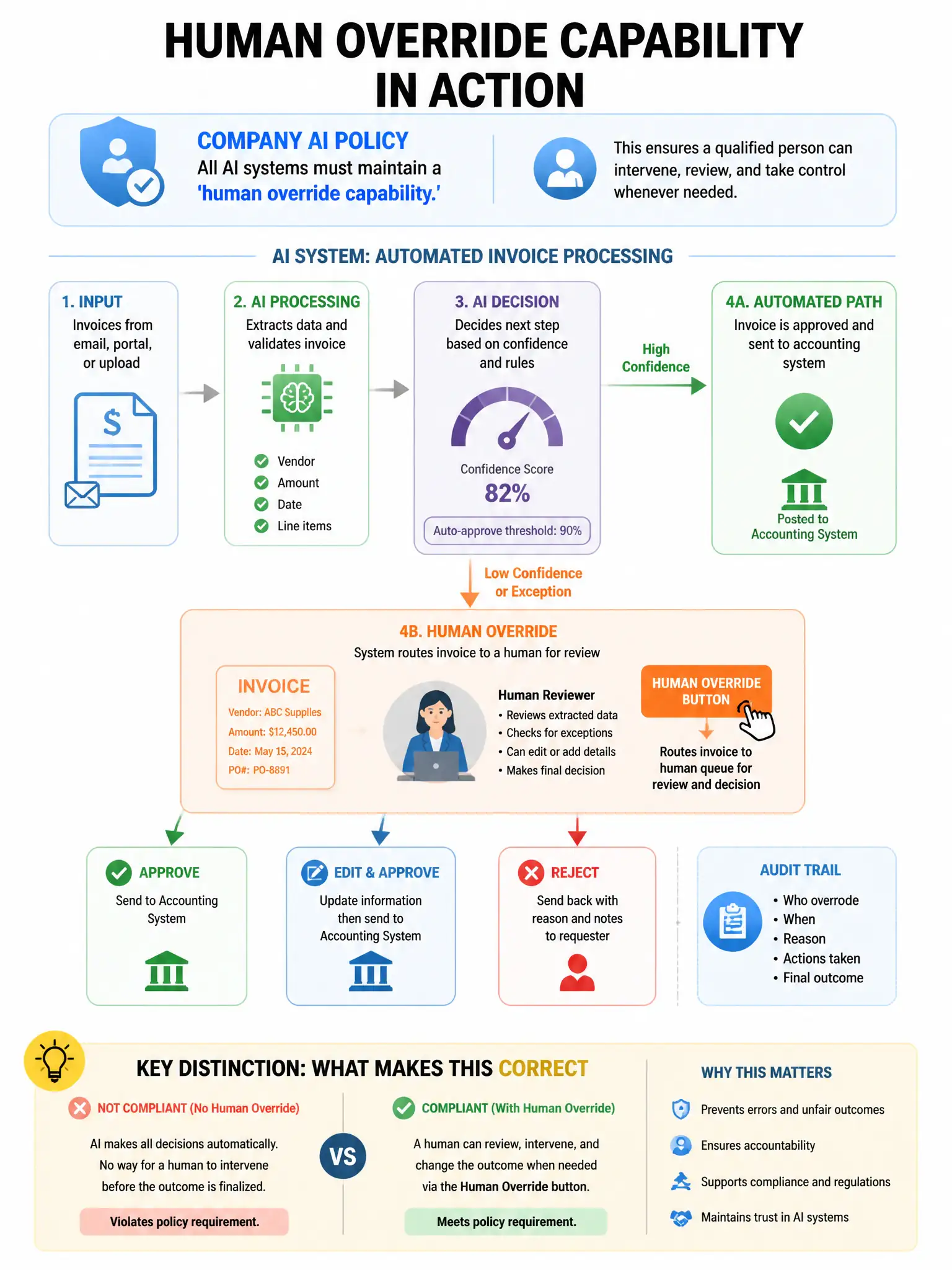
A company's AI policy requires all AI systems to maintain a 'human override capability.' An AI system for automated invoice processing has a human override button that routes invoices to a human reviewer. However, the reviewer queue is always backlogged by more than 2,000 items, and 95% of invoiced items expire before a human reviews them. What governance gap does this represent?
Select an answer to reveal the explanation.
Short Explanation
Here's the deal — a human override button only counts if someone can actually use it. With more than 2,000 items waiting and 95% expiring before review, the control is just for show, so the system is effectively fully automated.
Full Explanation
The correct governance gap is that the human override capability exists in name only; the review capacity is insufficient to make it a meaningful control, creating a de facto fully automated system without effective human oversight. An override mechanism is only meaningful if humans can actually exercise it. A perpetual backlog that causes 95% of items to expire before review means the override is illusory: the system functions as fully automated in practice. This is a governance gap where the control exists on paper but not in reality. The accuracy/retraining option may be a separate concern, but the backlog and expiration facts show a control-capacity gap. Redesigning to eliminate human review removes the control rather than fixing it. Increasing automation to reduce backlog further bypasses the required human review.