
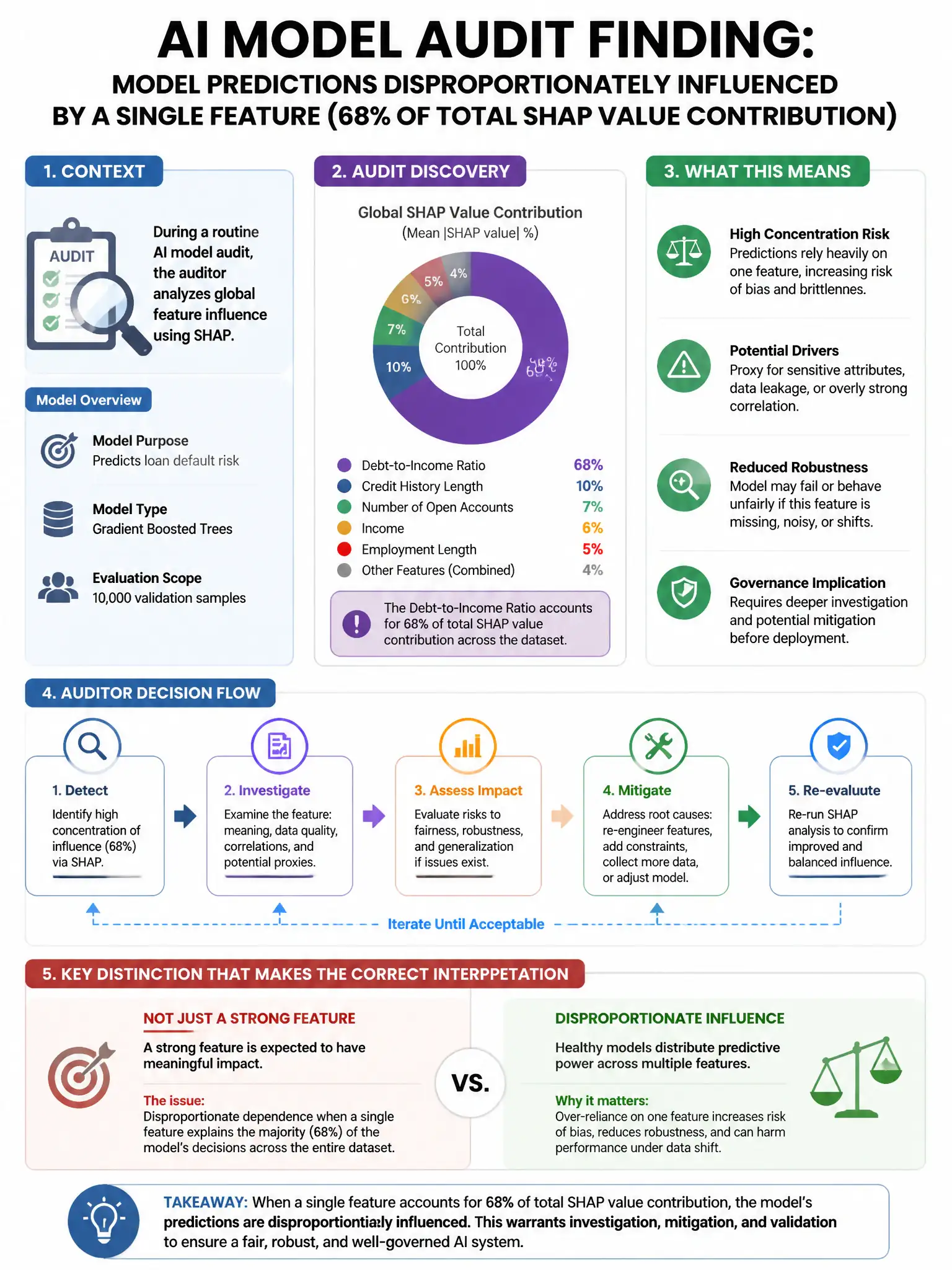
During an AI model audit, the auditor discovers that the model's predictions are disproportionately influenced by a single feature that accounts for 68% of total SHAP value contribution. What risk does this finding indicate?
Select an answer to reveal the explanation.
Short Explanation
Here's the deal — when one feature accounts for 68% of SHAP value contribution, you're looking at concentration risk. If that feature goes away, changes, or carries bias, the model's output can collapse or become unfair. You're dependent on one data point's integrity.
Full Explanation
The correct finding is high concentration risk: a model dominated by a single feature is brittle, because if that feature becomes unavailable, its measurement changes, or it begins to carry bias, the model's entire output is affected. This concentration risk means the model's performance and fairness hinge on one data point's integrity. This finding also raises questions about whether the model has truly learned the underlying problem or is exploiting a shortcut. The claim that the model is overfitting because the dominant feature has been over-engineered describes a different problem. The claim of a feature selection error involving an irrelevant feature is unlikely, because an irrelevant feature would typically receive low SHAP values, not dominate them. The claim of regulatory compliance risk because models with a dominant feature are prohibited in regulated industries is incorrect; no blanket prohibition exists on models with dominant features, and this is a risk management concern, not a regulatory rule.