
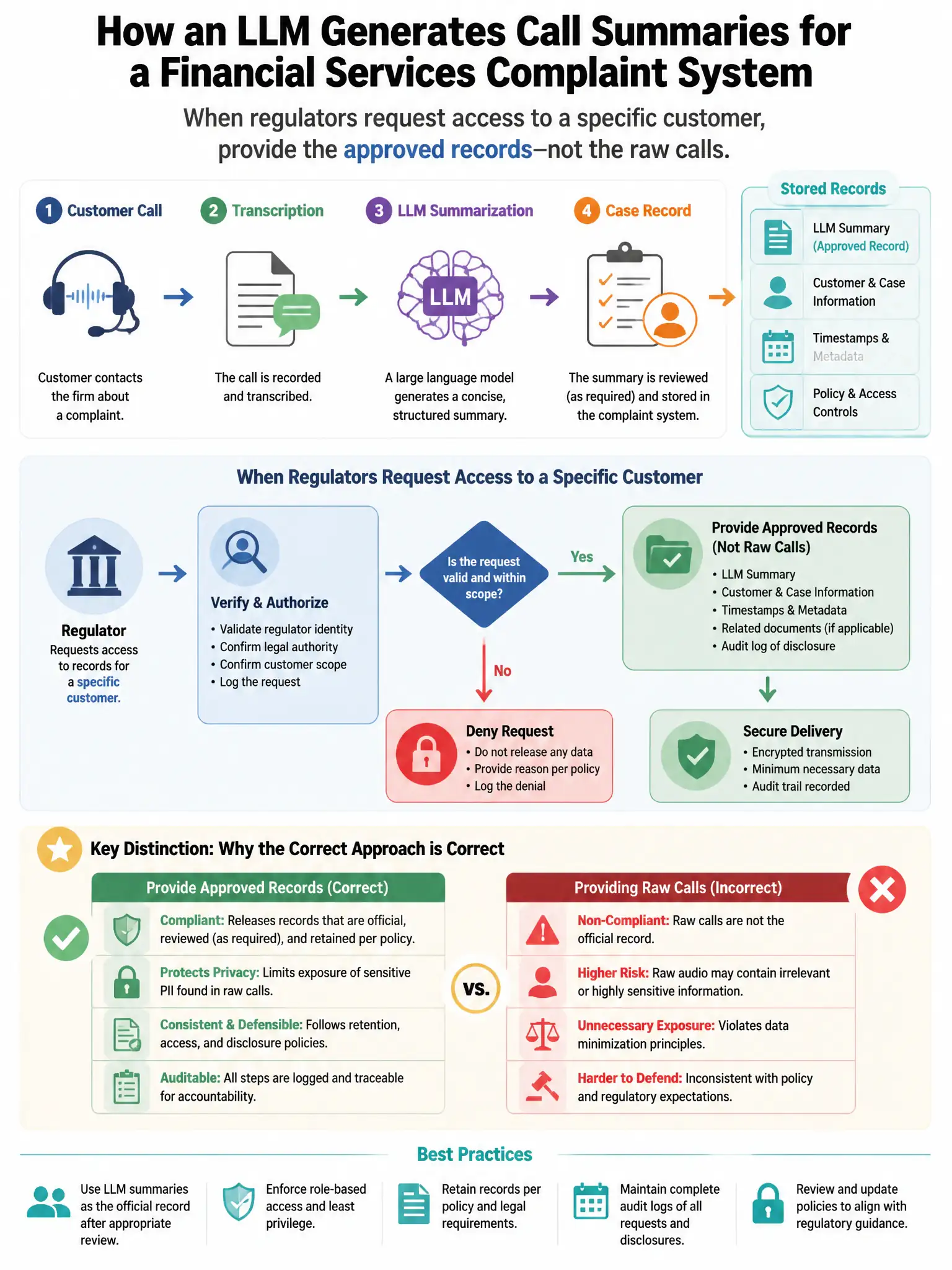
A large language model is used to generate summaries of customer calls for a financial services firm's complaint management system. Regulators request access to a specific customer's complaint records. The AI-generated summaries are available, but the original call recordings have been deleted per retention policy. What AI-specific governance risk does this scenario illustrate?
Select an answer to reveal the explanation.
Short Explanation
Here's the deal — you're looking at the risk of letting AI summaries become the only record. If regulators ask for proof, a generated summary may not hold up because it can omit, paraphrase, or distort the original complaint. That makes it an evidentiary and compliance problem, not just an AI accuracy issue.
Full Explanation
The correct risk is AI-generated records as sole documentation, where reliance on AI summaries as the primary record creates evidentiary and regulatory compliance challenges. Using AI-generated summaries as the sole documentation of customer complaints creates an evidentiary problem: AI summaries may contain hallucinations, omissions, or paraphrasing that does not accurately represent the original complaint. When regulators or courts require original records, AI-generated substitutes may be insufficient or inadmissible. This scenario illustrates the governance risk of over-relying on AI-generated records. The model hallucination risk, where the LLM fabricated complaint details not present in the original calls, is a related concern but is a symptom, not the governance risk. The data retention policy violation, from deleting the recordings too early, may be a separate concern, but the scenario states the policy allows deletion. The privacy risk, from storing customer call content in an LLM's training data, is a data governance concern separate from the records risk.