
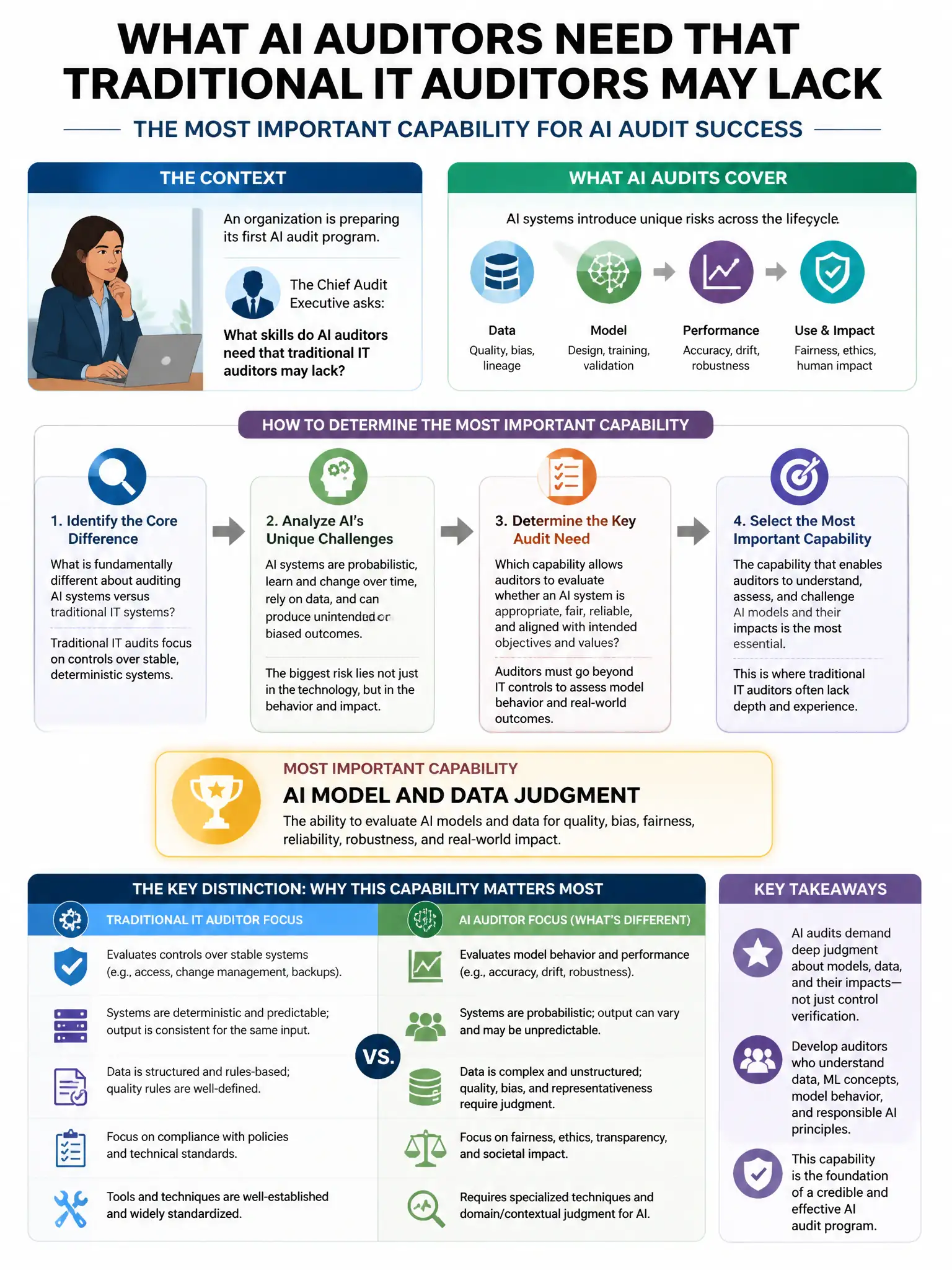
An organization is preparing its first AI audit program. The Chief Audit Executive asks what skills AI auditors need that traditional IT auditors may lack. Which capability is MOST uniquely required for AI auditing?
Select an answer to reveal the explanation.
Short Explanation
Here's the deal — you need to assess statistical model validity, evaluate bias testing methodologies, and interpret model performance metrics for the applicable use case. That's the AI-specific skill traditional IT auditors often lack.
Full Explanation
Assessing statistical model validity, evaluating bias testing methodologies, and interpreting model performance metrics in the context of applicable use cases is correct because AI auditing requires skills traditional IT auditors typically lack: statistical model development, bias testing frameworks, and machine learning metrics such as AUC, F1, precision, and recall, plus judging whether validation approaches fit the use case. Familiarity with network security protocols and firewall configuration is relevant to general IT auditing. Knowledge of software development lifecycle best practices and code review techniques is also relevant to general IT auditing. Proficiency in enterprise resource planning system audit procedures is entirely unrelated. The distinctive competency is quantitative model literacy combined with understanding of AI-specific risks.