
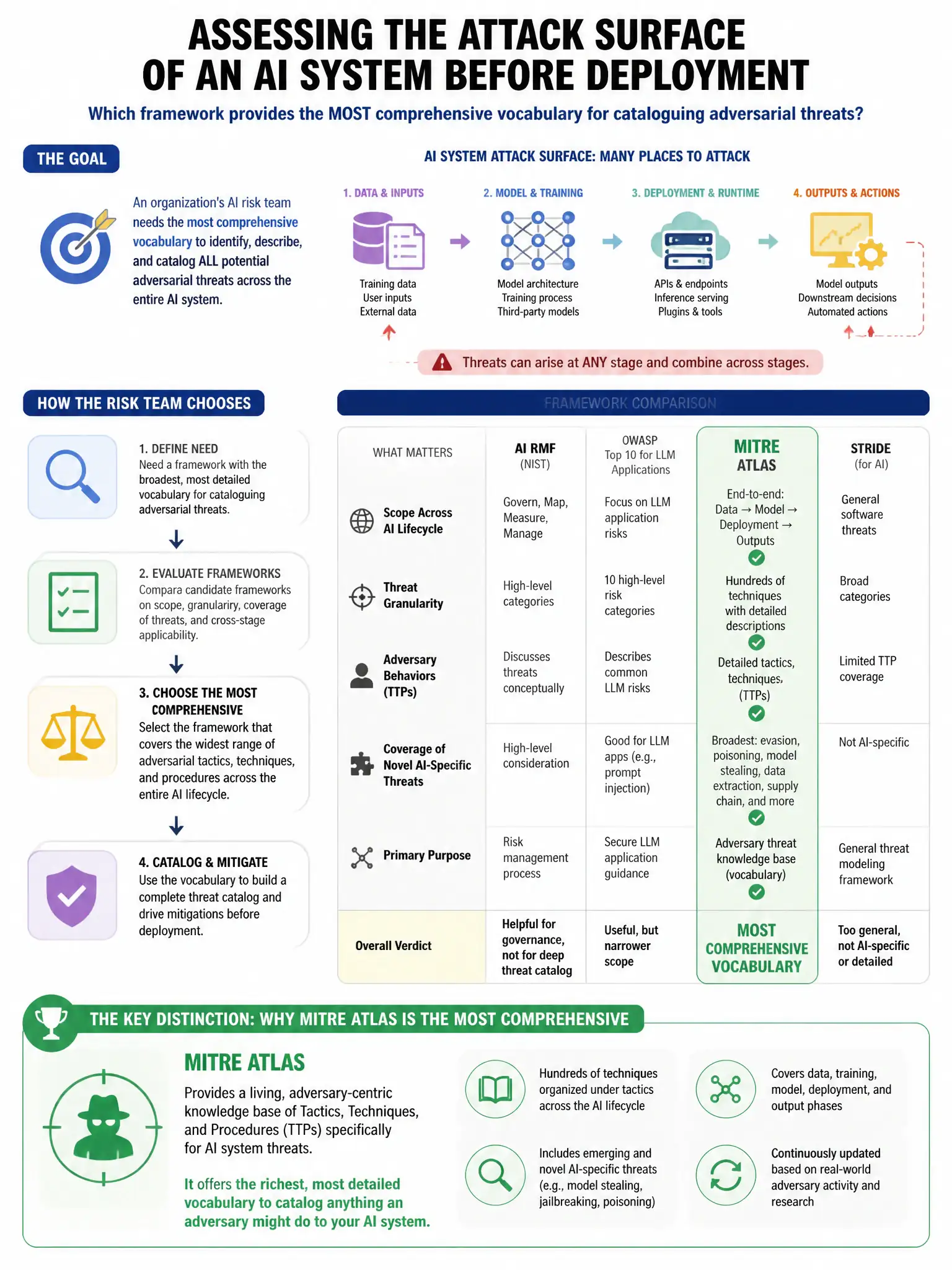
An organization's AI risk team wants to assess the attack surface of an AI system before deployment. Which framework provides the MOST comprehensive vocabulary for cataloguing adversarial threats specific to AI and ML systems?
Select an answer to reveal the explanation.
Short Explanation
Here's the deal — you want MITRE ATLAS because it catalogs real-world adversarial attack techniques aimed at AI and ML systems. It maps tactics like ML model access, training data poisoning, inference API access, and model evasion. That makes it the most comprehensive vocabulary for this job.
Full Explanation
MITRE ATLAS (Adversarial Threat Landscape for Artificial-Intelligence Systems) is correct because it is specifically designed to catalogue real-world adversarial attack techniques targeting AI and ML systems, organized in a structure analogous to MITRE ATT&CK. It covers tactics such as ML model access, training data poisoning, inference API access, and model evasion, which gives it the most comprehensive vocabulary for cataloguing AI-specific adversarial threats. The OWASP Top 10 Web Application Security Risks option focuses on web application vulnerabilities rather than ML-specific adversarial techniques. The NIST Cybersecurity Framework (CSF) 2.0 option is a general cybersecurity framework not specific to AI attack taxonomies. The ISO/IEC 27005 Information Security Risk Management option is a general information security risk management standard.