
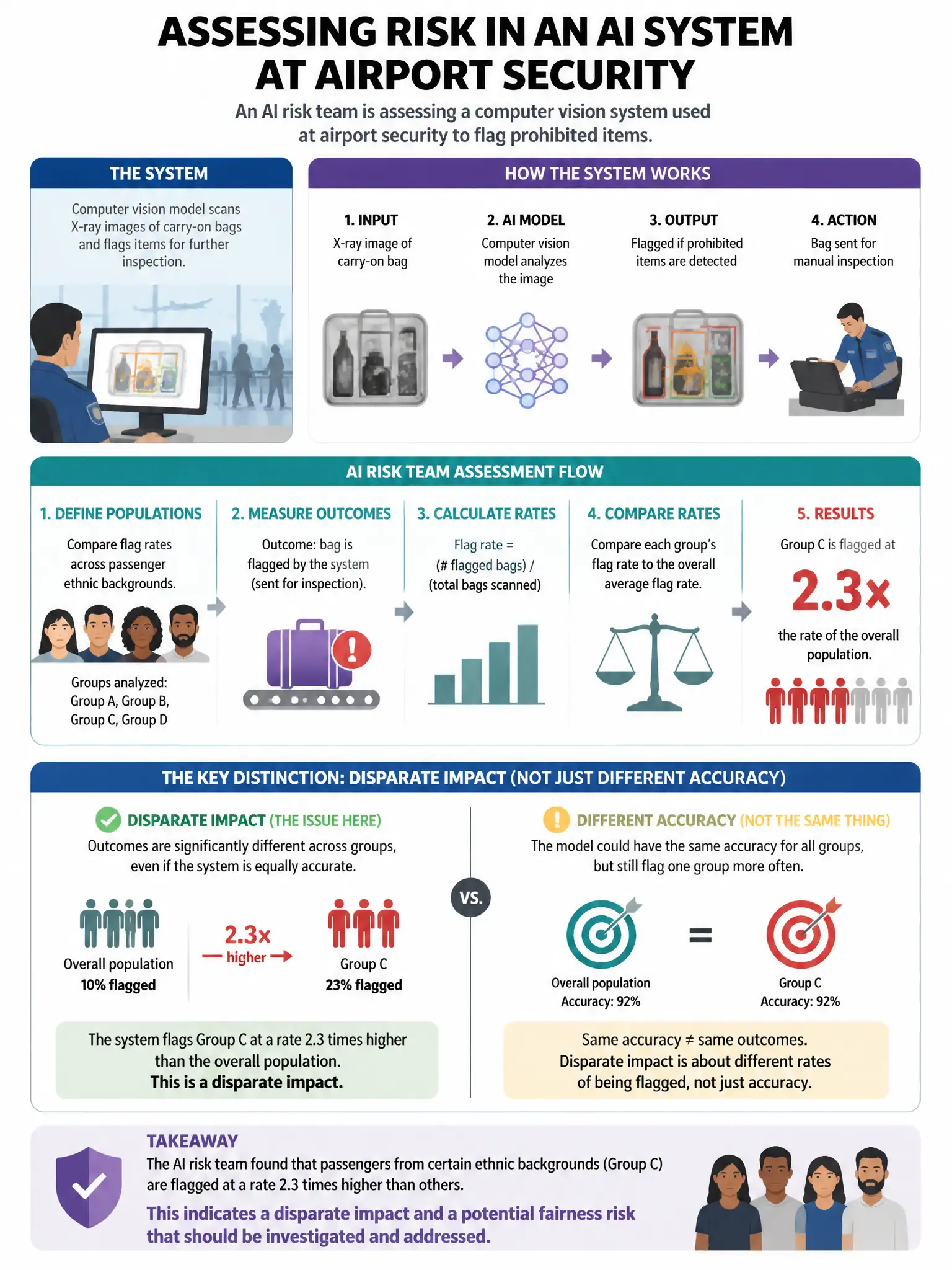
An AI risk team is assessing a computer vision system used at airport security to flag prohibited items. The system flags passengers from certain ethnic backgrounds at a rate 2.3 times higher than the overall population, controlling for actual prohibited item carry rates. This finding is BEST described as:
Select an answer to reveal the explanation.
Short Explanation
When a model flags a protected group at 2.3 times the general rate after controlling for actual carry rates, you're looking at disparate impact bias. That raises serious civil rights concerns, so you investigate the source and legal exposure instead of accepting or recalibrating it.
Full Explanation
The correct finding is disparate impact bias that may constitute unlawful discrimination and requires immediate investigation and remediation, because a model that flags a protected group at 2.3 times the general population rate after controlling for actual prohibited item carry rates shows classic disparate impact. That raises civil rights concerns under statutes such as Title VI and Section 1981, so you must investigate the source of bias and potential legal exposure rather than accept or recalibrate it. The option calling it acceptable performance variation due to natural population differences assumes real behavioral differences explain the disparity, but the scenario controls for actual carry rates. The option calling it a false positive rate issue requiring threshold adjustment mischaracterizes it as a simple threshold problem. The option calling it a distributional shift issue caused by demographic composition changes is not supported by the controlled analysis.