
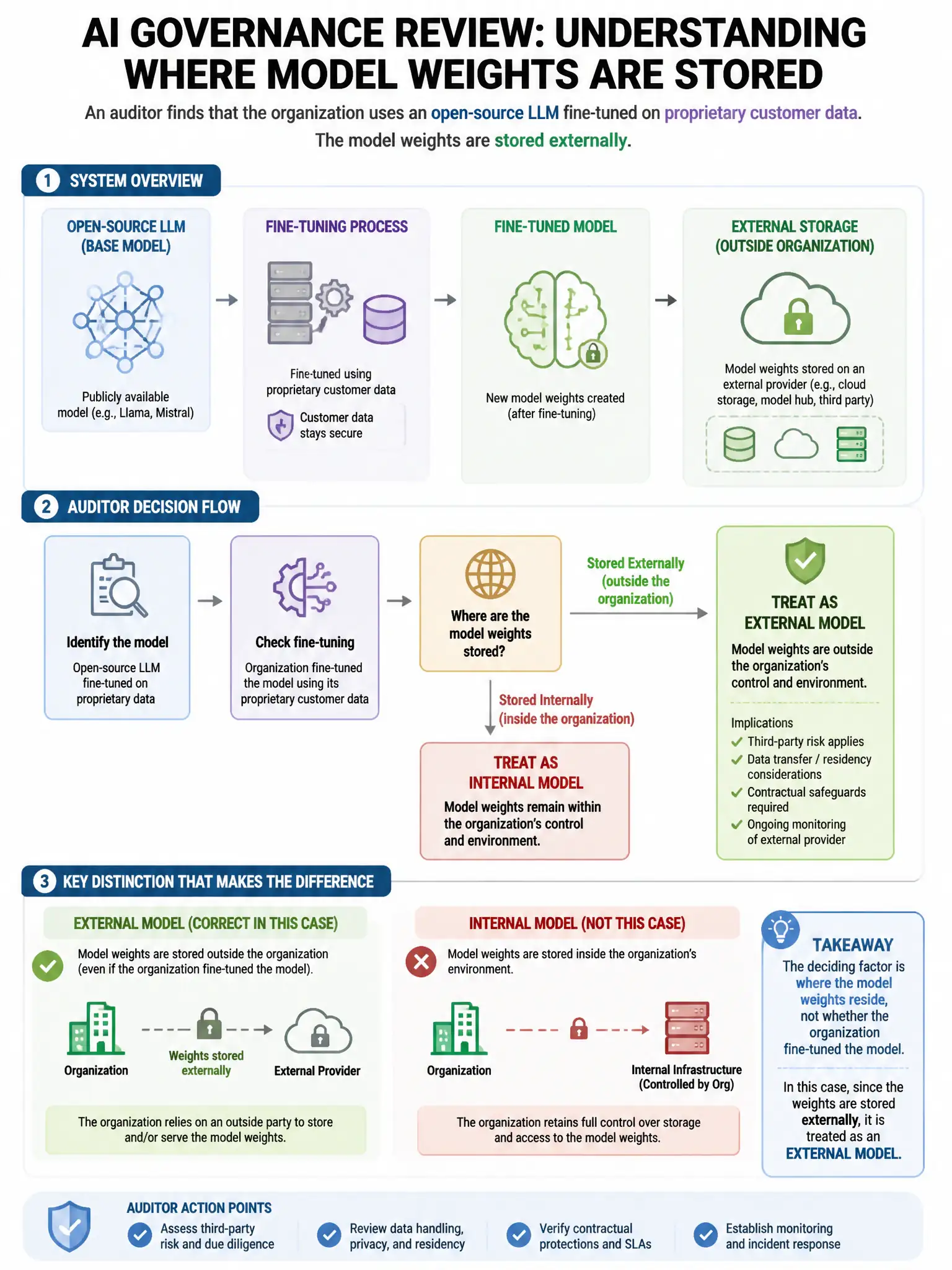
During an AI governance review, an auditor finds that the organization uses an open-source LLM fine-tuned on proprietary customer data. The model weights are stored externally on a cloud provider's infrastructure. Which AI supply chain risk is MOST relevant?
Select an answer to reveal the explanation.
Short Explanation
Here's the deal — if you fine-tune an open-source model on proprietary customer data and store the weights externally, the biggest supply-chain risk is that the data embedded in those weights can be extracted or controlled by someone else. Model inversion and membership inference attacks make that exposure real, especially outside your environment.
Full Explanation
Data exfiltration and loss of control over proprietary training data embedded in model weights is correct because proprietary customer data used for fine-tuning can be extracted from model weights through model inversion or membership inference attacks, and storing weights externally compounds this exposure. Hallucination from insufficient training data is a model quality issue, not a supply chain risk. Prompt injection from external users is an inference-time attack risk, separate from supply chain. Regulatory non-compliance due to using an open-source base model is not inherently true; open-source models are used in regulated industries with proper controls.