
A company's AI policy requires all AI systems to maintain a 'human override capability.' An AI system for automated invoice processing has a human override button that routes invoices to a human reviewer. However, the reviewer queue is always backlogged by more than 2,000 items, and 95% of invoiced items expire before a human reviews them. What governance gap does this represent?
Select an answer to reveal the explanation.
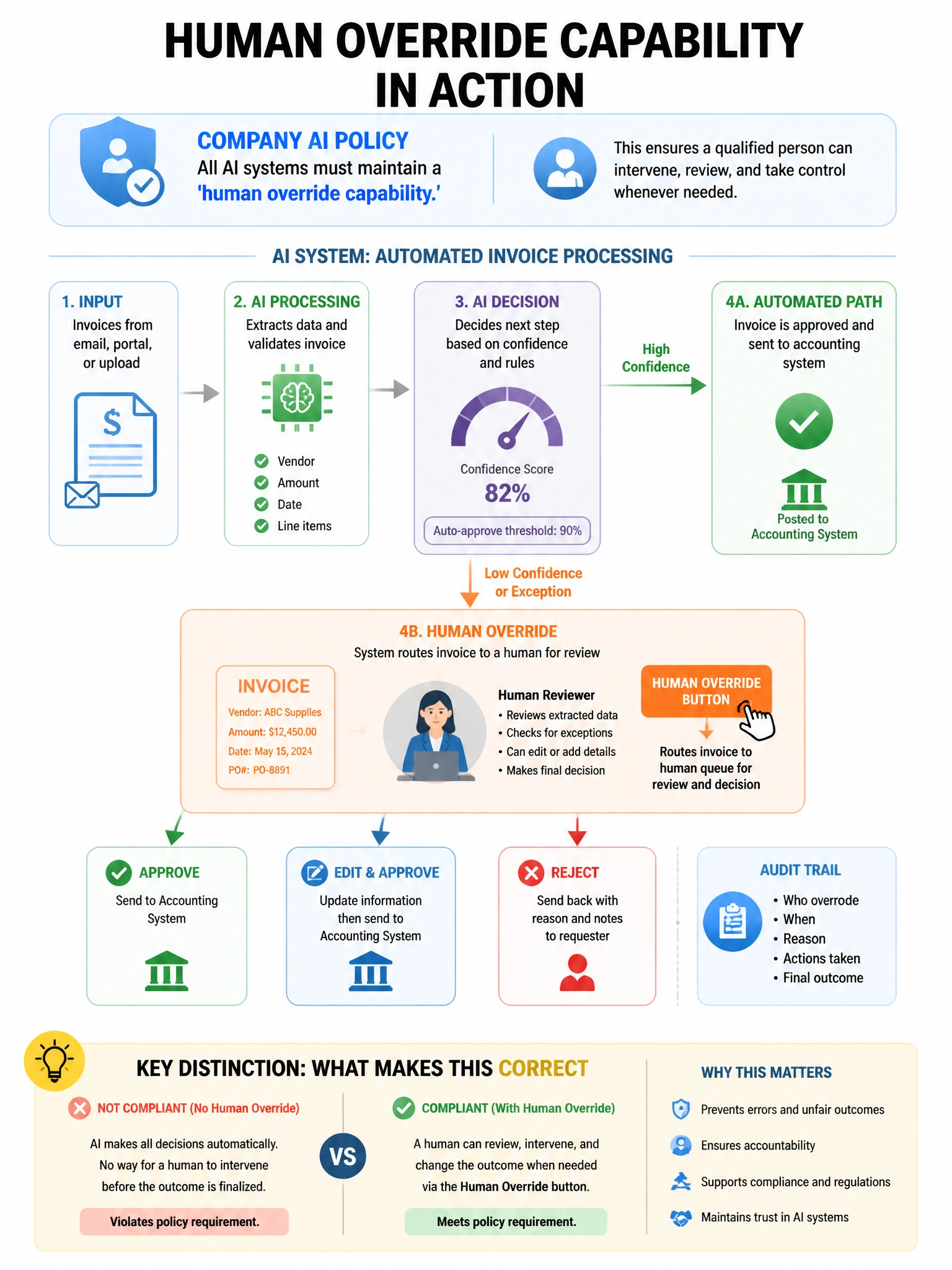
Short Explanation and Infographic
Here's the deal — b is correct because an override mechanism is only meaningful if humans can actually exercise it. A perpetual backlog that causes 95% of items to expire before review means the override is illusory: the system functions as fully automated in practice.
Full explanation below image
Full Explanation
B is correct because an override mechanism is only meaningful if humans can actually exercise it. A perpetual backlog that causes 95% of items to expire before review means the override is illusory: the system functions as fully automated in practice. This is a governance gap where the control exists on paper but not in reality. AI accuracy (A) may be a separate concern. Eliminating human review (C) would remove the control entirely rather than fix it. Increasing automation (D) would further bypass the human review that should be functioning.