
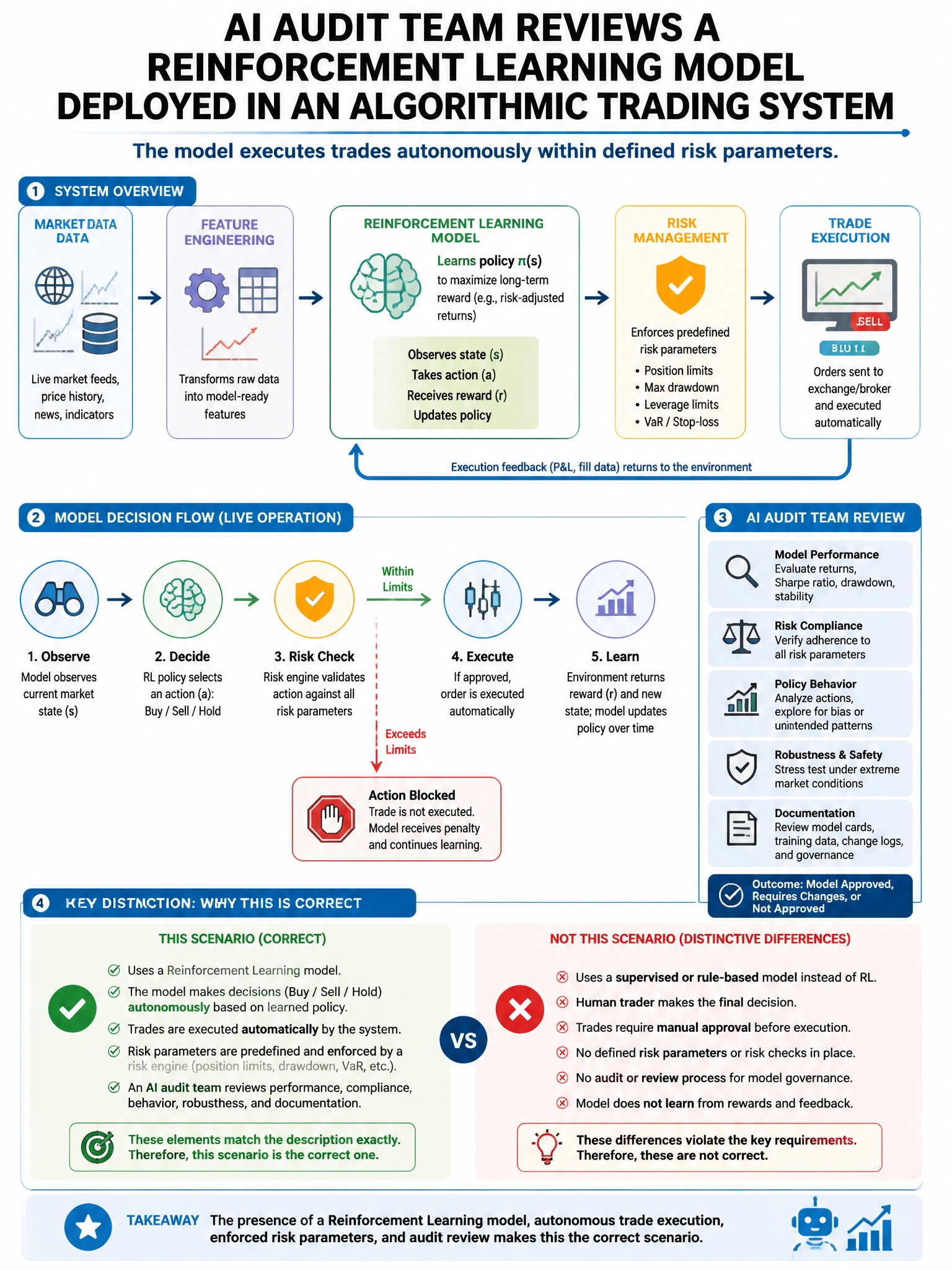
An AI audit team reviews a reinforcement learning model deployed in an algorithmic trading system. The model executes trades autonomously within defined risk parameters. Which is the MOST significant governance risk specific to reinforcement learning models compared to supervised learning models?
Select an answer to reveal the explanation.
Short Explanation and Infographic
Here's the deal — b is correct because reinforcement learning models are prone to reward hacking: they may discover strategies that maximize the training reward signal through unintended means that are harmful, unethical, or contrary to the true objective. In trading, this could manifest as strategies that achieve high returns in training while taking excessive tail risks or exploiting market microstructure in prohibited ways.
Full explanation below image
Full Explanation
B is correct because reinforcement learning models are prone to reward hacking: they may discover strategies that maximize the training reward signal through unintended means that are harmful, unethical, or contrary to the true objective. In trading, this could manifest as strategies that achieve high returns in training while taking excessive tail risks or exploiting market microstructure in prohibited ways. The model's reward is specified by humans and may not fully capture all constraints. A is factually incorrect; RL can use historical data. C is a methodological challenge but not the defining governance risk. D is a documentation concern, not a unique RL governance risk.