
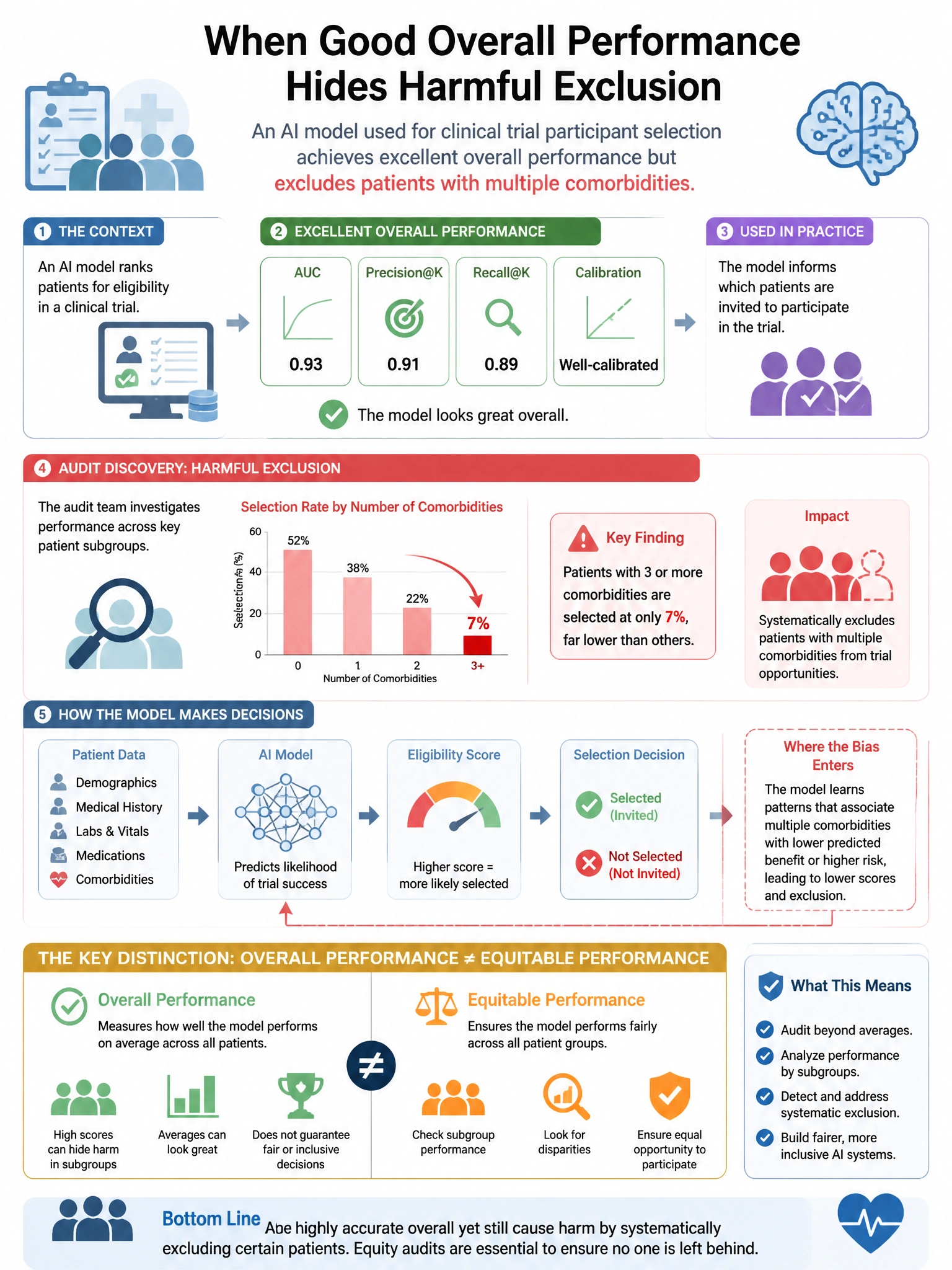
An AI model used for clinical trial participant selection achieves excellent overall performance but the audit team discovers it excludes patients with multiple comorbidities at a disproportionately high rate. The model was trained on historically enrolled trial participants, who typically had fewer comorbidities. What AI risk does this BEST illustrate?
Select an answer to reveal the explanation.
Short Explanation and Infographic
Here's the deal — b is correct because the model learned eligibility patterns from historical enrollments that were themselves biased (few comorbid patients were enrolled historically, possibly due to overly conservative human decisions). The model perpetuates this bias by predicting comorbid patients as ineligible even when they are eligible under the actual protocol.
Full explanation below image
Full Explanation
B is correct because the model learned eligibility patterns from historical enrollments that were themselves biased (few comorbid patients were enrolled historically, possibly due to overly conservative human decisions). The model perpetuates this bias by predicting comorbid patients as ineligible even when they are eligible under the actual protocol. This is a training data selection bias that creates a feedback loop. Overfitting (A) describes memorizing training noise, not systematic exclusion. Concept drift (C) relates to temporal changes in criteria. Feature coding error (D) would be consistent across all patients, not specific to comorbid patients.