
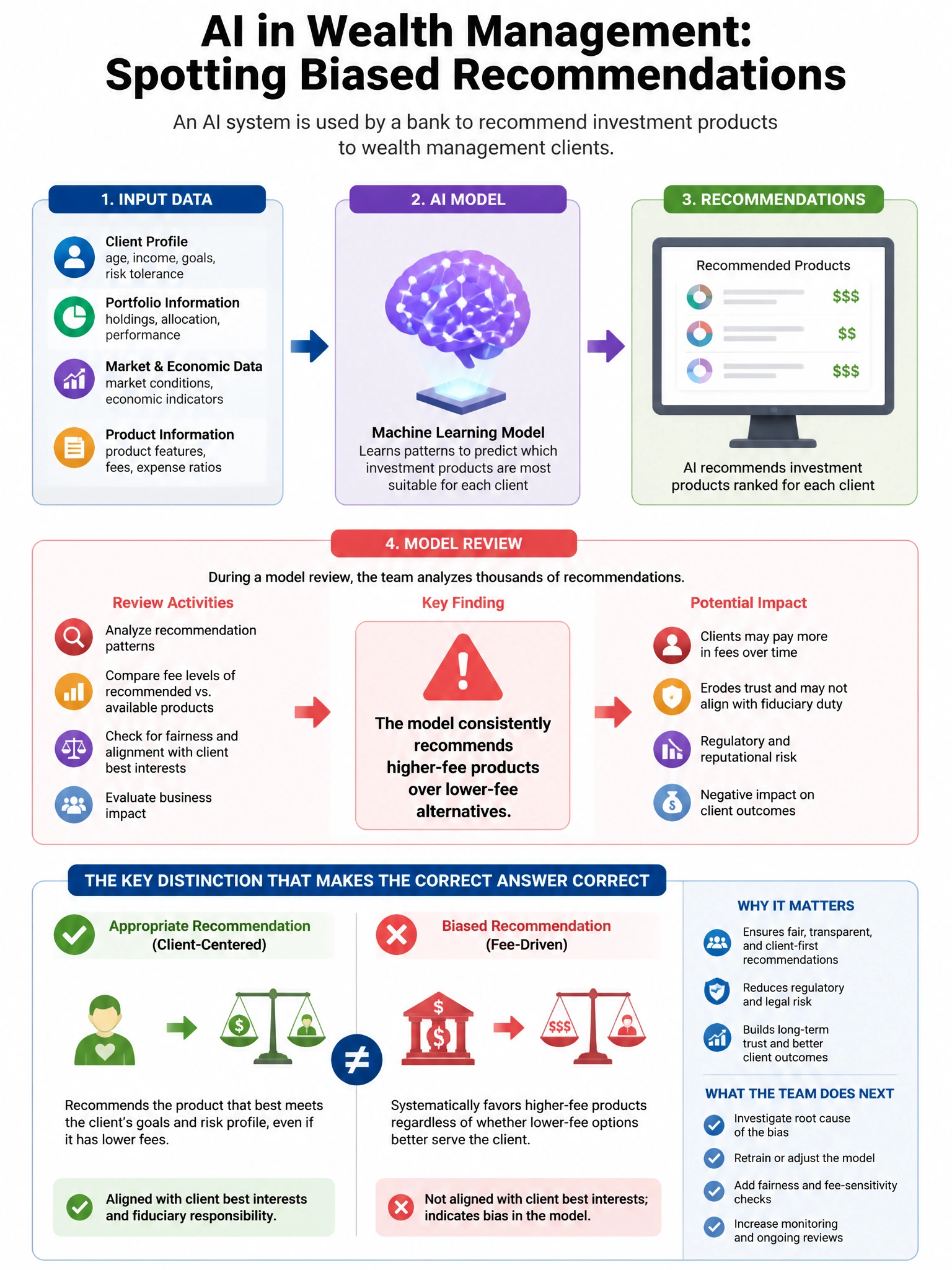
An AI system is used by a bank to recommend investment products to wealth management clients. During a model review, the team discovers the model consistently recommends higher-fee products to clients with lower financial literacy scores, regardless of suitability. Which risk does this MOST represent?
Select an answer to reveal the explanation.
Short Explanation and Infographic
Here's the deal — b is correct because if the model was trained on historical advisor recommendations, and those recommendations were influenced by commission structures that favored high-fee products, the model has learned to replicate commission-driven rather than suitability-driven behavior. This is a conflict of interest embedded in the training objective, a significant risk in financial services AI.
Full explanation below image
Full Explanation
B is correct because if the model was trained on historical advisor recommendations, and those recommendations were influenced by commission structures that favored high-fee products, the model has learned to replicate commission-driven rather than suitability-driven behavior. This is a conflict of interest embedded in the training objective, a significant risk in financial services AI. Model drift (A) and concept drift (D) relate to temporal changes, not systematic bias in the training objective. Data imbalance (C) may contribute but the described pattern points to a structural training bias, not merely imbalance.