
A public-health AI audit needs to reperform GenAI responses about clinic referrals. Which evidence type best supports that reperformance?
Select an answer to reveal the explanation.
Short Explanation
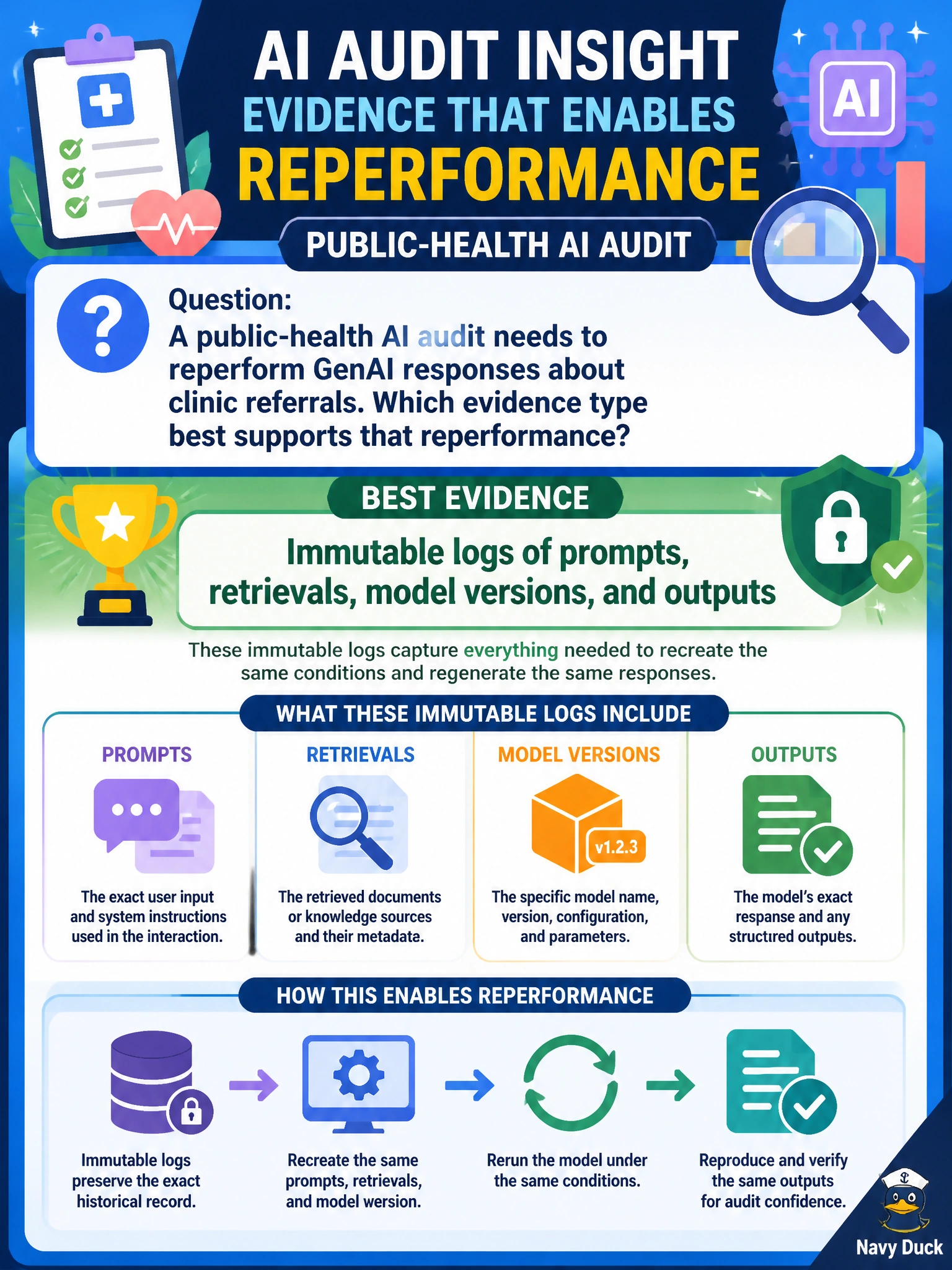
To re-run what the GenAI said, you need locked logs of the prompt, retrievals, version, and output — not an aggregated dashboard of weekly accuracy and volume. That trail is how civic AI gets retested. A weekly trend dashboard does not reperform answers.
Full Explanation
Immutable logs of prompts, retrievals, model versions, and outputs best support reperformance of GenAI clinic-referral responses because they preserve the inputs, context, and system state that produced each answer. A public-health auditor can reconstruct what the chatbot saw and said, then re-run comparable prompts against the same or documented model versions to evaluate correctness, safety, and referral appropriateness. Durability and integrity of that trail are what turn a transient chat into auditable civic AI behavior.
Versioned prompt templates and persona instructions for referrals fail by concept: they record intended setup and wording, not the actual prompt, retrieval, model-version, and output events needed to reperform a specific response or independently verify it after fieldwork. De-identified chat transcripts of final referral answers given fail because they show only what was said, not the prompts, retrievals, and model versions that produced each answer, so an auditor cannot re-run comparable inputs against the same system state. Aggregated dashboards tracking weekly referral accuracy and volume trends confirm broad patterns, not individual inputs, retrievals, or outputs; they cannot help the auditor reconstruct what the chatbot actually said for a given case or re-run comparable prompts against the logged model version.
Exam caveat: logs must be complete and protected; missing retrieval snippets or mutable logs that staff can edit after the fact weaken reperformance and may themselves become findings. Operational check: confirm logging covers prompt text, retrieved sources, model and prompt-template identifiers, timestamps, and outputs; verify write-once or hash-protected storage; then select clinic-referral samples and reperform against the logged evidence.