
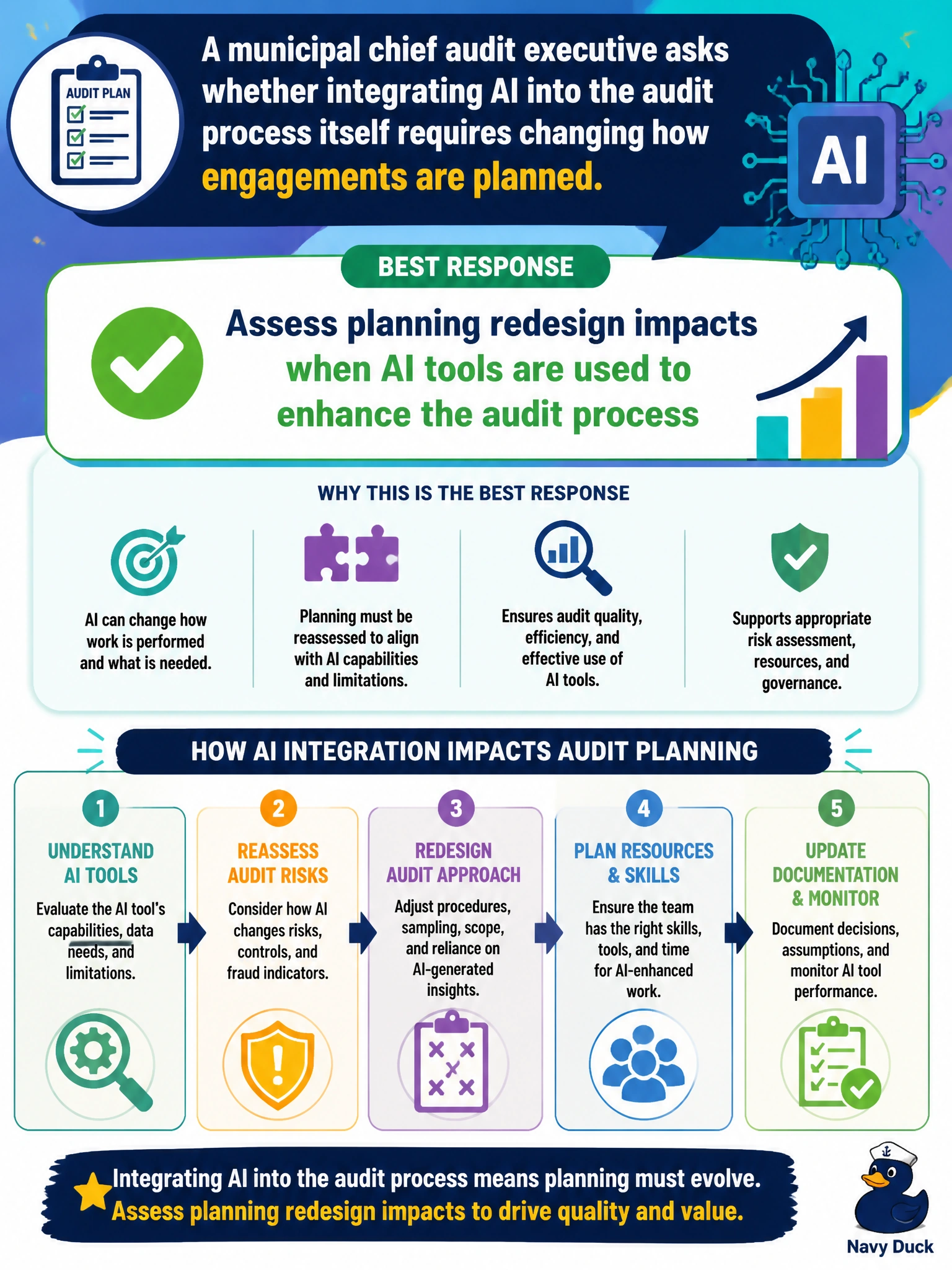
A municipal chief audit executive asks whether integrating AI into the audit process itself requires changing how engagements are planned. What is the best response?
Select an answer to reveal the explanation.
Short Explanation
If auditors start using AI to plan and test, the plan itself needs a tune-up — evidence, review, and bias checks change. Keeping old sampling methods unchanged for AI-analyzed full populations won't work, and the audited team shouldn't approve its own AI-assisted planning. Vendor contracts can't set audit scope on their own; that's a risk-based decision.
Full Explanation
Assessing planning redesign impacts when AI tools enhance the audit process works because AI-assisted scoping, sampling, evidence summarization, and anomaly hunting change how engagements are planned, reviewed, and documented. Evidence reliability, reviewer responsibilities, data handling, and bias in auditor-used models become planning inputs. CAEs should evaluate whether templates, quality programs, and skill mixes must change before auditors rely on AI productivity tools on municipal engagements.
Retaining existing audit sampling methods unchanged to test AI-analyzed complete audit populations fails: when AI reviews entire populations, sampling design, evidence evaluation, and exception handling must be rethought rather than carried over from prior engagements. Delegating planning approval for AI-assisted audit procedures to the audited program management team fails conceptually because it impairs internal audit independence—the audited function should not approve how it will be examined. Treating AI vendor contracts as sufficient evidence for audit engagement scope decisions fails because vendor documentation does not substitute for risk-based scoping, engagement objectives, or the auditor’s responsibility to determine what to examine.
Exam caveat: redesign should be proportionate—light summarization aids need lighter governance than tools that select samples or draft findings with minimal human review. Operational check: run a planning impact assessment covering permitted AI uses, prohibited data classes, mandatory human review points, documentation of AI-assisted steps, and update engagement planning templates before municipal auditors deploy those tools in live fieldwork.