
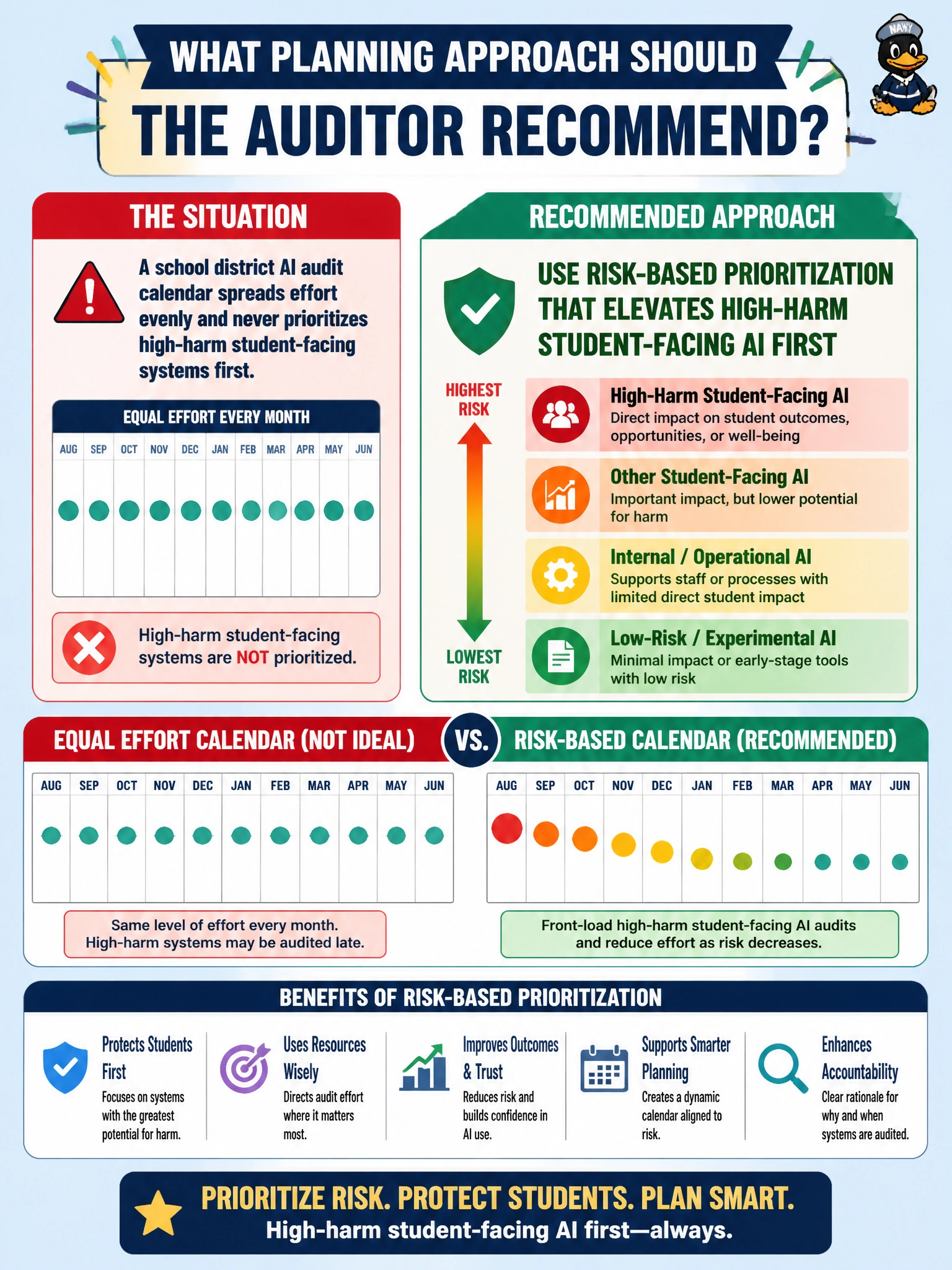
A school district AI audit calendar spreads effort evenly and never prioritizes high-harm student-facing systems first. What planning approach should the auditor recommend?
Select an answer to reveal the explanation.
Short Explanation
Even calendars feel fair until a high-harm student AI goes unchecked. Risk-based priority puts the sharpest tools first. Even quarterly rotations and purchase-order dates are not risk ranking.
Full Explanation
Using risk-based prioritization that elevates high-harm student-facing AI first works because even calendar allocation can leave the systems that affect discipline, placement, grading assistance, or safety under-assured while low-impact tools consume hours. School district audit resources are finite; harm potential, data sensitivity, and decision autonomy should drive sequence. Risk-based calendars protect students by testing sharp-edged AI before convenience apps.
Scheduling audits by procurement order ties sequence to paperwork timing rather than harm potential, so a high-harm student-facing system procured late could sit unaudited for a full cycle while a low-impact tool bought earlier gets checked first. Distributing audit effort evenly across schools on a quarterly rotation fails conceptually: even rotation is unrelated to residual risk and leaves high-harm student-facing systems unaudited simply because their turn has not come. Scheduling audits around planned school event calendars to minimize classroom disruption fails because it sequences work by disruption avoidance rather than harm potential, so high-harm student-facing AI can sit unaudited until a convenient window opens.
Exam caveat: “high-harm” needs documented criteria (decision impact, data class, population size); without them, prioritization becomes political rather than risk-based. Operational check: score district AI systems on harm/criticality, publish the ranked audit calendar with rationale, and require CAE approval when low-harm tools are scheduled ahead of high-harm student-facing models.