
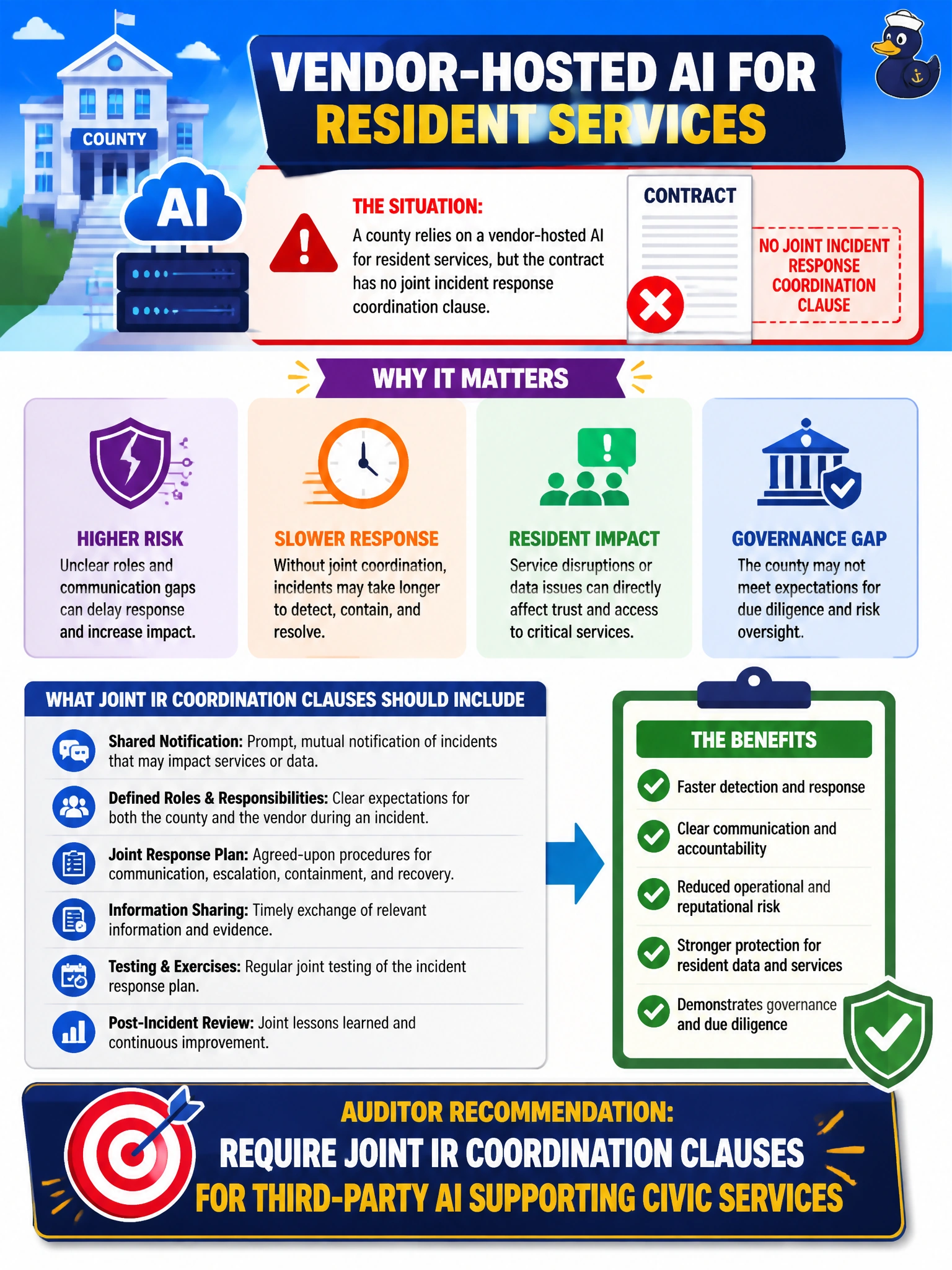
A county relies on a vendor-hosted AI for resident services, but the contract has no joint incident response coordination clause. What should the auditor recommend?
Select an answer to reveal the explanation.
Short Explanation
If the county's AI lives at a vendor, you need a written "who calls whom" when it breaks — not vibes. Joint IR clauses keep civic services from flying blind. You can't rely on an annual attestation, quarterly availability metrics, or a risk-register contact list as your incident playbook.
Full Explanation
Requiring joint incident response coordination clauses for third-party AI supporting civic services works because vendor-hosted models sit outside the county’s direct console access, yet resident-facing failures still belong to the county politically and operationally. Contracts that define notification timelines, bridge participation, evidence sharing, RTO/RPO expectations, and decision rights prevent finger-pointing during outages or data incidents. Auditors should treat missing joint IR language as a third-party risk control gap for civic AI dependencies.
Relying on annual vendor security attestations to cover live incident coordination fails because attestations are periodic point-in-time assurances that do not establish notification timelines, joint bridge participation, or decision rights during an active outage. Tracking vendor AI availability metrics in quarterly reviews to manage outage response fails conceptually: passive metrics reviewed quarterly cannot replace real-time joint incident coordination or govern dependency risk when a resident-facing failure occurs. Recording vendor escalation contacts in the risk register for use during service disruptions fails because merely logging names is an administrative step that creates no enforceable incident coordination obligations, shared procedures, or escalation authority when the AI service breaks.
Exam caveat: joint IR clauses must align with the vendor’s actual support model and shared responsibility matrix; boilerplate that conflicts with how the SaaS AI is operated will fail under real incidents. Operational check: amend or addendum the county AI vendor contract with named contacts, severity-based notify windows, joint bridge expectations, log/access provisions, and an annual joint tabletop; store results with the third-party risk file before renewing.