
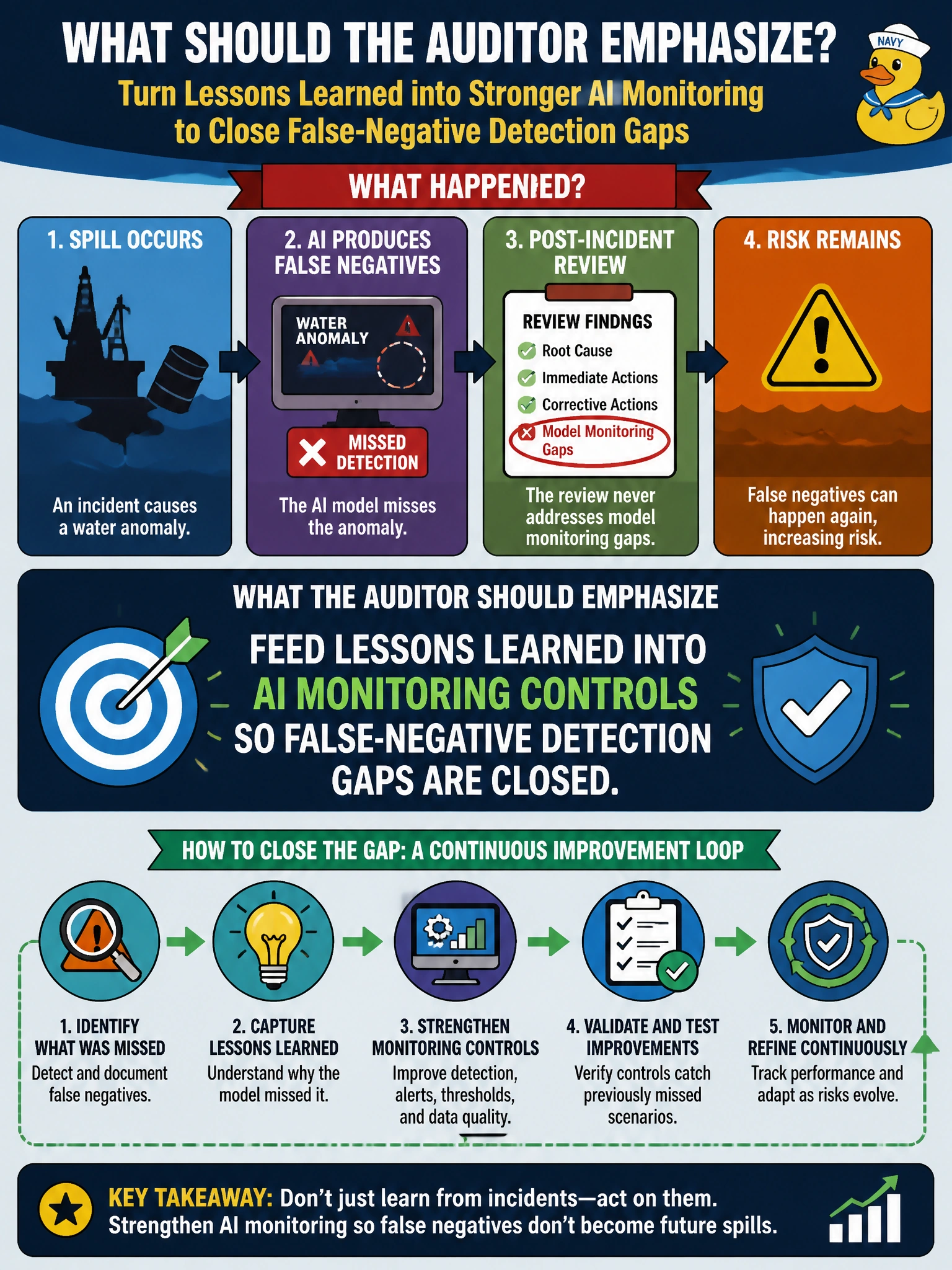
After a spill, investigators find the water anomaly AI produced false negatives, but the post-incident review never addresses model monitoring gaps. What should the auditor emphasize?
Select an answer to reveal the explanation.
Short Explanation
If the spill detector missed the spill, the write-up cannot stop at tuning ticket closure criteria. Lessons have to tighten the model's monitoring so the next miss gets caught. A side report nobody tracks back into monitoring does not fix false negatives.
Full Explanation
Feeding lessons learned into AI monitoring controls works because a spill preceded by false negatives is evidence that detection thresholds, features, labels, or alerting logic failed under real plant conditions. Post-incident reviews that stop at tuning ticket closure criteria leave the same blind spots armed for the next release event. Closing the monitoring gap—retraining signals, threshold tuning, shadow evaluation of missed events, and alert routing—converts a water-safety near miss into durable control improvement for the municipal treatment plant.
Tuning incident ticket closure criteria to shorten response times fails because faster ticket handling does not restore detection capability; the AI model that missed the anomaly remains unexamined and the false-negative gap stays open. Documenting retraining requirements in a separate technical report outside the IR process still leaves the false-negative gap unresolved inside the review that is supposed to close it; a report nobody tracks back into monitoring controls is not the same as fixing the detection gap. Channeling lessons learned into operator awareness training for spill response procedures fails because better operator awareness does not close the AI model's false-negative detection gap; the monitoring controls themselves are not updated to catch the anomaly next time.
Exam caveat: not every environmental incident is caused by the AI—confirm the false-negative chain with logs and labels before rewriting monitors, or you may overfit to noise. Operational check: require a formal AI lessons-learned workstream in every high-impact plant IR review; map each missed detection to a monitoring control change, owner, and verification test; and retest the anomaly detector against the spill signature before closing the problem record.