
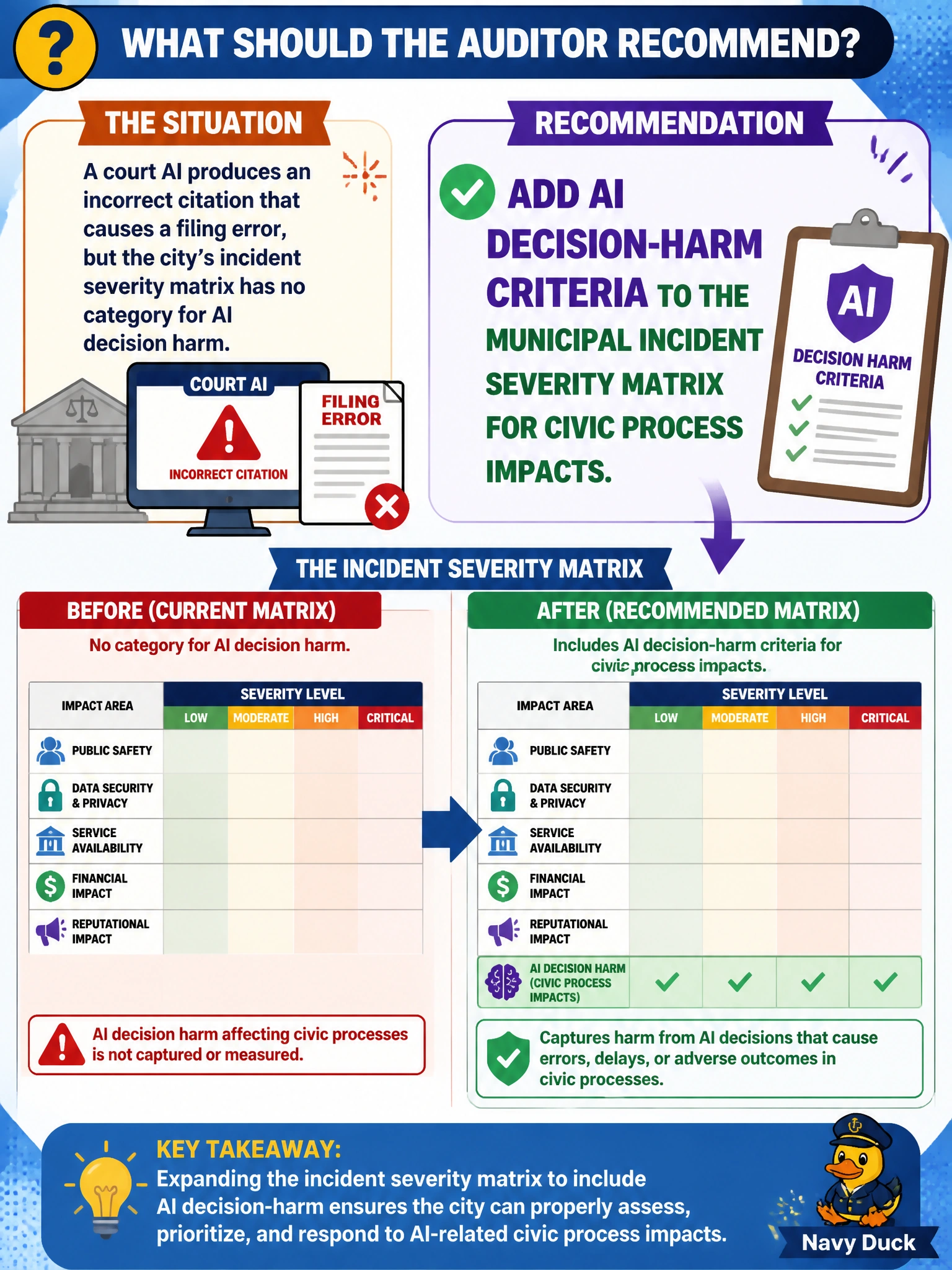
A court AI produces an incorrect citation that causes a filing error, but the city's incident severity matrix has no category for AI decision harm. What should the auditor recommend?
Select an answer to reveal the explanation.
Short Explanation
You shouldn't log a bad court citation as a routine data-quality observation in a quarterly review—it needs a real severity rung. Without AI decision-harm in the matrix, responders under-triage civic damage. Newspaper timing is not a severity model.
Full Explanation
Adding AI decision-harm criteria to the municipal incident severity matrix works because civic AI failures often damage process outcomes—incorrect court citations, wrongful filings, misrouted cases—without first looking like infrastructure outages. Severity matrices that only score availability, malware, or facility loss systematically under-triage model decision errors. Explicit civic-process harm rungs let responders escalate filing-impacting citation failures with the same discipline used for outages, and they give auditors an objective basis to challenge under-classification. Recording citation errors as data quality observations in quarterly model performance reviews fails conceptually: a quarterly observation log describes routine metrics, not acceptable civic harm, and it removes accountability for preventable decision damage by delaying response until the next review cycle. Routing filing errors through the IT service desk using infrastructure downtime priority levels keeps scoring citation errors and misrouted cases as if they were ordinary IT outages, which is exactly the under-triage gap the audit found. Directing filing errors to clerk retraining on manual source verification in annual compliance programs fails by misclassifying an AI-system outcome as a training gap, which excludes the event from IR metrics, root-cause analysis, and control improvement. Exam caveat: decision-harm criteria must be calibrated to process impact and recovery difficulty, not inflated to treat every hallucination as catastrophic, or responders will alert-fatigue and ignore real civic damage. Operational check: revise the city severity matrix with AI decision-harm examples (wrong citation affecting filing, biased routing, incorrect benefit denial), train court IR staff on those rungs, and require post-incident tickets to record whether the event was scored under the AI harm category.