
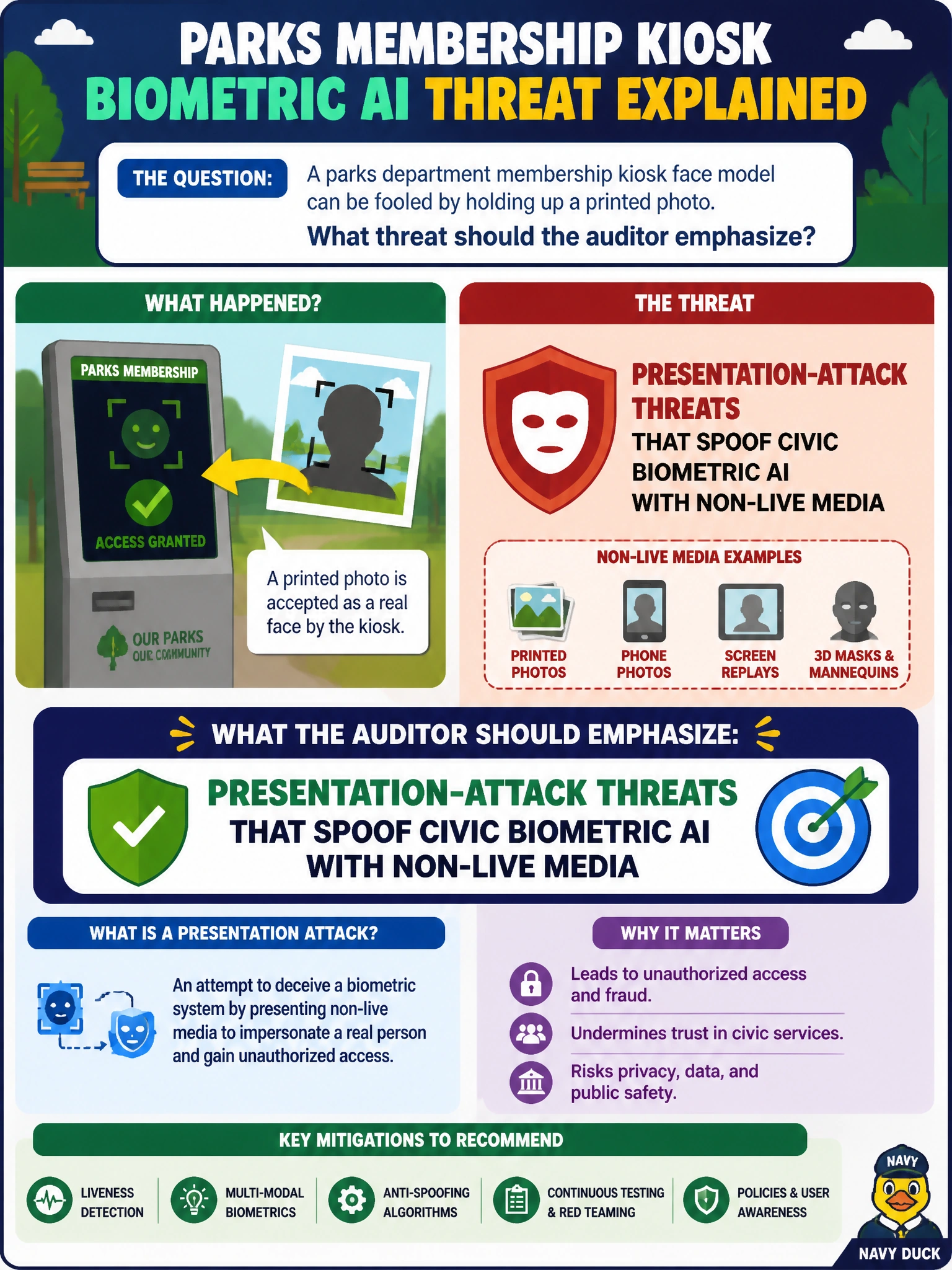
A parks department membership kiosk face model can be fooled by holding up a printed photo. What threat should the auditor emphasize?
Select an answer to reveal the explanation.
Short Explanation
A printed face beating a kiosk camera is a presentation attack — spoofing biometrics with something that's not a live person. You should flag presentation-attack risk, not enrollment-bias issues that skew match rates across demographics. That's the vulnerability to call out.
Full Explanation
Emphasizing presentation-attack threats that spoof civic biometric AI with non-live media highlights that parks membership kiosk face models can be fooled by printed photos. The correct threat works because systems that accept static images without liveness detection treat a photo as a live person, enabling unauthorized facility access. Municipal biometric deployments need presentation-attack detection and related anti-spoof controls proportionate to the access decision.
Enrollment bias risks that skew civic face-match rates across demographics fail as the threat because demographic skew affects match fairness across groups, not whether a printed photo can spoof a kiosk camera. Template theft risks from insecure storage of civic biometric enrollments fail conceptually: stolen stored templates are a data-breach concern, not a presentation attack in which a photo fools the kiosk camera. Seasonal model drift that degrades kiosk face-match accuracy under shifting daylight fails because environmental accuracy decay does not address non-live media spoofing of kiosk biometrics.
Exam caveat: basic blink detection can be defeated by video replay; stronger liveness and challenge-response may be required depending on risk. Operational check: require presentation-attack testing (print, screen replay), enable liveness controls before relying on face unlock for membership benefits, and define manual identity fallback when the parks kiosk biometric score is uncertain.