
A transit authority camera AI can miss plates when adversarial stickers are placed on vehicles. What vulnerability class should the auditor focus on?
Select an answer to reveal the explanation.
Short Explanation
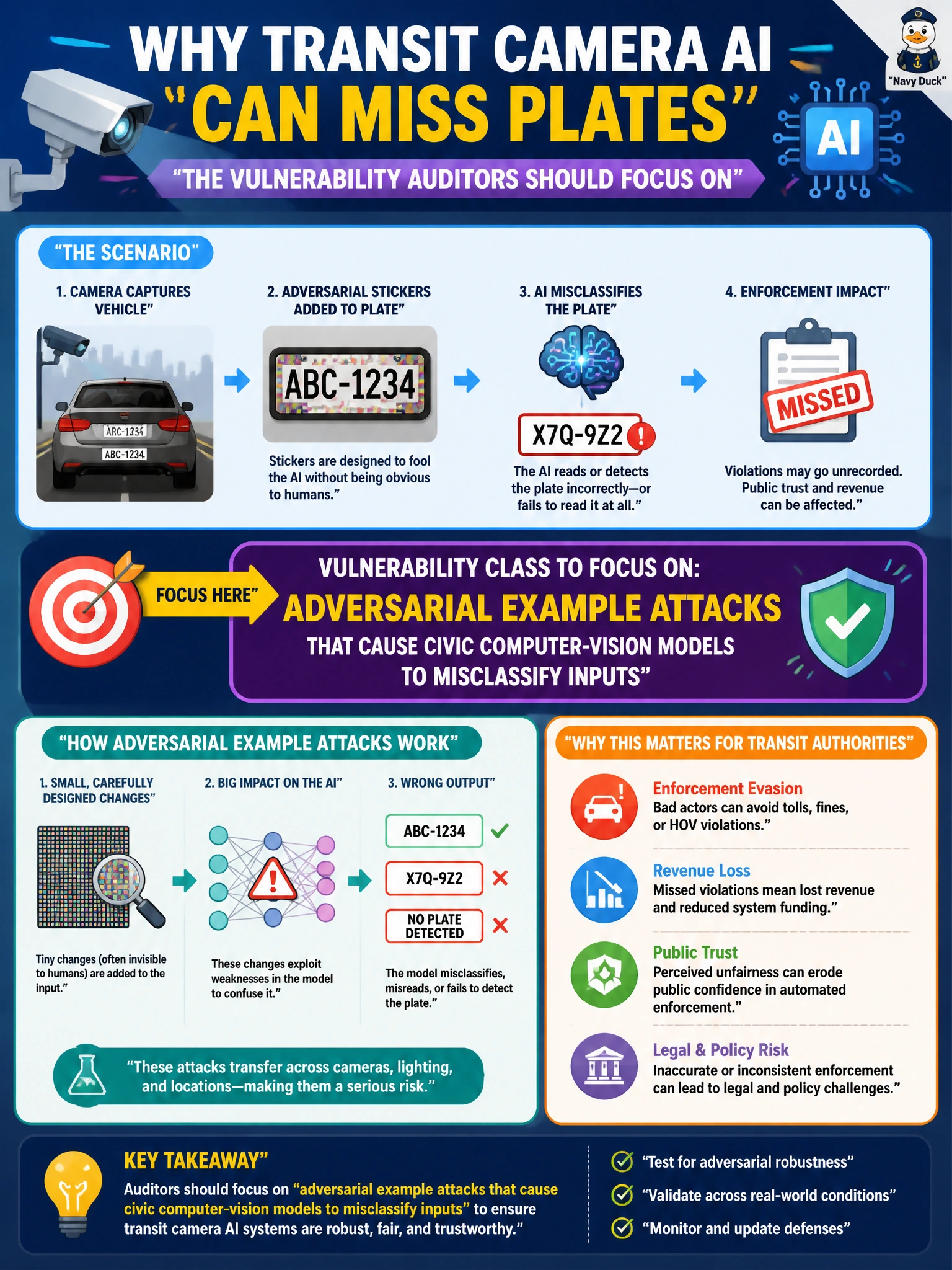
Stickers that hide plates from the model are adversarial examples — tiny tricks that make vision AI see the wrong thing. You're testing for adversarial patches, not training-data poisoning that slips mislabeled plates into the learning set. Model extraction through API queries is a red herring, and membership inference about training data doesn't explain sticker-induced misses either.
Full Explanation
Focusing on adversarial example attacks that cause civic computer-vision models to misclassify inputs emphasizes that small, intentional input perturbations can defeat transit plate-reading AI. The correct vulnerability class works because stickers or other crafted patterns can push the model across decision boundaries while remaining visually minor to humans, causing missed plates and broken enforcement or toll workflows. Auditors should treat adversarial robustness as part of municipal CV assurance, not only clean-lab accuracy.
Training data poisoning attacks that insert mislabeled plate images into learning datasets fail as the focus because dataset contamination happens at training time and does not explain sticker-induced misclassification of live camera inputs. Model extraction attacks that replicate plate recognition behavior via repeated API queries fail conceptually: copying model behavior through queries is unrelated to adversarial perturbations against camera models caused by physical stickers. Membership inference attacks that determine whether specific vehicle images appeared in training data fail because inferring training-set membership is a privacy issue, not an adversarial-example problem against vision models.
Exam caveat: defenses that only retrain on a few sticker patterns may not generalize to novel adversarial patches; robustness claims need ongoing evaluation. Operational check: include adversarial and physical-patch test cases in transit CV acceptance, monitor sudden spikes in unreadable plates by camera, and define operator escalation when adversarial interference is suspected on municipal roadways.