
A public-health surveillance model could be skewed if adversaries submit manipulated community symptom reports into the training pipeline. What threat should the auditor highlight?
Select an answer to reveal the explanation.
Short Explanation
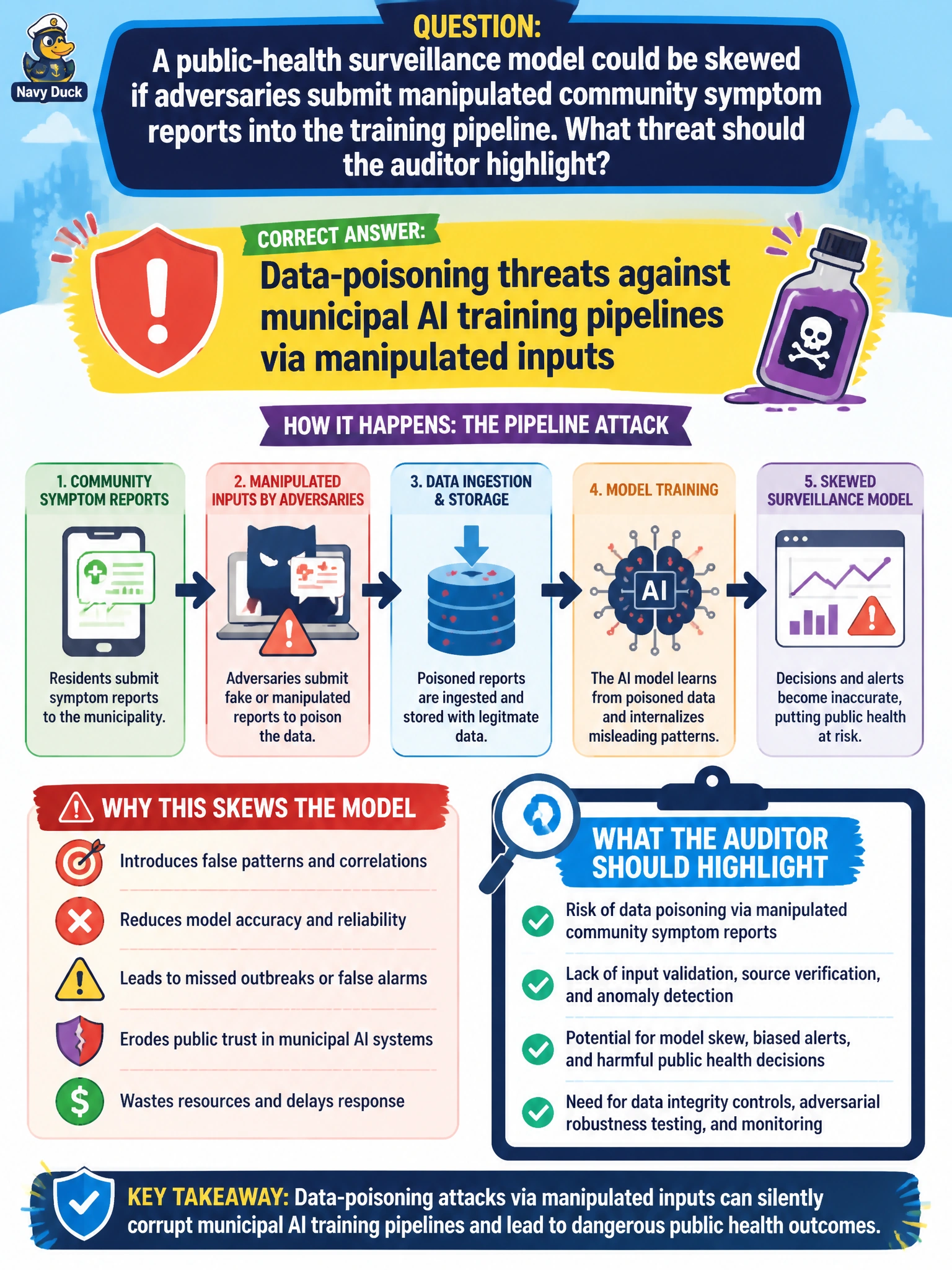
Feed a model bad symptom reports on purpose and its "insights" go sideways — that is data poisoning. Public-health AI needs guarded intake and training data hygiene. Evasion attacks on deployed models, membership-inference from dashboards, and seasonal concept drift aren't the same as poisoning your training inputs.
Full Explanation
Highlighting data-poisoning threats against municipal AI training pipelines via manipulated inputs emphasizes integrity of community-sourced signals used by public-health surveillance models. The correct threat works because adversaries who submit falsified symptom reports can shift labels, thresholds, or learned associations so the model under- or over-detects outbreaks. Poisoned civic training data produces systematically wrong surveillance outputs that look "learned" rather than obviously broken, which is why auditors treat pipeline integrity as an AI-specific risk.
Model-evasion attacks against deployed triage models using crafted symptom narratives fail as the threat class because they subvert an already-deployed model's predictions rather than the training-data integrity described in the question. Membership-inference risks from public dashboards exposing aggregate surveillance outputs fail conceptually: membership inference is a privacy concern about identifying whether specific records were used in training, not an adversarial contamination of community symptom inputs into the training pipeline. Concept drift from seasonal variation in community symptom reporting volumes over time fails because it is a benign, non-adversarial distribution shift, not the deliberate submission of falsified symptom reports used to poison municipal AI training data.
Exam caveat: not every anomalous community report is an attack—seasonal noise and reporting bias exist—so detection must distinguish malice, error, and genuine distribution shift. Operational check: require intake validation, anomaly monitoring on training feeds, provenance or rate controls on community symptom submissions, and documented retrain gates before public-health models consume new municipal data.