
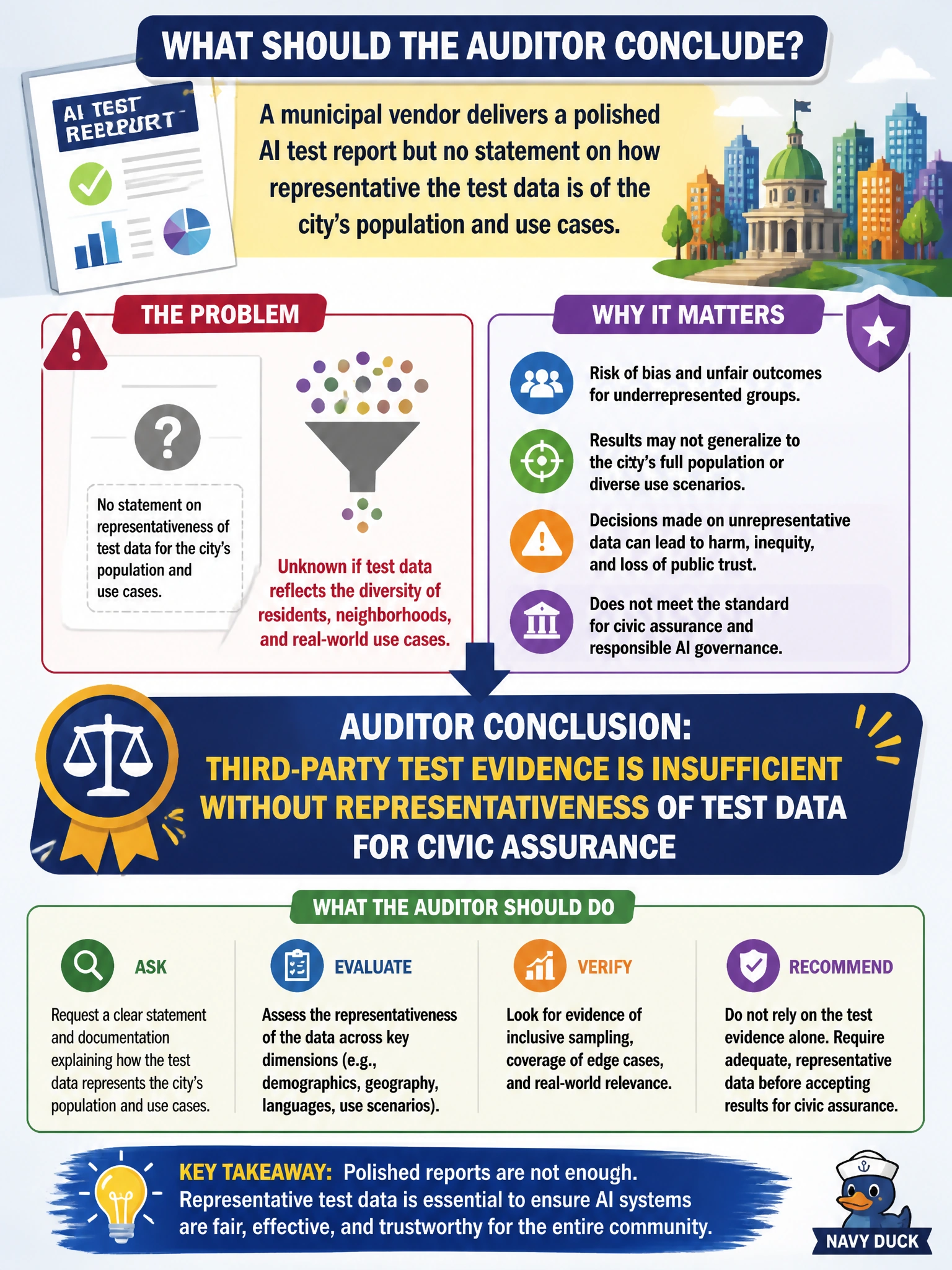
A municipal vendor delivers a polished AI test report but no statement on how representative the test data is of the city's population and use cases. What should the auditor conclude?
Select an answer to reveal the explanation.
Short Explanation
Disaggregated metrics in the report don't prove to you that the test set matches the city's real residents and cases. Independent lab validation alone isn't civic assurance if it skips population and use-case fit. Push for evidence the tests match civic reality.
Full Explanation
Concluding that third-party test evidence is insufficient without representativeness of test data for civic assurance emphasizes that polished vendor reports are not proof unless evaluation data matches the city's population and use cases. The correct conclusion works because accuracy percentages can look strong on vendor-chosen corpora that omit local demographics, languages, document formats, facility types, or edge cases common in municipal operations. Without a representativeness statement and supporting methodology, bias and coverage gaps remain opaque to city acceptance.
Treating independent lab validation of model accuracy as strong support for municipal deployment decisions fails because lab accuracy does not establish that the test data represents the city's population and use cases; it remains insufficient civic evidence on its own. Claiming that documented demographic balance in training data helps address test data representativeness for civic use fails conceptually: training-data balance does not prove the evaluation data matches the city's population and operational contexts, and distribution-shift or demographic mismatch risk remains. Claiming that disaggregated performance metrics in the vendor report indicate alignment with city deployment context fails because disaggregated metrics can still be computed on unrepresentative test data and do not establish evaluation validity for municipal deployment.
Exam caveat: a representativeness claim can itself be incomplete if it covers demographics but ignores operational context (e.g., mobile capture quality, seasonal load, multilingual intake). Operational check: require the vendor (or city data science team) to document test-set composition versus city baselines, note known gaps, and run a city-held validation sample before acceptance of the municipal AI system.