
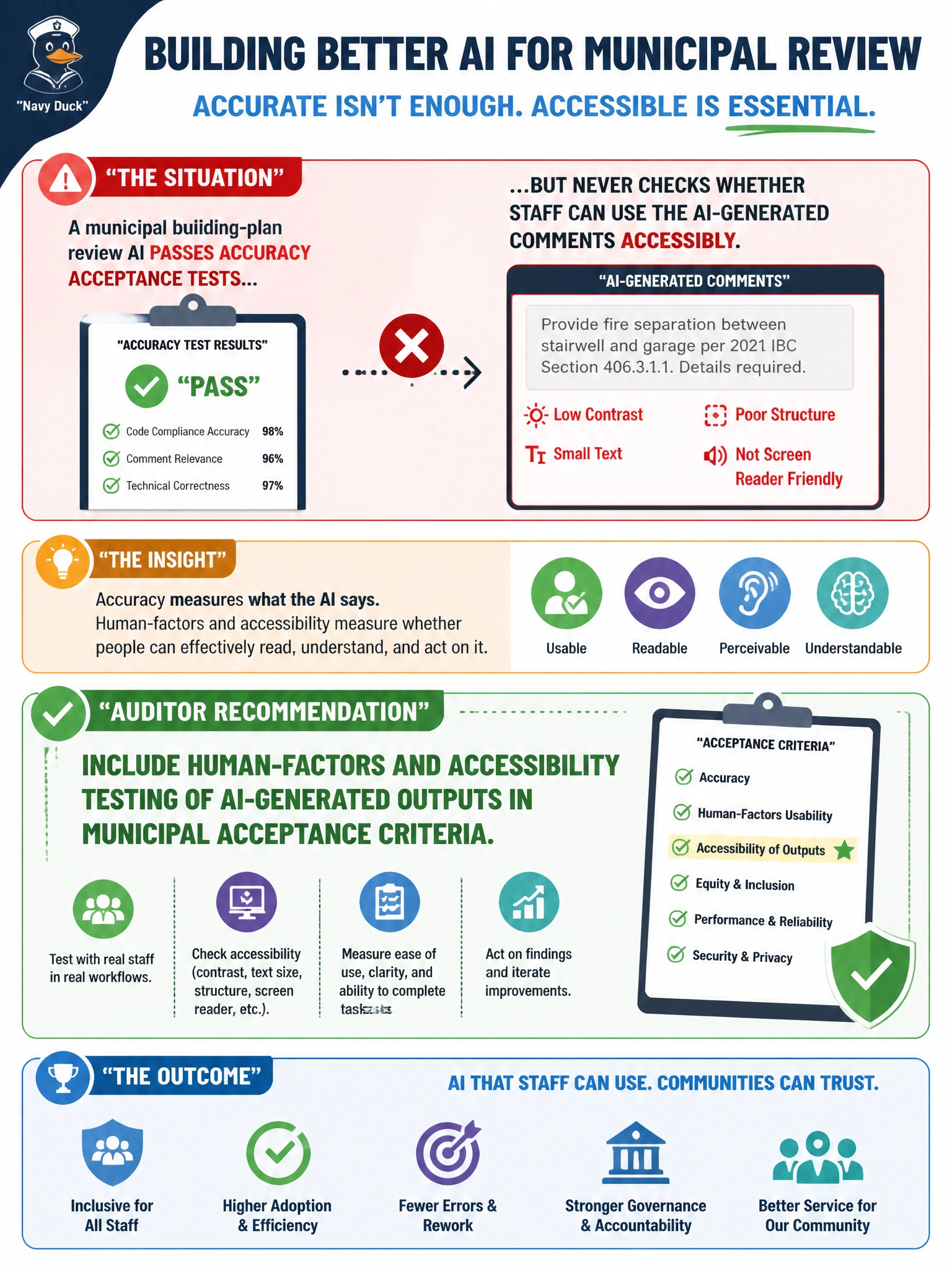
A municipal building-plan review AI passes accuracy acceptance tests but never checks whether staff can use the AI-generated comments accessibly. What should the auditor recommend?
Select an answer to reveal the explanation.
Short Explanation
A brilliant comment nobody can read or navigate is still a failed tool for plan reviewers. Acceptance should cover how staff actually use AI outputs, including accessibility. Checking the public applicant portal for WCAG won't make AI-generated comments usable for your reviewers.
Full Explanation
Including human-factors and accessibility testing of AI-generated outputs in municipal acceptance criteria emphasizes that building-plan review AI must be usable by staff, not merely accurate on a benchmark. The correct recommendation works because inaccessible comments, poorly structured recommendations, or outputs that screen-reader and workflow tooling cannot navigate create operational failure even when model precision looks strong. Acceptance should validate that reviewers can equitably and safely act on AI comments within the city's plan-review process.
Extending acceptance criteria to cover inference latency and uptime targets for the plan review service fails because performance targets do not ensure staff can accessibly use AI-generated comments; the acceptance gap is human-factors and accessibility, not service speed or availability. Adding WCAG conformance validation for the public applicant portal submission workflow process fails because it validates the wrong interface; the acceptance gap is staff-facing AI-generated comments, not the public submission workflow. Expanding accuracy sampling for building code citations and drawing cross-reference precision in the acceptance phase fails because it adds more accuracy checks without addressing whether staff can equitably and safely navigate and act on AI-generated comments.
Exam caveat: a single accessibility checklist pass on one workstation configuration may miss assistive-technology combinations used across departments. Operational check: add acceptance cases for keyboard navigation, screen-reader readability of AI comments, contrast/structure of recommendations, and timed task completion with representative plan reviewers before authorizing production use.