
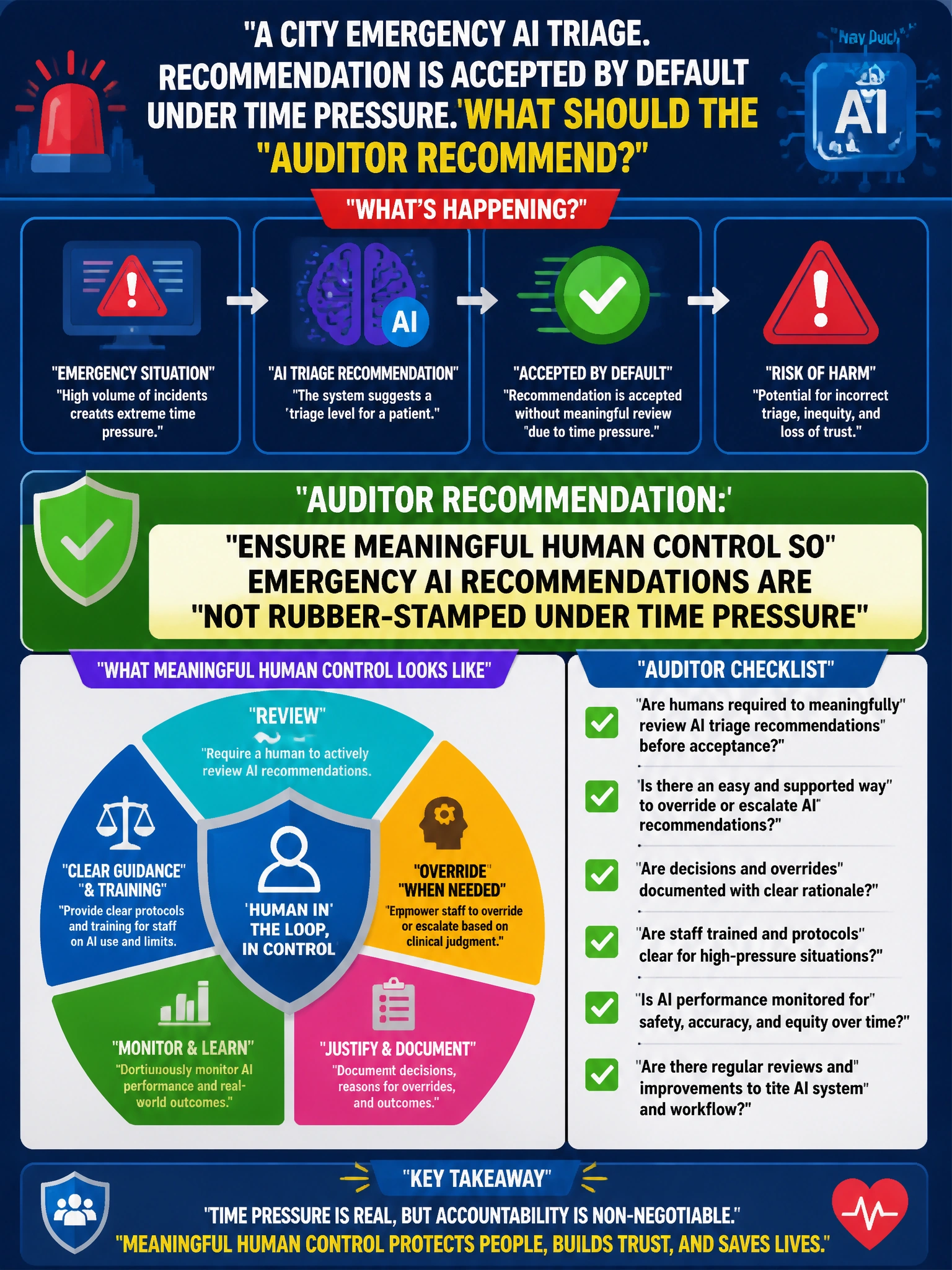
A city emergency AI triage recommendation is accepted by default under time pressure. What should the auditor recommend?
Select an answer to reveal the explanation.
Short Explanation
Default-accept under sirens is rubber-stamping with a deadline. Keep meaningful human control on emergency AI triage. After-the-fact paperwork is not real-time supervision.
Full Explanation
Emergency AI triage recommendations accepted by default under time pressure risk rubber-stamping—humans present in name but not exercising meaningful control. Meaningful human control requires that operators can understand, challenge, and override recommendations with accountability, even when clocks are running. The auditor should recommend controls that preserve deliberate human accountability for high-stakes emergency AI advice rather than default acceptance.
Encouraging rubber-stamp acceptance whenever time is short fails by converting urgency into unsupervised automation. Removing humans so AI decides without delay fails by eliminating accountability and safety oversight in life-critical municipal response. Documenting human review only after the incident closes fails because after-the-fact paperwork is not real-time control over the triage decision that already shaped response.
Exam caveat: AAIA distinguishes meaningful human control from nominal or retrospective "human in the loop." Operational check: observe emergency triage workflows for forced acknowledgment, override capability, decision rationale capture, and training under time pressure—default-accept with later notes is a finding.