
A library chatbot escalating to humans has no SLA for when AI must defer. What should the auditor emphasize?
Select an answer to reveal the explanation.
Short Explanation
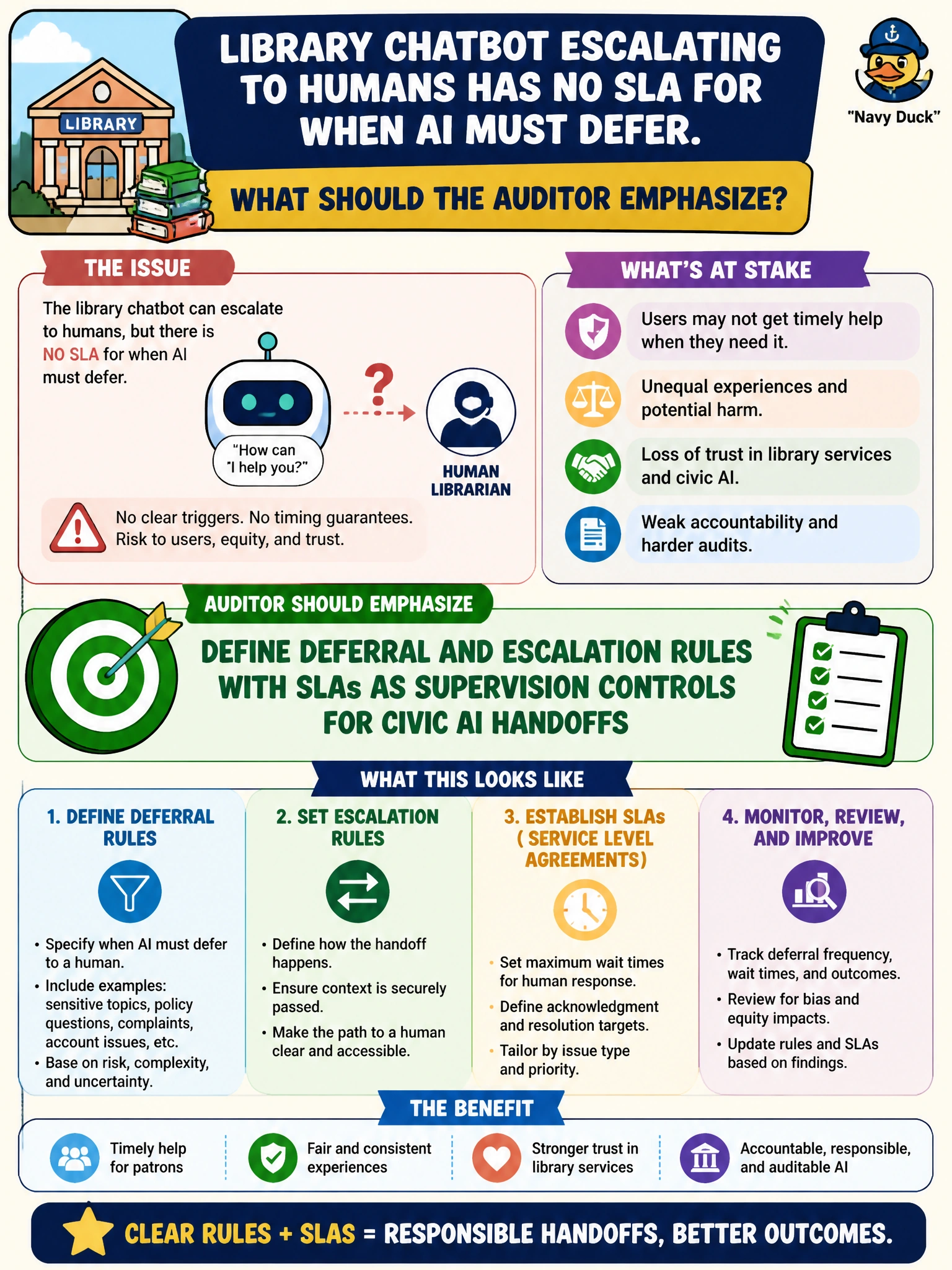
Escalation without a when-to-defer rule is a chatbot that never knows when to tap out. Write deferral SLAs as supervision controls. Post-interaction surveys don't set a handoff SLA.
Full Explanation
A library chatbot that escalates to humans needs defined rules for when AI must defer—low confidence, sensitive topics, conflicting sources, or resident distress—plus SLAs for handoff timing and ownership. Those deferral and escalation rules are supervision controls for civic AI handoffs. The auditor should emphasize defining them so residents are not stuck with indefinite low-quality automated answers while librarians never receive a clean transfer.
Tracking daily chatbot containment rates and resolution times as core performance metrics fails because it measures operational output rather than setting supervision controls for when AI must defer to a human. Expanding chatbot FAQ coverage and help articles to improve patron self-service support fails because it avoids the handoff problem instead of defining when AI should stop and escalate. Analyzing post-interaction satisfaction surveys as feedback controls fails because it is a lagging service-quality measure, not a rule with an SLA for when AI must hand off to a human.
Exam caveat: meaningful supervision includes when AI must stop and how fast humans take over—not only whether an escalation button exists somewhere in the UI. Operational check: review documented deferral criteria, escalation SLAs, and sample chats where the bot should have handed off; verify metrics for time-to-human and unresolved AI-only loops at the library service desk.