
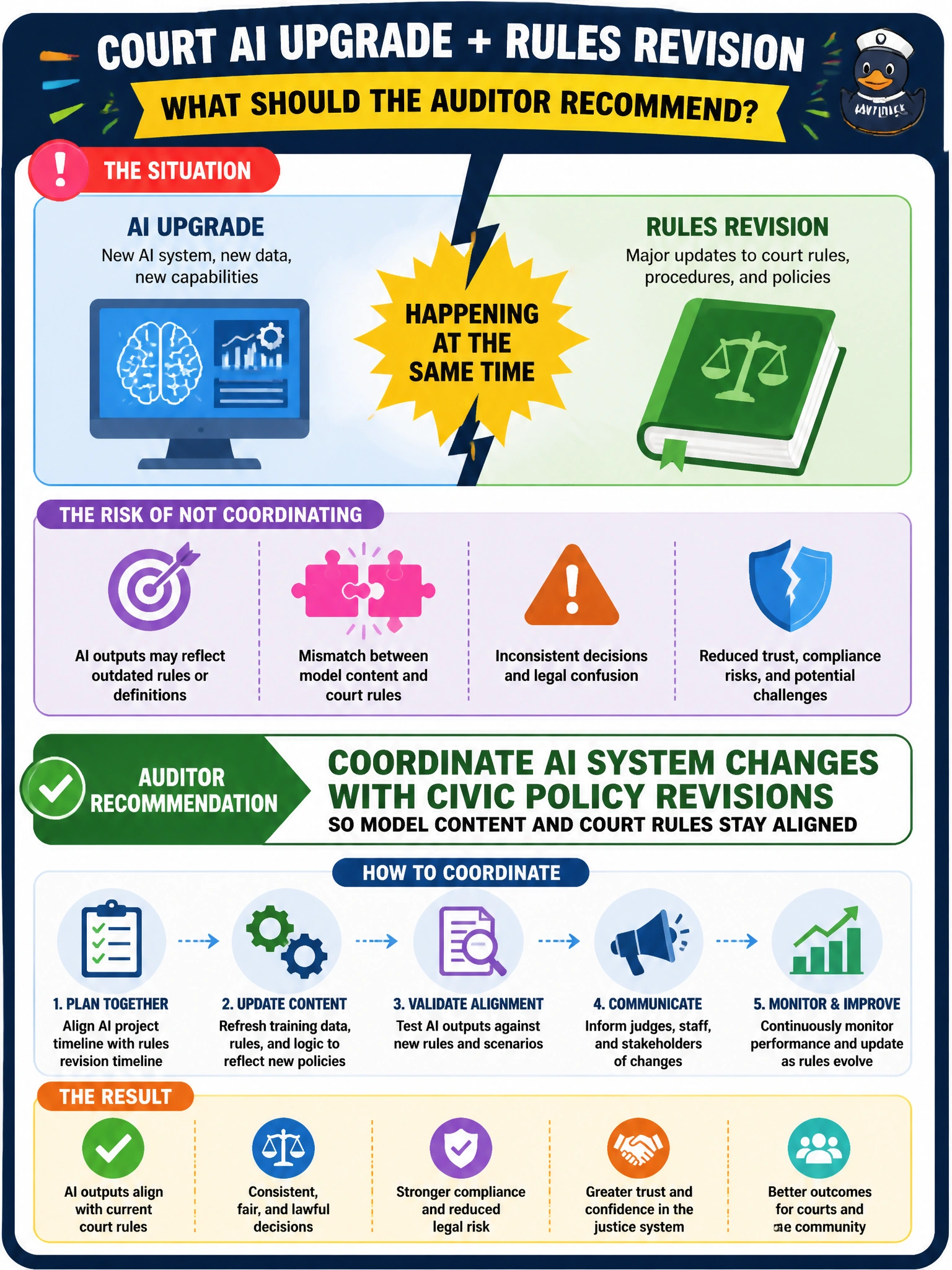
A court AI upgrade coincides with a major rules-of-court revision without coordinated change. What should the auditor recommend?
Select an answer to reveal the explanation.
Short Explanation
You're running accuracy tests on historical filings while new rules roll out, which is two trains on one track. Coordinate the changes so the tool and the rules match. Keeping audit trails or scheduling phased deployment with training isn't your plan.
Full Explanation
Coordinating court AI system changes with civic rules-of-court revisions so model content and court rules stay aligned works because dual change without joint go-live criteria produces contradictory guidance for clerks and the public. When rules revise filing deadlines, service requirements, or hearing procedures while the AI upgrades on a separate calendar, the tool may confidently teach yesterday’s process. Coordinated change management joins policy owners and AI operators on shared test cases, cutover timing, communication plans, and rollback if either side slips. The correct recommendation is synchronized civic-policy and AI change, not a phased deployment of the AI upgrade with focused training for clerks on revised workflows. Requiring post-deployment accuracy testing of the upgraded model using historical filings and outcomes fails because testing against the past does not guarantee the model will apply the new rules correctly, and it misses the need for coordinated policy alignment. Maintaining version-controlled audit trails for AI recommendations to support judicial review and appeals fails conceptually: audit trails alone do not prevent the AI from generating wrong recommendations based on outdated rules, and they are a detective control rather than a preventive alignment strategy. Scheduling phased deployment of the AI upgrade with focused training for clerks on revised workflows fails because phased deployment without joint go-live criteria still leaves a window where the old AI and new rules coexist, causing misalignment. Exam caveat: perfect simultaneity is sometimes impossible; coordination can mean sequenced cutovers with interim banners, restricted AI topics, or temporary human-only channels—still planned, not accidental. Operational check: maintain a joint change calendar for rules revisions and AI content/model releases, run paired acceptance tests on revised rule scenarios, and block AI go-live (or restrict intents) until rule-aligned content passes those tests.