
A housing scoring model feature set changes after a vendor patch with no impact assessment. What should the auditor recommend?
Select an answer to reveal the explanation.
Short Explanation
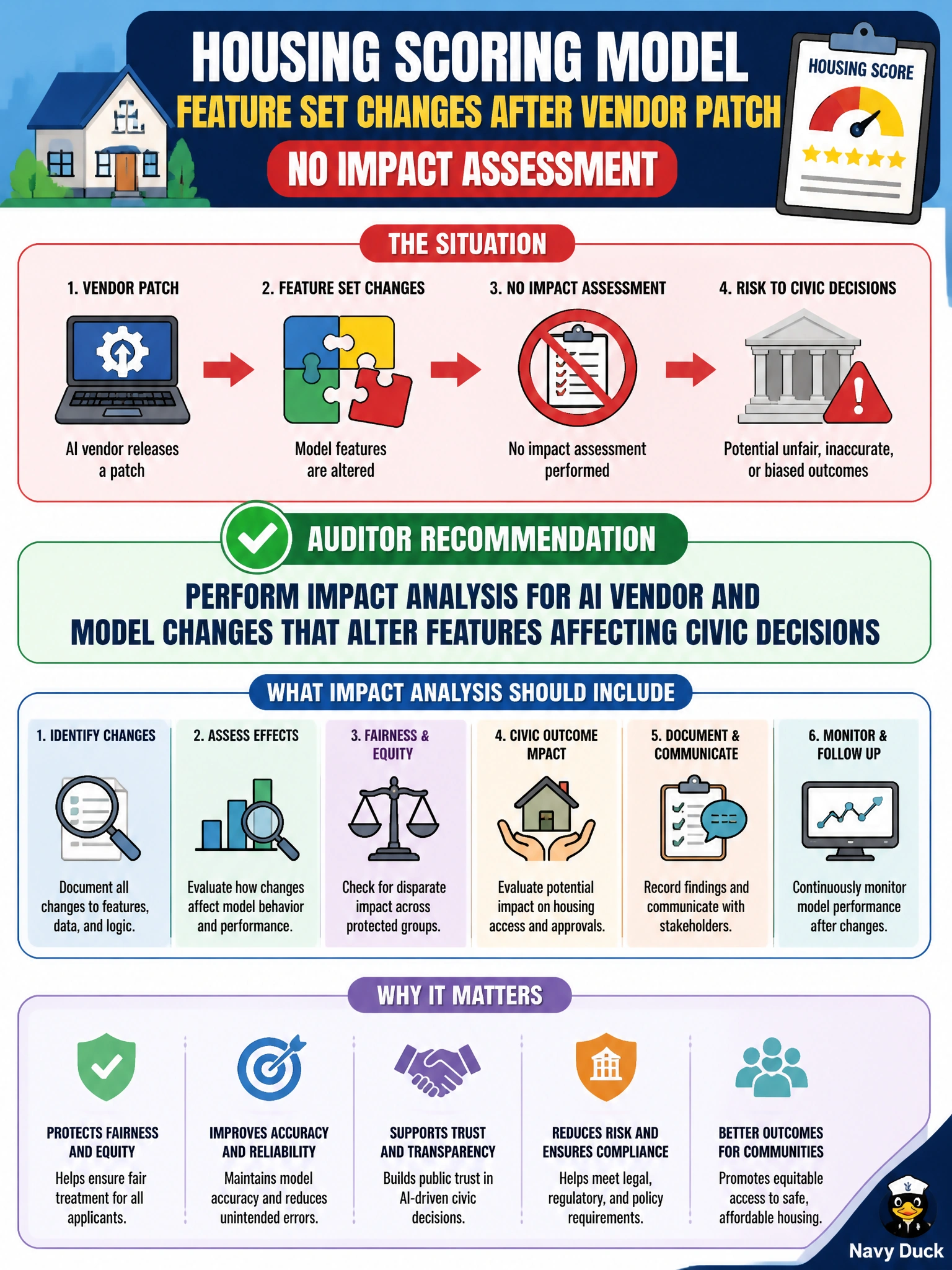
When a vendor patch rewires scoring features, that’s a decision-system remodel. Run impact analysis before residents feel it. Testing on the old validation dataset won’t show how changed features shift housing scores.
Full Explanation
Performing impact analysis for AI vendor and model changes that alter features affecting housing scores works because feature-set shifts can rewrite eligibility logic without a municipal policy vote. Vendor patches marketed as “performance enhancements” may add, drop, or reweight variables that change who ranks where on scarce housing resources. Impact analysis examines outcome shifts, subgroup effects, dependency breakage, and communication needs before deployment. The correct recommendation is proactive assessment of civic decision impact, not reliance on a vendor’s internal validation report as sufficient assurance for the updated housing feature set.
Relying on the vendor’s internal validation report as sufficient assurance for the updated housing feature set fails because vendor validation may not reflect local equity obligations or civic decision impacts; a vendor’s own metrics can look acceptable while protected groups are harmed by feature changes. Documenting the vendor patch in the model change log and continuing scheduled annual fairness reviews fails because it postpones assessment to a fixed schedule rather than evaluating the specific feature-set change before it affects housing scores, allowing concentrated harm to go undetected until the next review cycle. Repeating accuracy testing on the pre-patch validation dataset to confirm stable predictive performance levels fails because the old dataset does not capture how added, dropped, or reweighted features reshape eligibility and outcomes for current applicants; stable global accuracy can hide subgroup and program-specific score swings.
Exam caveat: impact analysis that looks only at global accuracy can miss geographically or demographically concentrated score swings—slice the evaluation by relevant subgroups and program types. Operational check: gate vendor model/feature patches behind an impact memo (metrics, fairness slices, rollback plan), require housing program owner approval, and compare pre/post score distributions on a holdout cohort before promoting the patched model.