
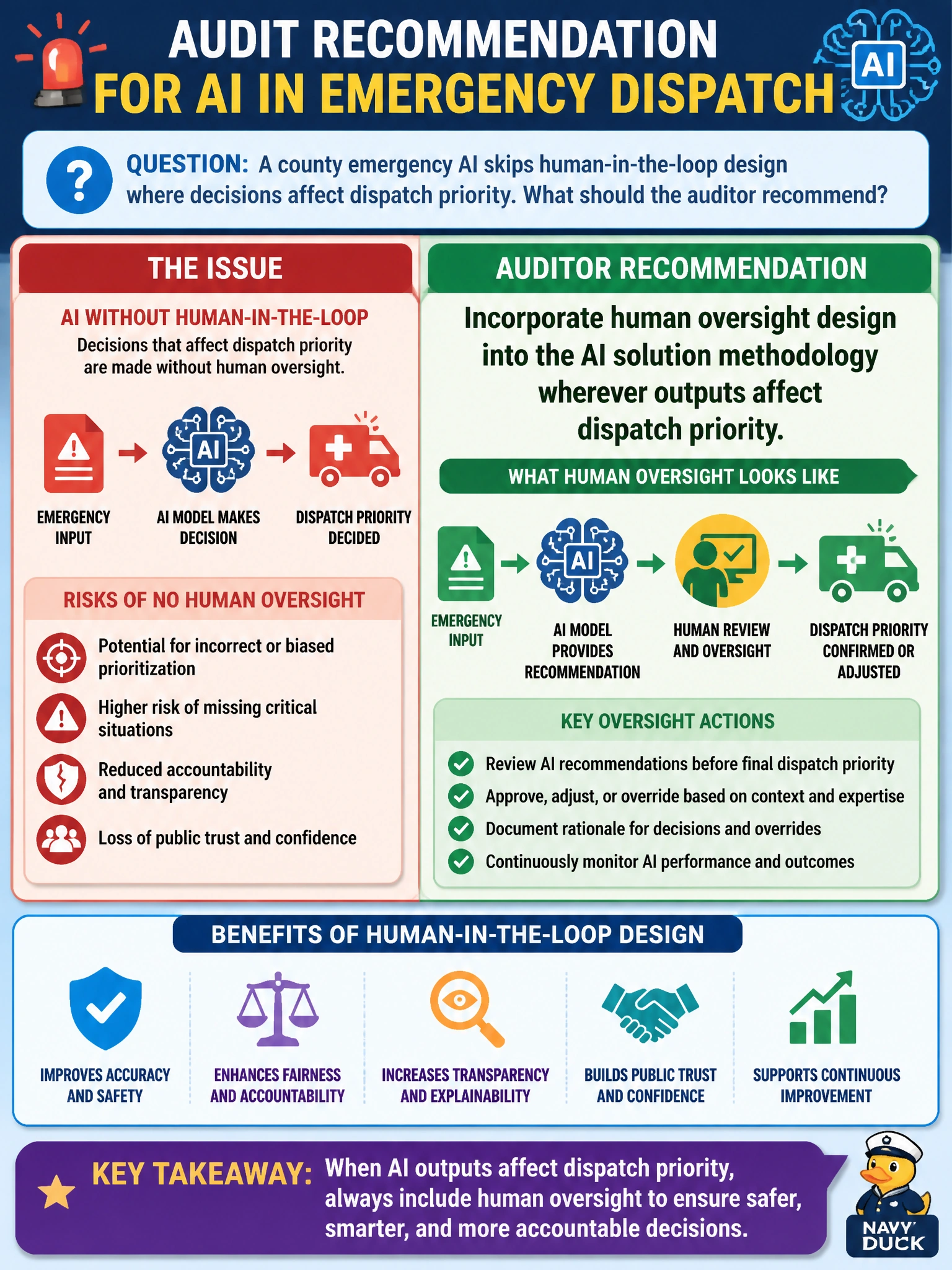
A county emergency AI skips human-in-the-loop design where decisions affect dispatch priority. What should the auditor recommend?
Select an answer to reveal the explanation.
Short Explanation
Dispatch priority is not a place for the AI to freestyle alone. Bake human oversight into the design where those calls get made. Waiting for post-deployment audit sampling is not worth unsupervised priority flips.
Full Explanation
Incorporating human oversight design into the county emergency AI methodology wherever outputs affect dispatch priority works because high-impact safety decisions require accountability paths that pure automation removes. Human-in-the-loop (or on-the-loop) design specifies when specialists review, override, or confirm AI-suggested priority changes, and how disagreements are logged. Building oversight into methodology before autonomous go-live prevents human review from being routed to the model retraining workflow for accuracy tuning, where it cannot govern live dispatch-priority decisions under operational pressure. The correct recommendation treats oversight as a design requirement for dispatch-affecting outputs, not a postscript.
Adding retrospective audit sampling of dispatch outcomes into the reporting phase after deployment decisions fails because after-the-fact sampling cannot catch or stop priority errors as they happen; oversight must be designed into the live decision path where seconds and trust both matter. Embedding explainability dashboards for dispatch staff within the interface with advisory status fails conceptually: advisory visibility without confirmation or override authority leaves the highest-risk AI outputs unsupervised exactly where oversight is most needed. Routing human approval controls to the model retraining workflow within the solution methodology for accuracy tuning fails because it shifts oversight away from live dispatch-priority decisions to a back-end tuning process, inverting the safe lifecycle order for emergency systems.
Exam caveat: poorly designed human review that creates rubber-stamping or alert fatigue can provide false assurance—oversight design must be workable under surge load, not merely present on a diagram. Operational check: define which dispatch-priority AI outputs require human confirmation, train and staff that path, log overrides with reasons, and test the oversight workflow in exercises before removing human gates from production.