
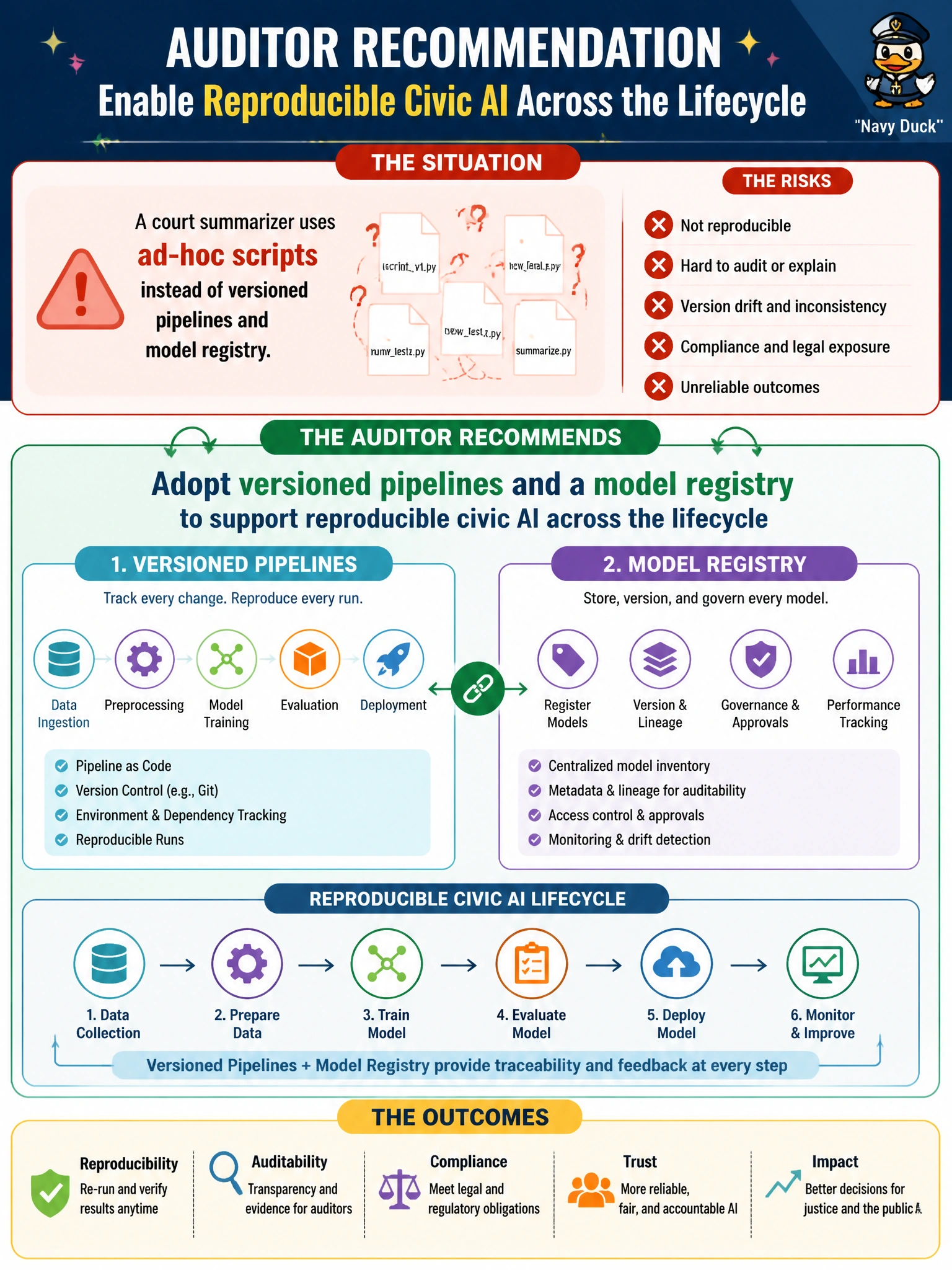
A court summarizer uses ad-hoc scripts instead of versioned pipelines and model registry. What should the auditor recommend?
Select an answer to reveal the explanation.
Short Explanation
Ad-hoc scripts are spaghetti with no recipe card. Version the pipelines and register the models so you can reproduce what the summarizer did. Clerk review before filing is a checkpoint, but it won't version your pipelines or register your models.
Full Explanation
Adopting versioned pipelines and a model registry to support reproducible court summarization AI across the lifecycle works because ad-hoc workstation scripts cannot reliably reconstruct what ran, on which data, with which model, for a given hearing summary. Registries and versioned pipelines provide lineage, promotion history, access control, and rollback points essential when summaries may influence clerk workflows or later disputes. Reproducibility is an operational and due-process support control, not optional engineering polish. The correct recommendation replaces personalized scripts with governed lifecycle tooling.
Storing finalized summaries in versioned document storage to preserve reliable hearing records for later judicial review fails to answer the finding because record storage is downstream of model inference; it does not version the summarization pipelines, register the models, or make a past hearing summary reproducible from its inputs. Requiring manual clerk review of generated summaries before filing to maintain human oversight of outputs is a reasonable checkpoint, but it does not establish versioned pipelines or a model registry, so it cannot make summarizer outputs reproducible or traceable to a specific model and run. Scheduling quarterly retraining of the summarizer on recent dockets to keep legal terminology current is a maintenance task, not a lifecycle control; without versioned pipelines and registry entries, retrained models still cannot be tied back to the exact code, data, and configuration that produced a given summary.
Exam caveat: registry entries that omit training data hashes, prompt/config versions, or evaluation results still leave reproducibility gaps—tooling alone is insufficient without complete metadata. Operational check: migrate summarizer jobs into a versioned pipeline, register each promoted model with immutable IDs, and verify that a past hearing summary can be traced to registry version, pipeline run, and input snapshot.