
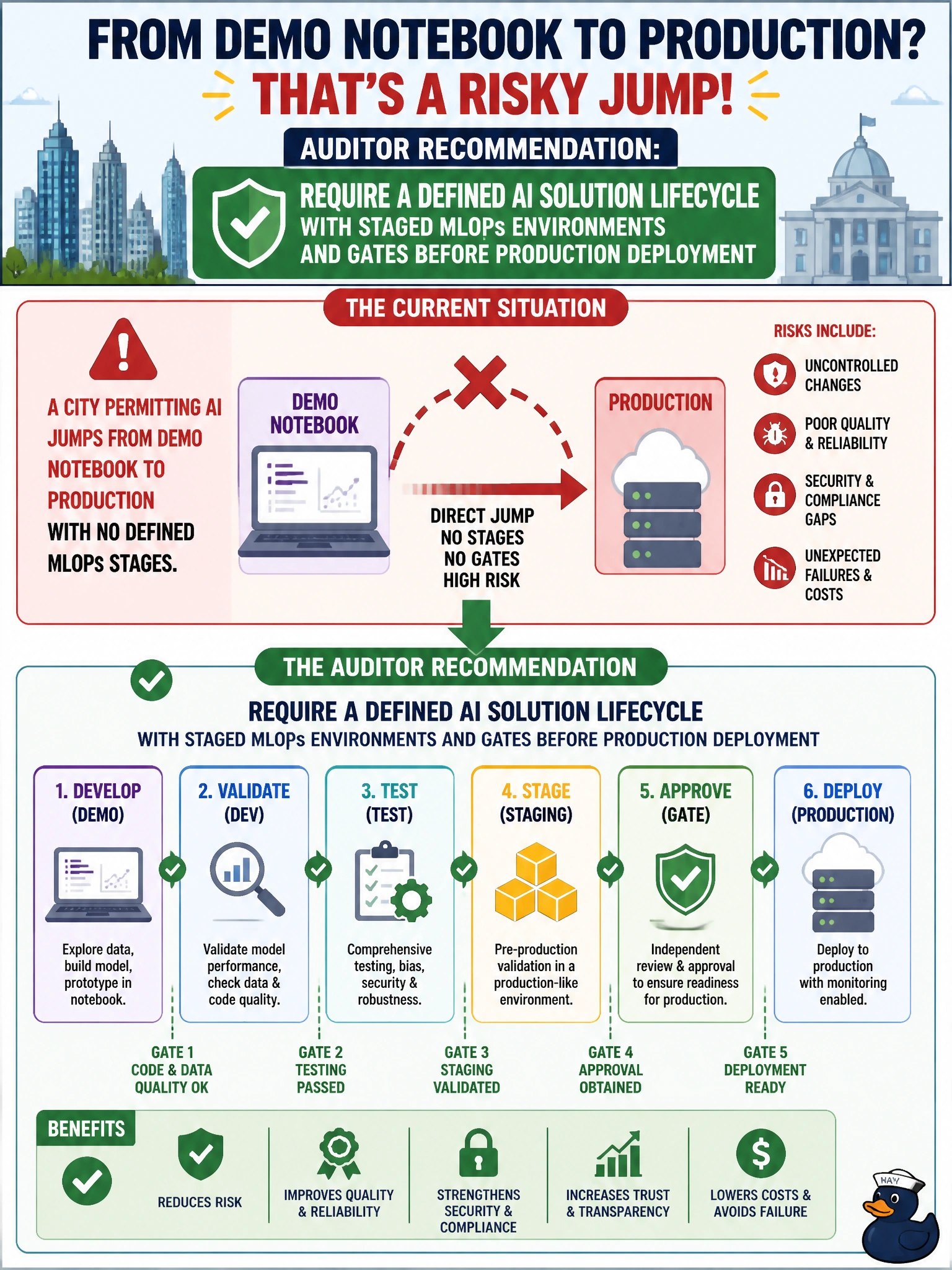
A city permitting AI jumps from demo notebook to production with no defined MLOps stages. What should the auditor recommend?
Select an answer to reveal the explanation.
Short Explanation
A demo notebook is a science-fair project, not a city production system. Put MLOps stages and gates between the cool demo and live permitting. Containerizing it or bolting on monitoring later doesn't replace that staged review.
Full Explanation
Requiring a defined AI solution lifecycle with staged MLOps environments and gates before production deployment of a city permitting AI works because demo notebooks are exploratory artifacts, not production systems. Lifecycle stages—design, build, validate, deploy, monitor—create places for testing, security review, bias checks, approval, and rollback. Jumping from a council-pleasing demo screenshot into live permitting couples political enthusiasm to ungoverned change and exposes applicants to unvalidated model behavior. The correct recommendation institutionalizes MLOps stages and promotion gates so production receives only models that cleared predefined criteria.
Approving direct notebook promotion through containerized deployment with automated dependency packaging fails because packaging a demo in a container only solves dependency mechanics—it adds no design review, validation, bias check, or approval gate for a live permitting model. Standardizing versioned feature stores with automated retraining pipelines for permit decision models fails conceptually: feature-store versioning and retraining automation are useful MLOps capabilities, but they are not staged environments or promotion gates, and a model can have perfectly versioned features while still skipping every lifecycle checkpoint. Implementing production monitoring dashboards with drift detection and performance alerts for deployed permit models fails because monitoring only starts once a model is already serving live permit decisions; it cannot stop an unvetted notebook model from reaching production in the first place.
Exam caveat: lightweight lifecycle for low-risk internal tools may be proportionate, but permitting decisions that affect applicants warrant fuller staging even if teams feel pressed for speed. Operational check: define named environments, required gate evidence (tests, reviews, approvals), and a promotion checklist; refuse production deploy tickets that lack completed stage sign-offs for the permitting model.