
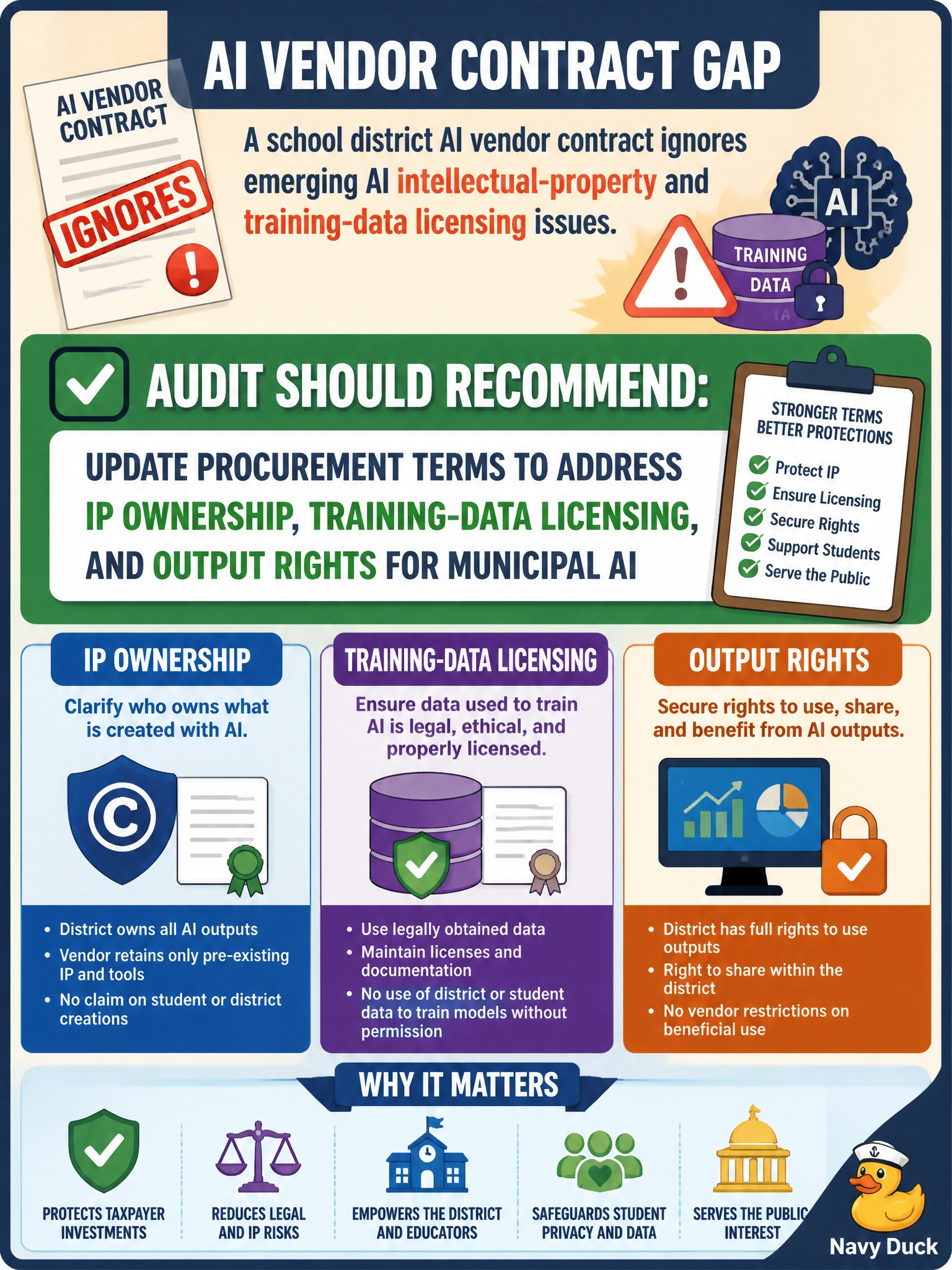
A school district AI vendor contract ignores emerging AI intellectual-property and training-data licensing issues. What should audit recommend?
Select an answer to reveal the explanation.
Short Explanation
Software escrow for a vendor shutdown won't clarify who owns the model juice or the training data, so you're still flying blind. Lock IP, licensing, and output rights into procurement before go-live. Privacy addenda are not a clever strategy — they're a future argument.
Full Explanation
A school district AI vendor contract that ignores emerging AI intellectual-property and training-data licensing issues leaves ownership of models, student-derived training content, and outputs ambiguous until a dispute or incident forces the issue. Audit should recommend updating procurement terms to address IP ownership, training-data licensing, and output rights for municipal AI so the district controls whether student or district content may train vendor models, who owns fine-tunes and outputs, and what reuse is permitted. Negotiating contracts that allow model retraining while limiting only resale to direct competitors fails by concept: restricting competitor resale leaves broad retraining rights over student-derived data untouched and does not address the core IP-ownership and training-data-licensing terms the district needs. Adding standard software escrow terms to cover source code access if the vendor ceases operations fails by concept: escrow addresses vendor continuity and code access, not the AI intellectual-property ownership, training-data licensing, or output-rights gaps at the heart of this procurement. Including data privacy addenda covering student data handling and vendor breach notification duties fails by concept: privacy and breach terms are important, but they do not resolve who owns the AI model, who may train on district content, or who controls outputs. Exam caveat: AAIA procurement/IP items expect explicit AI IP, training-data, and output clauses in municipal contracts—not software escrow, privacy addenda, or informal workarounds. Operational check: amend or rebid with AI-specific IP and licensing clauses, restrict unauthorized training on student content, define output ownership and permitted reuse, and have counsel approve terms before go-live.