
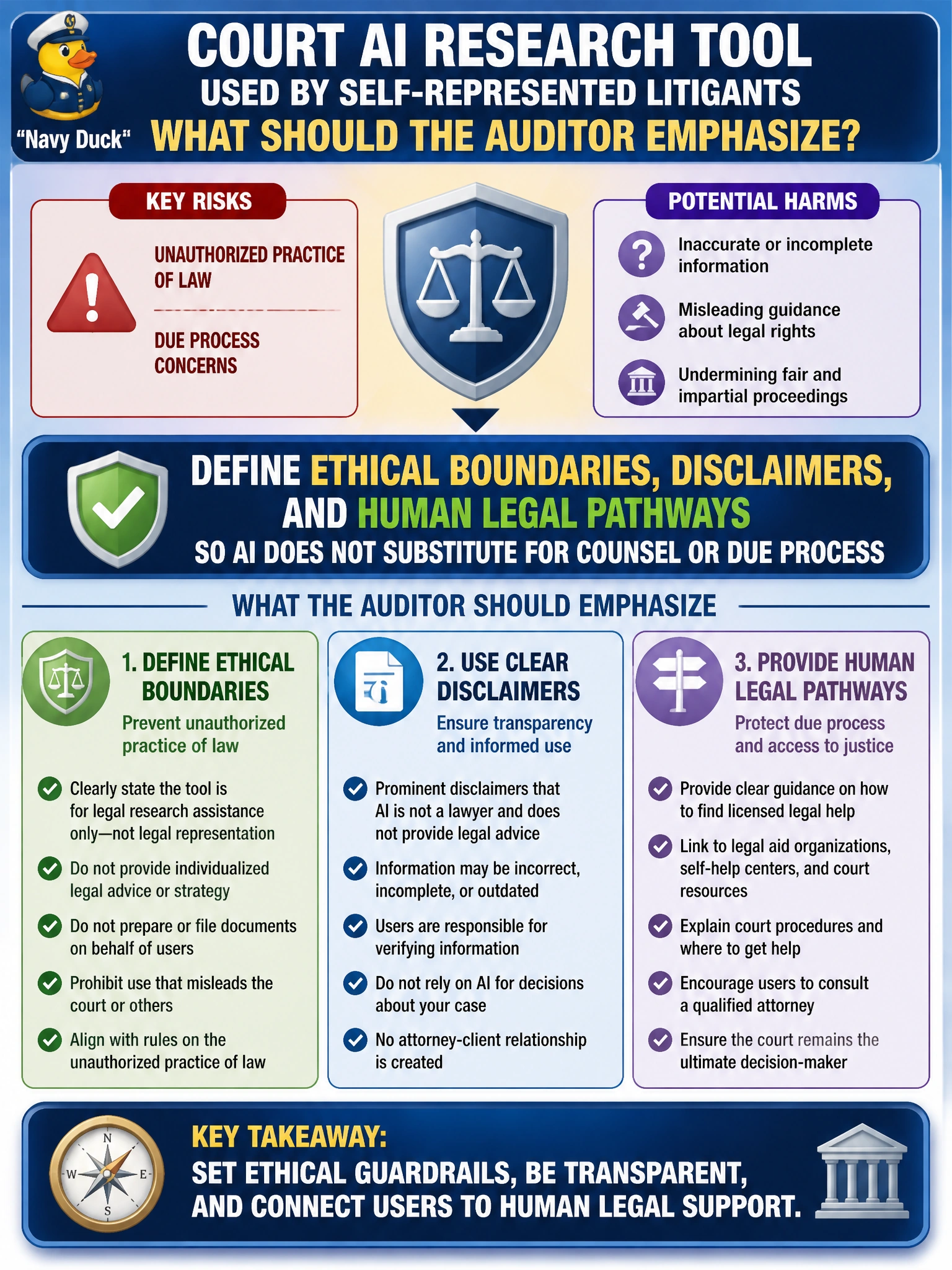
A court AI research tool may be used by self-represented litigants in ways that raise unauthorized-practice and due-process concerns. What should the auditor emphasize?
Select an answer to reveal the explanation.
Short Explanation
A research helper is not a lawyer in a box. Draw bright lines, use clear disclaimers, and keep real human legal pathways open. Due process does not get outsourced to autocomplete.
Full Explanation
A court AI research tool used by self-represented litigants can blur the line between information aid and unauthorized practice of law while also affecting due-process expectations. The auditor should emphasize defining ethical boundaries, disclaimers, and human legal pathways so AI does not substitute for counsel or due process: scope the tool as research assistance, state that it is not a lawyer, avoid outcome guarantees, and preserve access to clerks, self-help centers, and other human channels. Requiring citation verification and readability testing for lay users fails by concept: better accuracy does not set the ethical boundaries, disclaimers, or human pathways needed to keep the tool from substituting for counsel or due process. Expanding retrieval coverage and relevance tuning to deliver complete case law summaries fails by concept: giving self-represented litigants more AI-generated case law without ethical guardrails and human legal pathways risks substituting for counsel and undermining due process. Documenting model versions and query logs for reproducibility and performance monitoring fails by concept: tracking outputs does not itself create the ethical boundaries, disclaimers, or human legal pathways required to prevent unauthorized practice and protect due process. Exam caveat: AAIA ethics items at the justice intersection reward bright-line scope limits, disclaimers, and preserved human pathways—not citation tuning, broader case-law delivery, or output logging alone. Operational check: review disclaimers and UI framing, confirm clerks and self-help remain available, sample outputs for unauthorized legal-advice patterns, and document governance that prohibits treating the tool as counsel or a due-process substitute.