
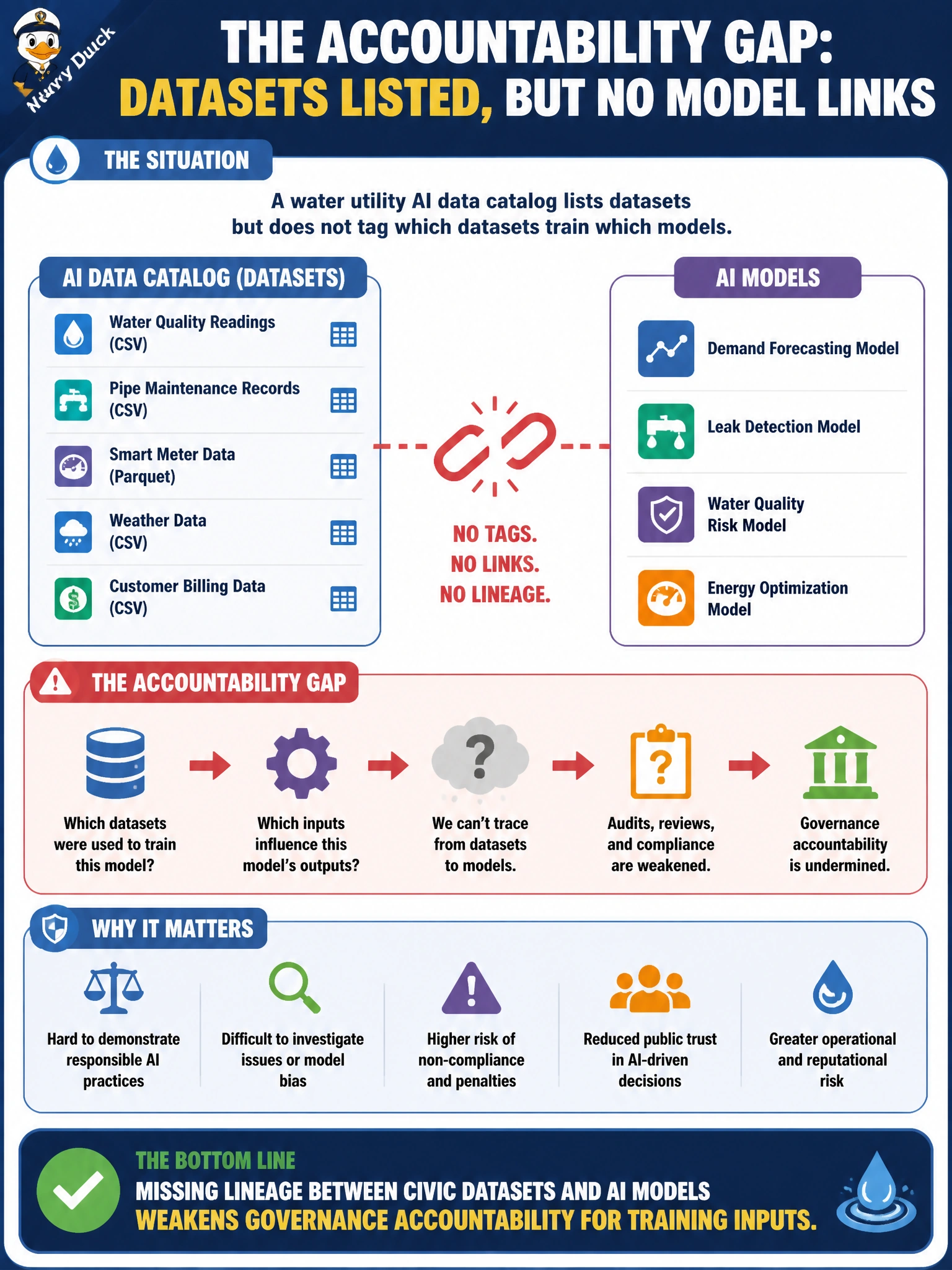
A water utility AI data catalog lists datasets but does not tag which datasets train which models. What accountability gap does this create?
Select an answer to reveal the explanation.
Short Explanation
If you cannot say which lake of data taught which model, you cannot govern either. Tag dataset-to-model lineage in the catalog so accountability has a trail. Download logs showing who grabbed a file don’t tell you which datasets trained which models.
Full Explanation
Missing lineage between civic datasets and AI models weakens governance accountability for training inputs. A water-utility AI data catalog that lists datasets but does not tag which datasets train which models leaves owners unable to trace impact when data quality, retention, or privacy rules change. AI data governance requires dataset-to-model lineage so corrections, withdrawals, and re-training obligations have a clear trail.
Claiming dataset download logs provide audit coverage for governance of model training inputs fails because download logs track access, not the dataset-to-model lineage required to govern training inputs. Asserting stored version histories preserve reproducibility for governance reviews of training inputs fails because version history records dataset changes over time, not which datasets trained which models; it does not establish dataset-to-model lineage. Claiming catalog ownership metadata assigns dataset stewards supporting accountability for model training inputs fails because stewardship metadata identifies responsible parties, not the dataset-to-model link; it does not close the training-input accountability gap.
Exam caveat: lineage that is maintained only in a data scientist’s notebook is not enterprise lineage—tags must live in the governed catalog with owners and change history. Operational check: pick a production water AI model and require the catalog to show training/inference datasets; if the link is missing, raise a governance finding and block undocumented corpus changes until lineage is restored.