
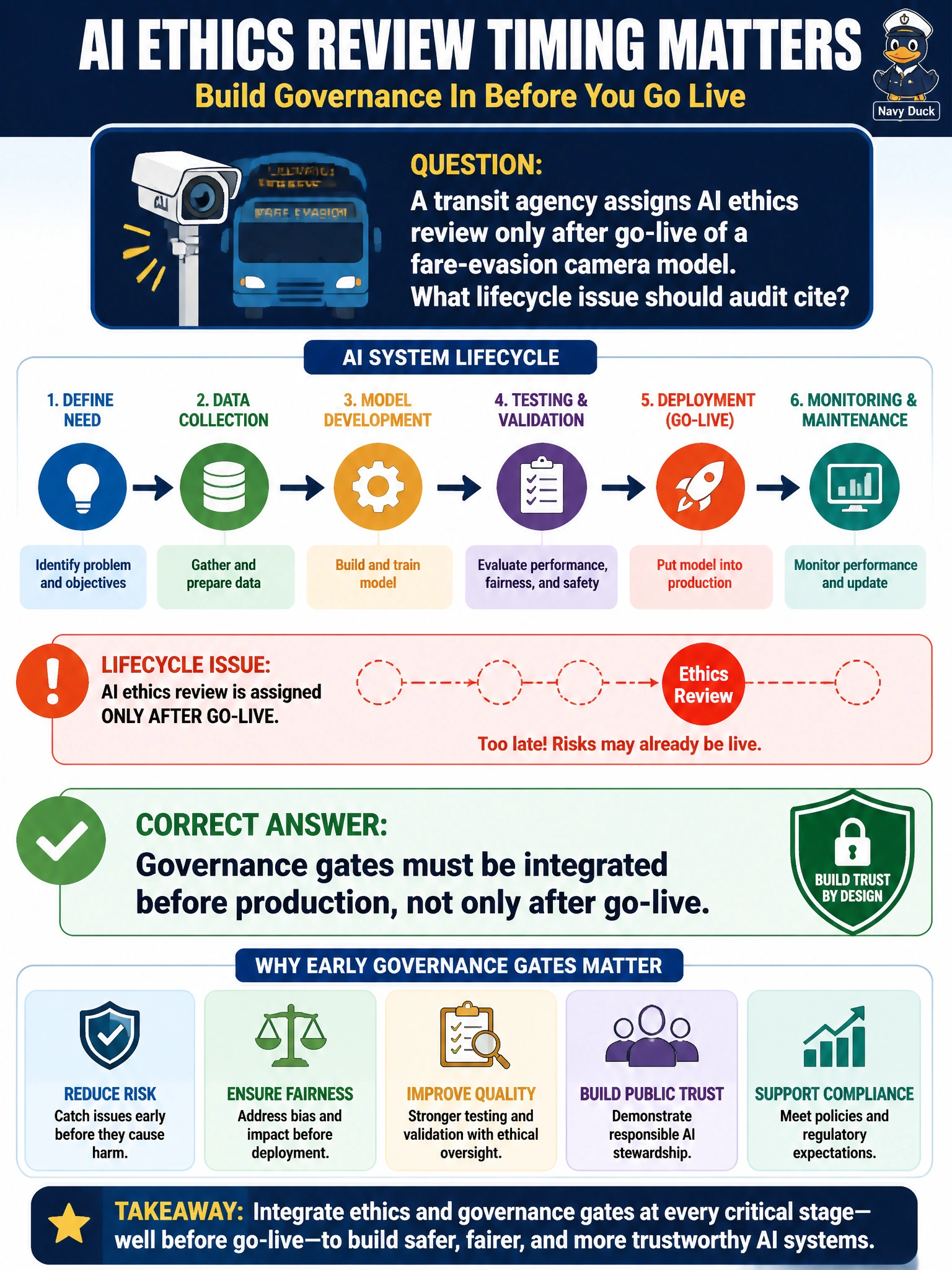
A transit agency assigns AI ethics review only after go-live of a fare-evasion camera model. What lifecycle issue should audit cite?
Select an answer to reveal the explanation.
Short Explanation
Ethics isn’t a party you throw after the cameras are already live. Build the governance gate into the runway—review before takeoff, not only after passengers complain.
Full Explanation
Assigning AI ethics review only after go-live of a fare-evasion camera model cites a lifecycle failure: governance gates must be integrated before production, not only after go-live. Camera analytics affecting riders raise privacy, bias, proportionality, notice, and escalation issues that are cheaper and more ethical to address in design and pilot gates than after enforcement workflows depend on the model. Pre-deployment review also preserves the option to redesign sensors, retention, or human review thresholds.
Deferring bias testing until ridership complaint trends stabilize waits for harm to surface before acting; ethics and bias review must happen in design and pilot gates, not after riders are affected. Finalizing ethics documentation only during periodic retraining cycles makes review a maintenance task instead of a pre-deployment gate; documentation and approval must be complete before production cutover, not deferred to later retraining. Relying on aggregated accuracy and uptime dashboards for pre-launch approval swaps performance metrics for ethics review; accuracy and uptime do not address privacy, bias, proportionality, or necessity, so they cannot replace a pre-deployment gate.
Exam caveat: lifecycle governance (design → validate → deploy → monitor) is a recurring theme—timing of ethics and privacy gates matters as much as their existence. Operational check: require ethics/privacy approval artifacts before production cutover, freeze go-live if gates remain open, schedule post-deployment reviews without treating them as the first control, and re-open ethics review when use cases expand beyond fare evasion.