
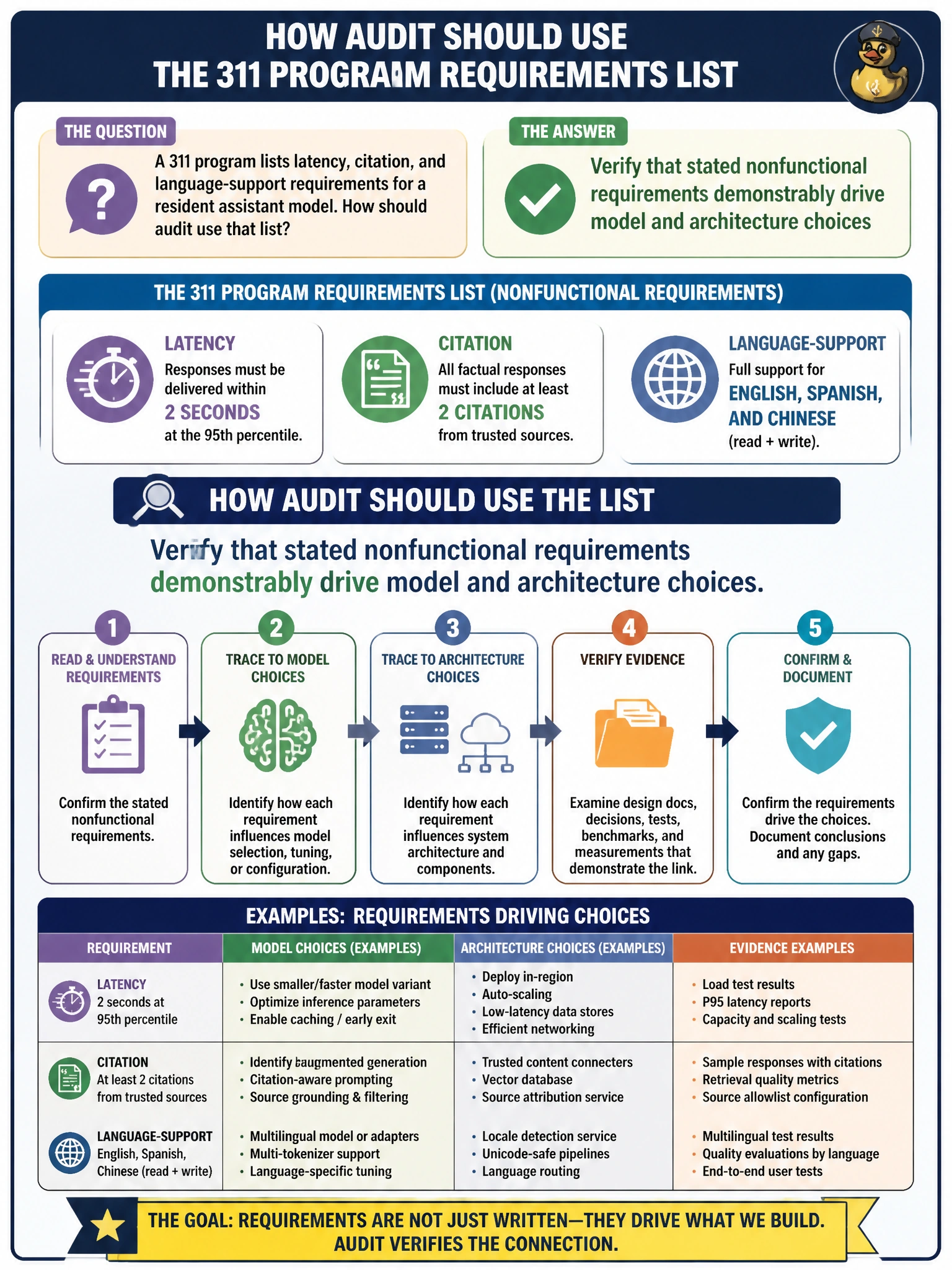
A 311 program lists latency, citation, and language-support requirements for a resident assistant model. How should audit use that list?
Select an answer to reveal the explanation.
Short Explanation
Those latency, citation, and language bullets aren’t wallpaper—they’re the spec sheet. Audit checks that the architecture actually follows them, not that procurement compares pricing, delivery timelines, and support terms.
Full Explanation
When a 311 program lists latency, citation, and language-support requirements for a resident assistant model, audit should verify that those stated nonfunctional requirements demonstrably drive model and architecture choices. Nonfunctional requirements define resident experience and accountability: slow answers undermine trust; missing citations weaken verification; weak language support excludes communities the city serves. Architecture decisions (caching, retrieval, translation pipelines, SLA monitoring) should map to that list with evidence.
Checking production latency dashboards and help-desk ticket volumes to inform future capacity planning is an operational task that does not verify the requirement list drove model and architecture choices. Sampling assistant responses for citation formatting and translation coverage during acceptance testing examines outputs after the fact rather than confirming that the stated requirements shaped the model and architecture. Confirming procurement records compare vendor pricing, delivery timelines, and support terms reviews commercial terms instead of whether nonfunctional requirements drove model and architecture choices.
Exam caveat: nonfunctional requirements must be testable (e.g., p95 latency, citation coverage, language quality thresholds), not aspirational slogans. Operational check: trace each listed NFR to design decisions and acceptance tests, review monitoring dashboards that alert on breaches, and confirm multilingual evaluation sets reflect actual 311 demand.