
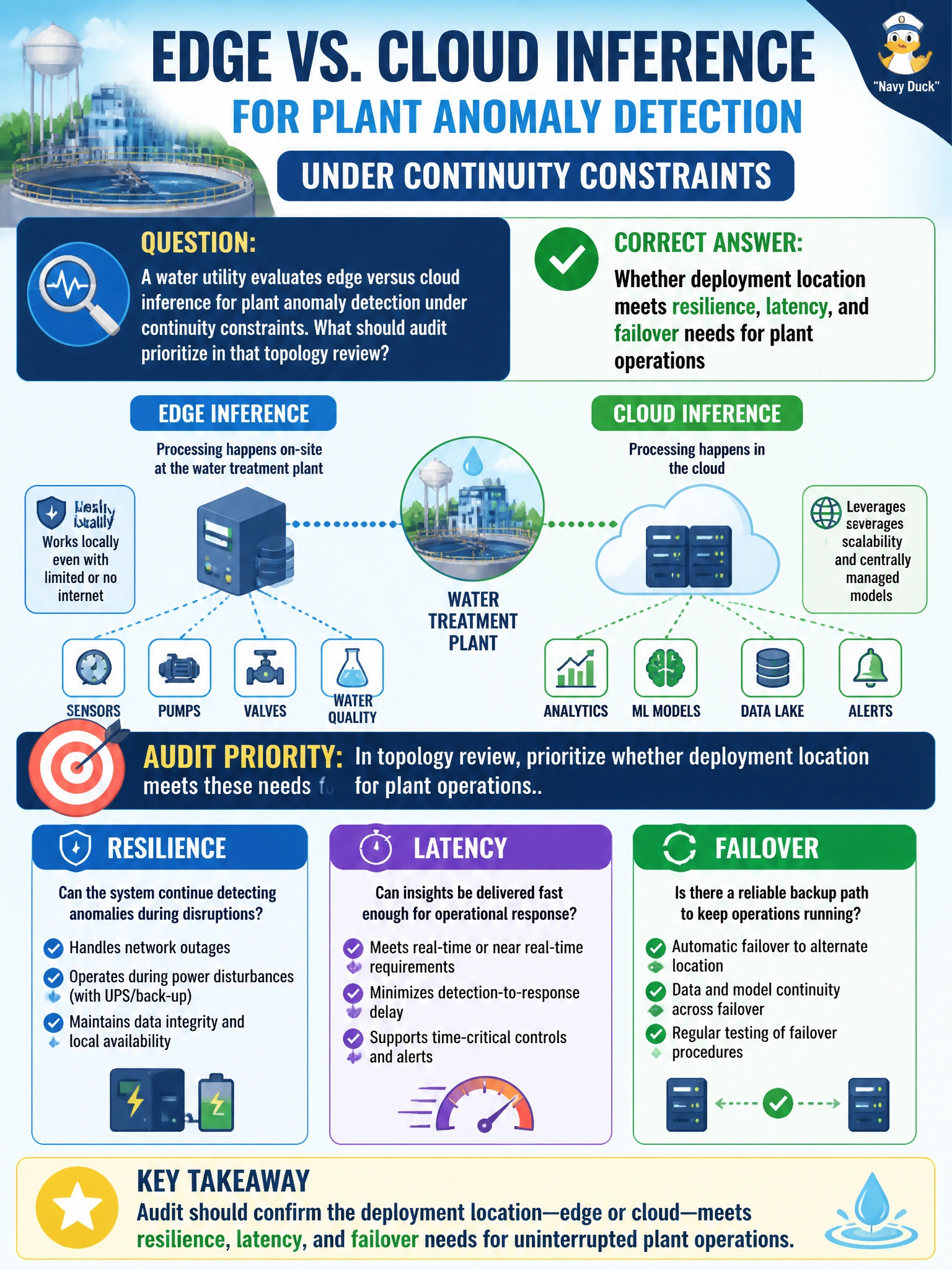
A water utility evaluates edge versus cloud inference for plant anomaly detection under continuity constraints. What should audit prioritize in that topology review?
Select an answer to reveal the explanation.
Short Explanation
The plant can’t wait for a cloudy day if the pipe’s already vibrating wrong. Match where the model runs to uptime, speed, and backup needs—faster cloud retraining or cheaper spot instances for batch scoring don’t keep water flowing. And cutting backhaul bandwidth for routine telemetry uploads doesn’t remove the need for local failover when the connection drops.
Full Explanation
For a water utility choosing edge versus cloud inference for plant anomaly detection under continuity constraints, audit should prioritize whether deployment location meets resilience, latency, and failover needs for plant operations. Process anomalies can require sub-second local response when connectivity drops; cloud paths may offer richer analytics but introduce network dependency. Topology review is an operations and continuity decision first: where inference runs, how it fails over, and whether plant safety interlocks remain independent of the model path.
Selecting cloud because aggregation might improve centralized retraining speed ignores the plant’s uptime and latency requirements for anomaly detection. Choosing edge because gateways reduce backhaul bandwidth for routine telemetry uploads dodges the continuity analysis rather than satisfying it. Basing inference hosting on economics that favor cloud spot capacity for batch scoring of historical workloads misaligns spend with operational risk for critical infrastructure.
Exam caveat: hybrid designs are common; the exam point is fit-to-requirement, not “edge always” or “cloud always.” Operational check: require documented RTO/RPO for detection alerts, network-loss behavior tests, segregation from safety PLCs where required, and explicit residual-risk acceptance if cloud dependency remains.