
During a walk-through of a RCRA Large Quantity Generator central accumulation area, an EHS specialist notices a 55-gallon steel drum of spent ignitable solvent fitted with a metal funnel whose hinged lid is propped open for convenience across the shift. Which RCRA container management standard is the facility violating under 40 CFR 262.17?
Select an answer to reveal the explanation.
Short Explanation
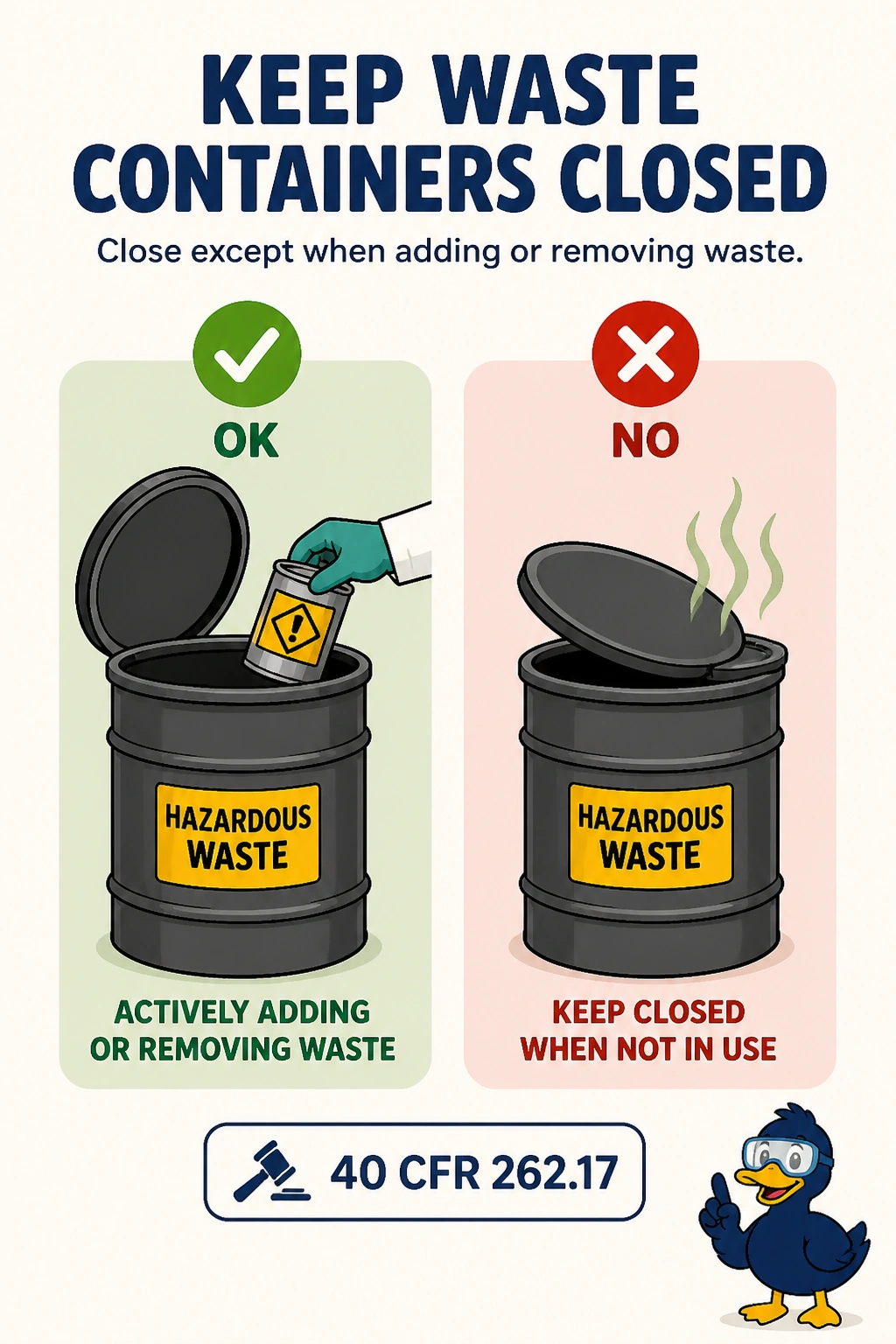
An open funnel lid lets volatile solvent vapors escape and gives a stray spark a chance to ignite them. You must keep hazardous waste containers closed except when actively adding or removing waste. Same-shift convenience does not permit leaving the lid propped open between pours.
Full Explanation
Under 40 CFR 262.17, hazardous waste containers must remain closed except when waste is actively being added or removed. This contains volatile organic vapors, helps prevent spills if a drum is bumped, and keeps incompatible materials from entering accidentally. A funnel lid propped open between intermittent pours violates the closed-container rule even when operators are nearby. Allowing open drum funnels whenever waste is generated on the same shift invents a convenience exception that federal hazardous waste regulations do not provide. Loose plastic sheeting over an open-top drum is not a vapor-tight, secure closure and cannot reliably contain liquids if the drum tips. Continuously venting a closed solvent drum through an open bung hole into the room creates fire and inhalation hazards and violates closure requirements; an approved pressure-relief device engineered for safety is different. As an exam caveat, a latching safety funnel that seals tightly when released can satisfy closure rules when properly maintained. As a practical check during weekly accumulation-area inspections, verify that every drum bung and funnel latch is fully seated and secure.
Prefer to study offline? Printable PDF study book + test engine ($7.50, unofficial). These questions stay free here.