
A composite-materials manufacturer receives drums of methyl ethyl ketone peroxide catalyst for resin curing. Which storage arrangement should the warehouse manager establish to prevent thermal runaway?
Select an answer to reveal the explanation.
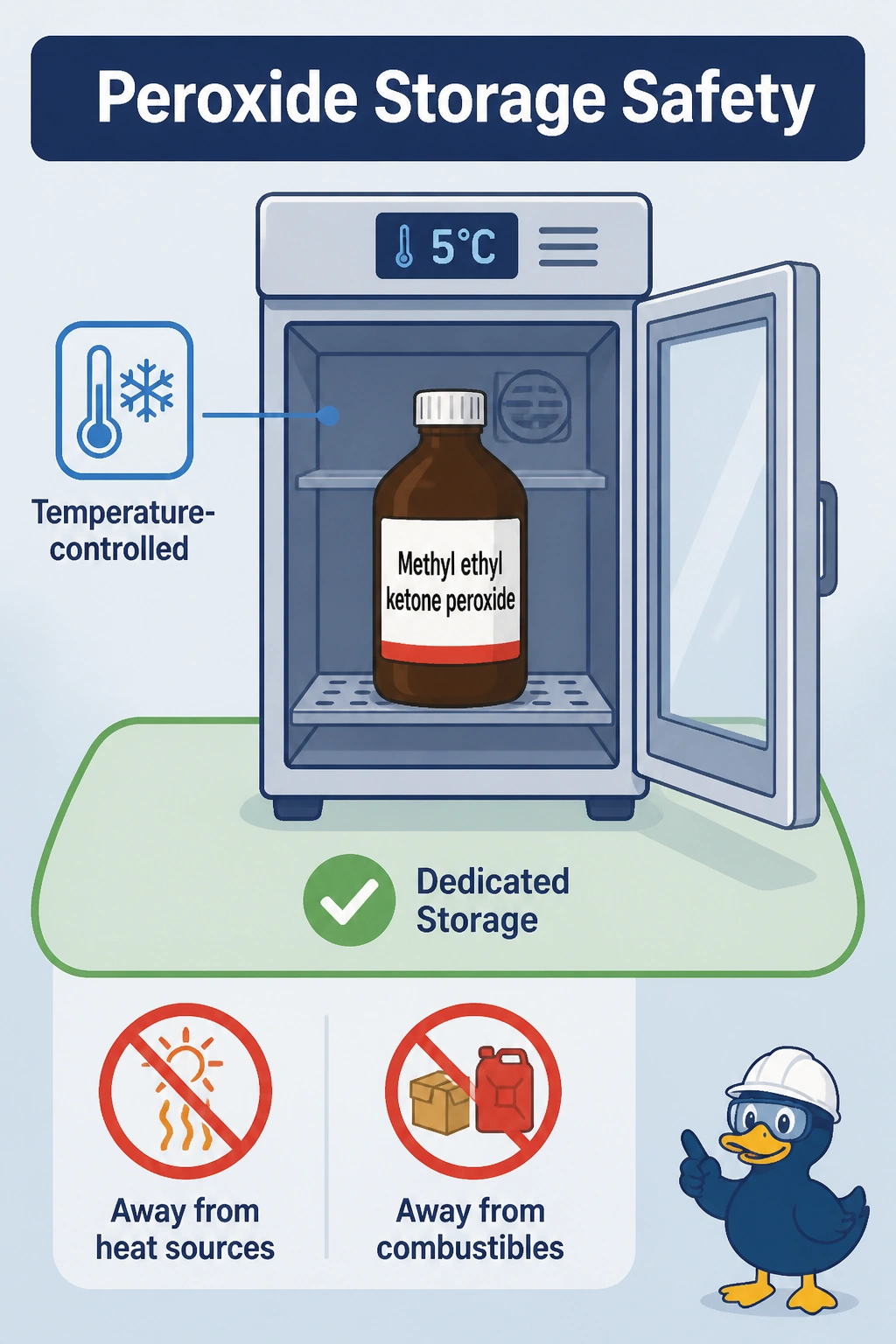
Short Explanation
You’re right to prioritize temperature control: MEKP is chemically unstable, and a slow warm-up can lead to thermal runaway. You need dedicated temperature-controlled storage, away from heat sources and combustibles. A shared flammable-liquid cabinet beside concentrated mineral acids treats the peroxide like an ordinary flammable liquid, despite its incompatibility risks.
Full Explanation
MEKP is an organic peroxide, with fuel and oxygen within the same molecular structure, so dedicated temperature-controlled storage away from heat sources and combustibles is needed to keep it below its self-accelerating decomposition temperature and prevent violent decomposition or fire. An unheated outdoor metal shed exposed to direct afternoon sunlight and freezing is unsuitable: solar heating can raise drum temperatures toward decomposition thresholds, while freezing can cause phase separation that destabilizes certain peroxide formulations. A shared flammable-liquid cabinet directly beside concentrated mineral acid jugs is unsuitable because organic peroxides are incompatible with strong acids and combustible solvents; contamination or leaks can trigger rapid exothermic reactions. A basement mechanical room adjacent to steam boilers and electrical switchgear is unsuitable because boiler heat and potential ignition sources create thermal-runaway and fire hazards in an enclosed space. One exam caveat is that storage limits and dilution requirements vary by peroxide formulation, so check the Safety Data Sheet’s Section 7. As a practical check, inspect temperature-monitoring alarms and verify that incompatible materials are physically segregated.
Prefer to study offline? Printable PDF study book + test engine ($7.50, unofficial). These questions stay free here.