
A manufacturing plant is reorganizing its indoor chemical warehouse and needs to store drums of concentrated nitric acid alongside drums of isopropyl alcohol. Both liquids are currently scheduled to sit on the same four-drum spill containment pallet to save floor space. Why must the warehouse supervisor separate these two materials into different containment areas?
Select an answer to reveal the explanation.
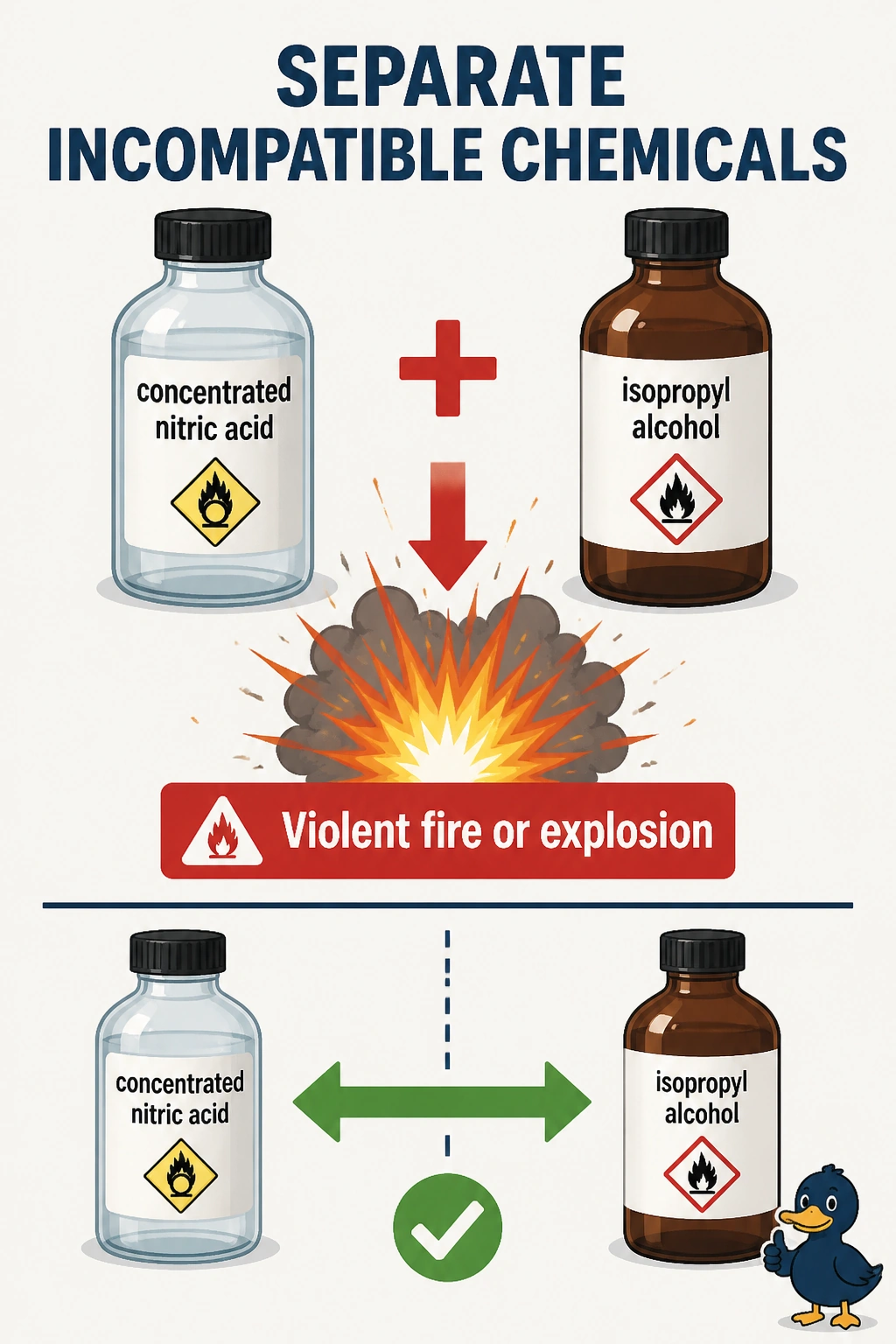
Short Explanation
Sharing a spill pallet between an oxidizer and a fuel is like storing matches inside a gasoline can—if both drums leak, the containment sump becomes a reactor. You must physically separate incompatible chemicals so a single spill cannot mix them. The trap is thinking secondary containment protects you from chemical incompatibility, when a shared sump actually brings leaking materials together.
Full Explanation
Incompatible hazardous materials must be segregated by physical barriers or separate containment systems so leaks cannot combine. Mixing an oxidizing acid with a flammable solvent can cause a violent fire or explosion because nitric acid is a strong oxidizer that reacts vigorously with organic fuels like isopropyl alcohol, generating heat and toxic nitrogen oxide fumes. Claiming that Nitric acid and isopropyl alcohol share Packing Group II so they may share one spill pallet confuses hazard ranking with compatibility; Packing Group indicates degree of danger within a class, not whether an oxidizer and fuel may mix. Asserting that DOT highway placarding rules prohibit storing any two liquid hazard classes inside one warehouse confuses transport placarding under 49 CFR with facility storage rules, which allow multiple classes in one building when properly segregated. Stating that Nitric acid and isopropyl alcohol may share a pallet when both drums stay closed and labeled is false because closed containers and labels do not prevent leaks, and a shared sump would still combine incompatible liquids if both drums release. Fire codes and OSHA flammable storage limits still govern maximum allowable quantities per control area. As an operational check, review Section 10 of each Safety Data Sheet and verify that incompatible drums never share a spill pallet or floor drain.
Prefer to study offline? Printable PDF study book + test engine ($7.50, unofficial). These questions stay free here.