
A chemical formulator is filling 55-gallon steel drums with a Class 3 flammable liquid solvent during a cool winter morning for highway shipment to a southern distribution hub. An operator wants to fill each drum completely to the bung opening to maximize payload and reduce freight costs. Why does DOT 49 CFR 173.24(h) prohibit filling liquid hazardous materials packagings completely full?
Select an answer to reveal the explanation.
Short Explanation
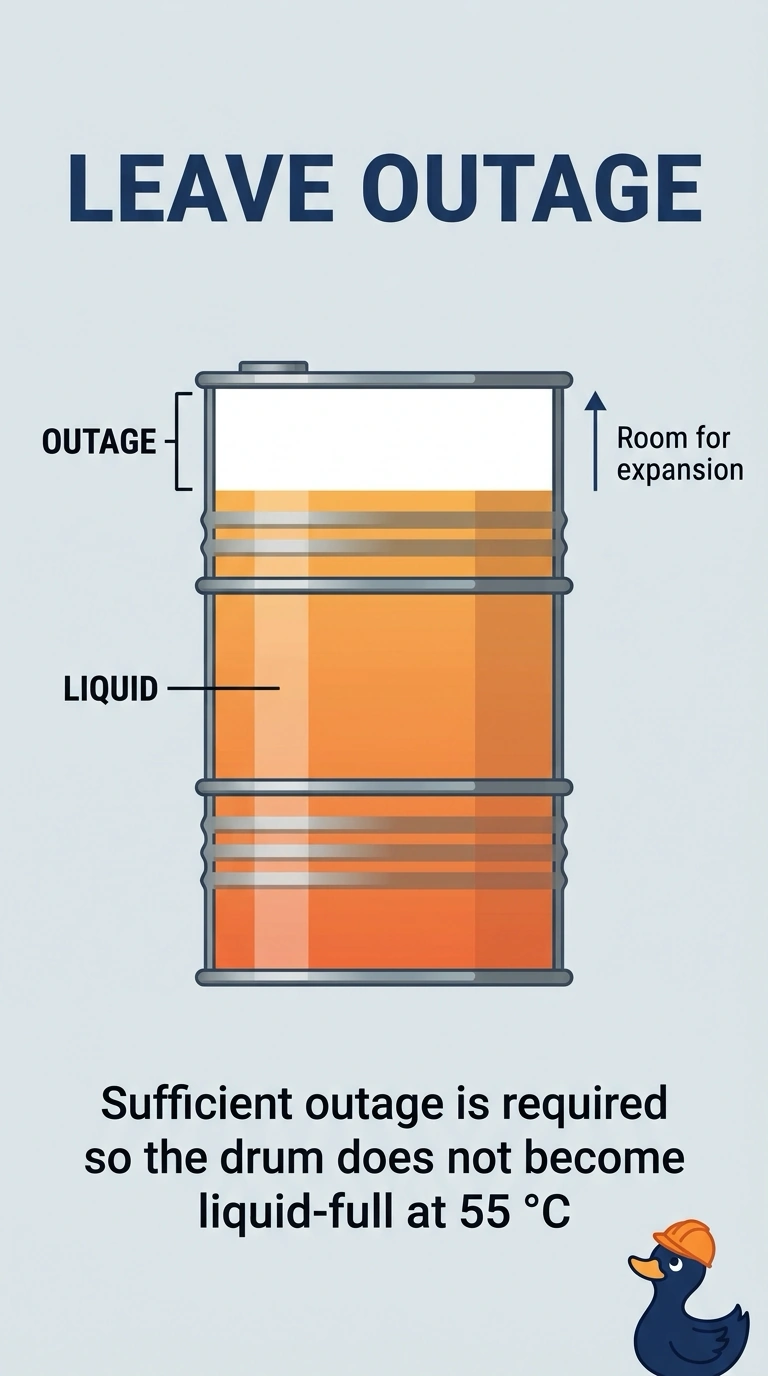
Liquids expand when they warm up, and a drum filled brim-full on a cold morning turns into a hydraulic bomb inside a hot trailer. DOT requires enough outage—headspace—so your liquid packaging never becomes liquid-full during transit. The trap is guessing a fixed ten-percent air gap or thinking fill level changes the Packing Group.
Full Explanation
49 CFR 173.24(h)(1) requires sufficient outage and, for this non-bulk drum, 173.24a(d) requires that the packaging not become liquid-full at 55 C (131 F). This ensures that thermal expansion during warm-weather transport or sun-heated trailers does not cause leaking closures, permanent drum distortion, or rupture. Claiming "Drums filled to capacity automatically shift into a higher Packing Group" is false because Packing Group assignment depends on the material's inherent hazard properties such as flash point and boiling point, not fill volume. Stating "Federal rules require at least ten percent air space in all bulk and non-bulk drums" invents an arbitrary fixed percentage; required outage varies with the liquid's coefficient of thermal expansion and the filling temperature. Asserting "Filled drums cannot accept UN specification markings on the top head" is incorrect because UN performance markings are embossed or applied by the packaging manufacturer and are unrelated to headspace. As an operational caveat, liquids with high coefficients of thermal expansion filled at low ambient temperatures require larger outage allowances than those filled at room temperature. For an operational check, calibrate drum-filling meters or weigh scales using target fill weights that preserve the calculated headspace and verify closure torque with a calibrated torque wrench.
Prefer to study offline? Printable PDF study book + test engine ($7.50, unofficial). These questions stay free here.