
A warehouse worker accidentally punctures the side seam of a 55-gallon steel drum containing a Class 3 flammable liquid, leaving the drum unfit for normal highway shipment to a recovery facility. Under DOT Hazardous Materials Regulations (49 CFR 173.3), how may the shipper legally package and transport the damaged drum?
Select an answer to reveal the explanation.
Short Explanation
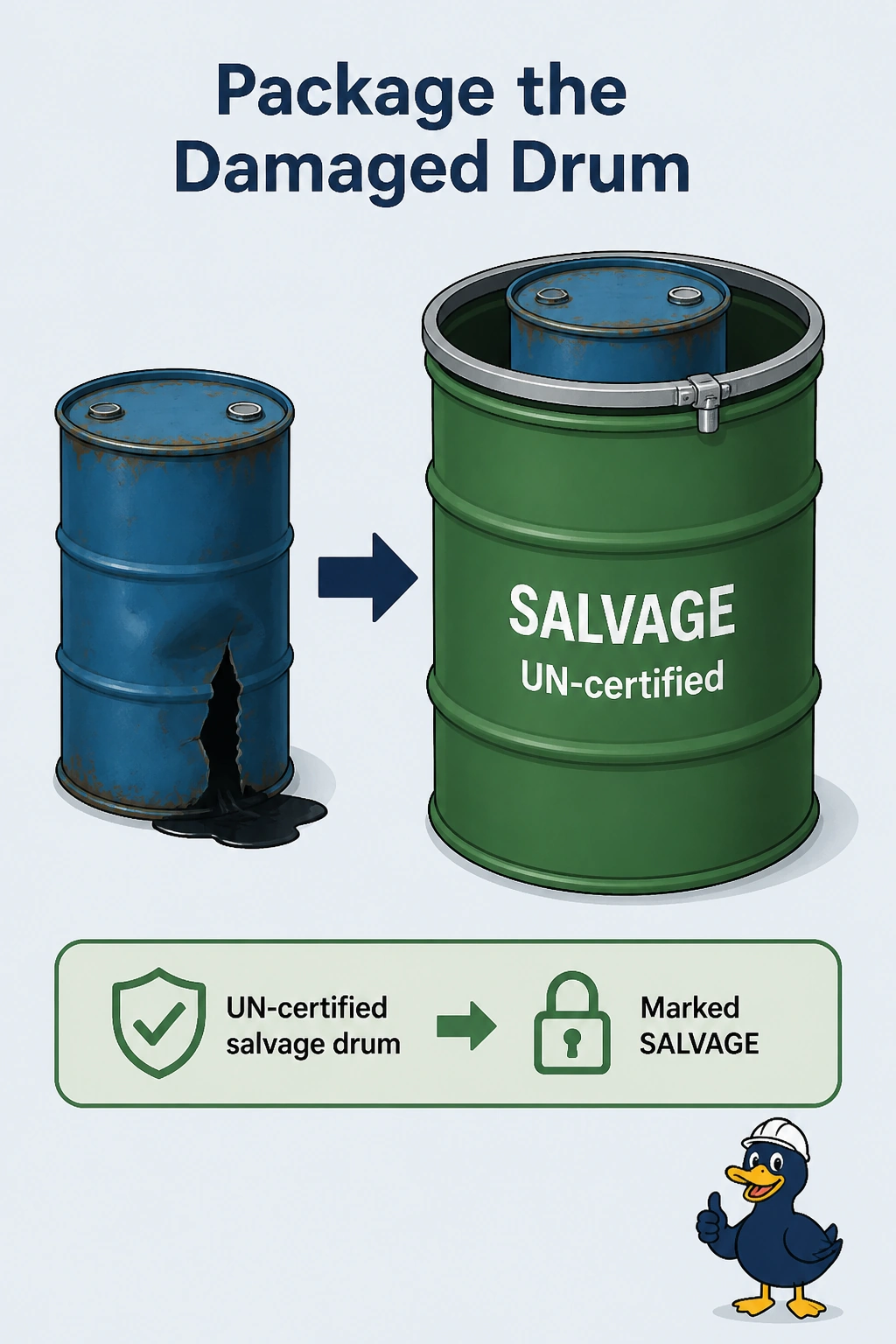
A punctured drum cannot hit the highway just because you patched it with tape. Under DOT rules, the trap is thinking any outer box or cab spill kit makes a damaged drum roadworthy, when you must overpack it inside a compatible UN-certified salvage drum marked SALVAGE.
Full Explanation
Under DOT 49 CFR 173.3, packages of hazardous materials that are damaged, defective, or leaking may be transported for repackaging or disposal only if the shipper chooses to Place the damaged drum inside a compatible UN-certified salvage drum marked SALVAGE. The salvage drum must be cushioned and contain sufficient absorbent material to absorb any liquid contents. The salvage drum must be a UN 1A2, 1B2, 1N2, or 1H2 tested and marked for Packing Group III or higher, leakproofness-tested to 20 kPa, capacity not over 450 L (119 gal), and marked SALVAGE. A Z-rated (PG III) salvage drum may hold a leaking PG I inner package. Choosing to Seal the puncture with chemical-resistant tape and ship the drum in a standard dry van violates 49 CFR 173.24 general packaging integrity rules because field-patched containers are not authorized UN specification packagings. Choosing to Place the leaking drum inside a standard fiberboard box labeled with a regular class label fails because a non-certified fiberboard box lacks liquid containment and structural strength for a 55-gallon steel drum. Choosing to Ship the damaged drum directly without overpacking if a spill kit travels in the cab is illegal because emergency response gear does not substitute for compliant containment. As a regulatory caveat, salvage drums must also carry the proper shipping name, UN number, and hazard class labels of the inner material. Operationally, inspect the salvage drum gasket and closure torque, verify cushioning and absorbent placement, and document the salvage packaging on the shipping paper.
Prefer to study offline? Printable PDF study book + test engine ($7.50, unofficial). These questions stay free here.