
A railcar carrying a placarded hazardous liquid derails in a rural industrial corridor and begins leaking a visible vapor cloud. First responders arrive upwind at a safe distance with binoculars and read the four-digit identification number on the orange panel. How should the incident commander use the PHMSA Emergency Response Guidebook to establish initial protective actions?
Select an answer to reveal the explanation.
Short Explanation
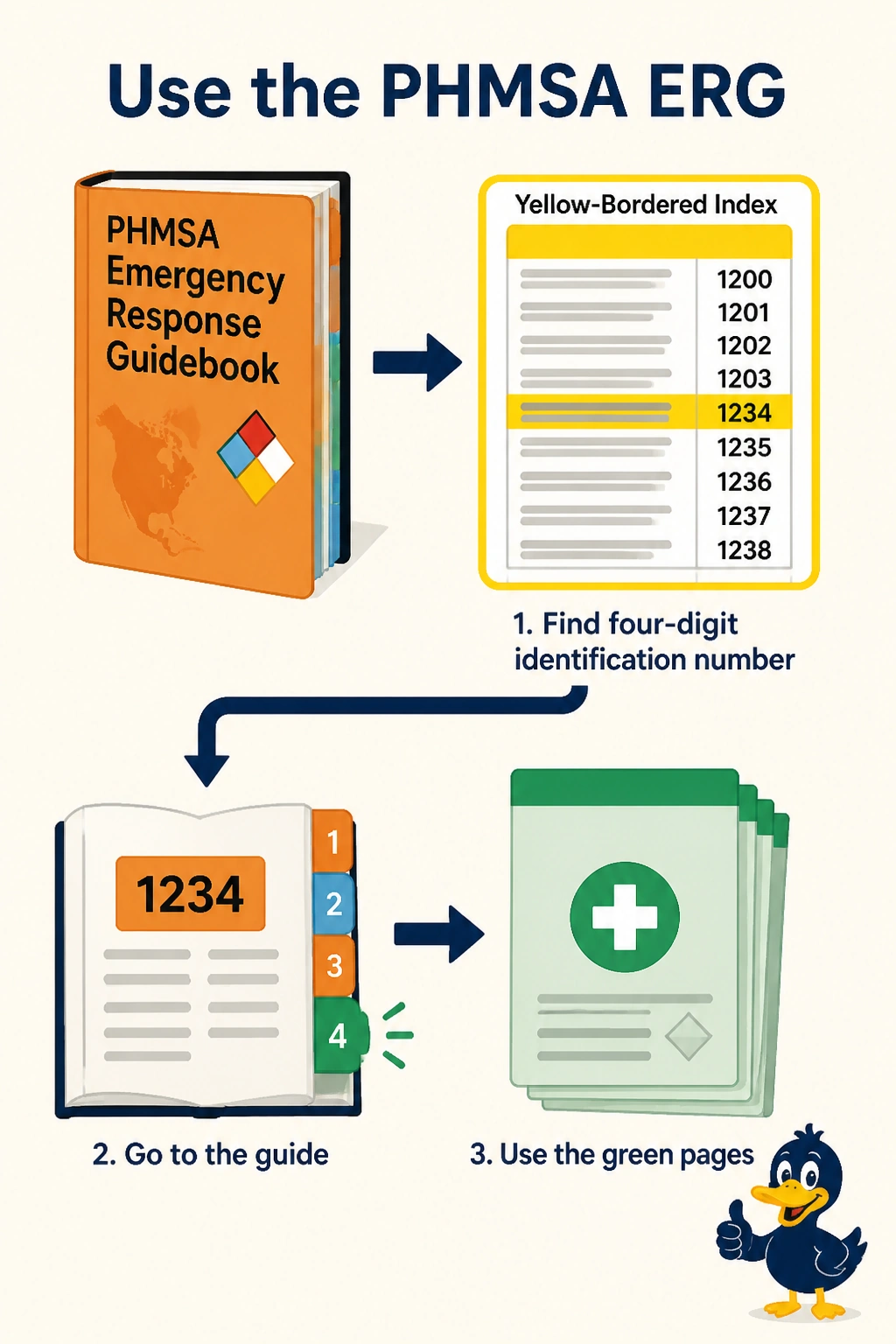
When a railcar is hissing in front of you, the Emergency Response Guidebook is built to give you life-saving answers in seconds, not hours. Reading the four-digit ID from a safe distance lets you jump straight to the yellow-bordered pages for the right response guide and green-bordered isolation distances. The trap is rushing in closer to read small tank stamps or waiting for lab tests while a plume spreads.
Full Explanation
The PHMSA Emergency Response Guidebook is designed for the critical first minutes of a transportation incident before technical specialists arrive. Choosing to Look up the four-digit ID in the yellow-bordered index to find the guide and green pages allows the incident commander to quickly identify the material, apply the appropriate orange-bordered safety guide, and check green-bordered tables if the substance is a Toxic Inhalation Hazard requiring larger isolation zones. Deciding to Wait for off-site laboratory analytical results from a vapor grab sample before consulting any guide wastes precious time during an active vapor release when immediate evacuation or sheltering decisions are needed. Attempting to Approach the railcar leak immediately to read the container gauge and manufacturer stamp puts responders directly into an uncharacterized toxic or flammable atmosphere. Relying on the placard hazard class alone to set initial downwind evacuation distances is too generic because one hazard class covers many materials with very different toxicity and isolation needs that only the ID-specific guide and green tables address. As a caveat, ERG isolation distances apply primarily to the initial phase and must be refined once air monitoring data and local weather conditions are confirmed. As an operational check, confirm that emergency vehicles carry current ERG editions and that responders verify wind direction before staging command posts.
Prefer to study offline? Printable PDF study book + test engine ($7.50, unofficial). These questions stay free here.