
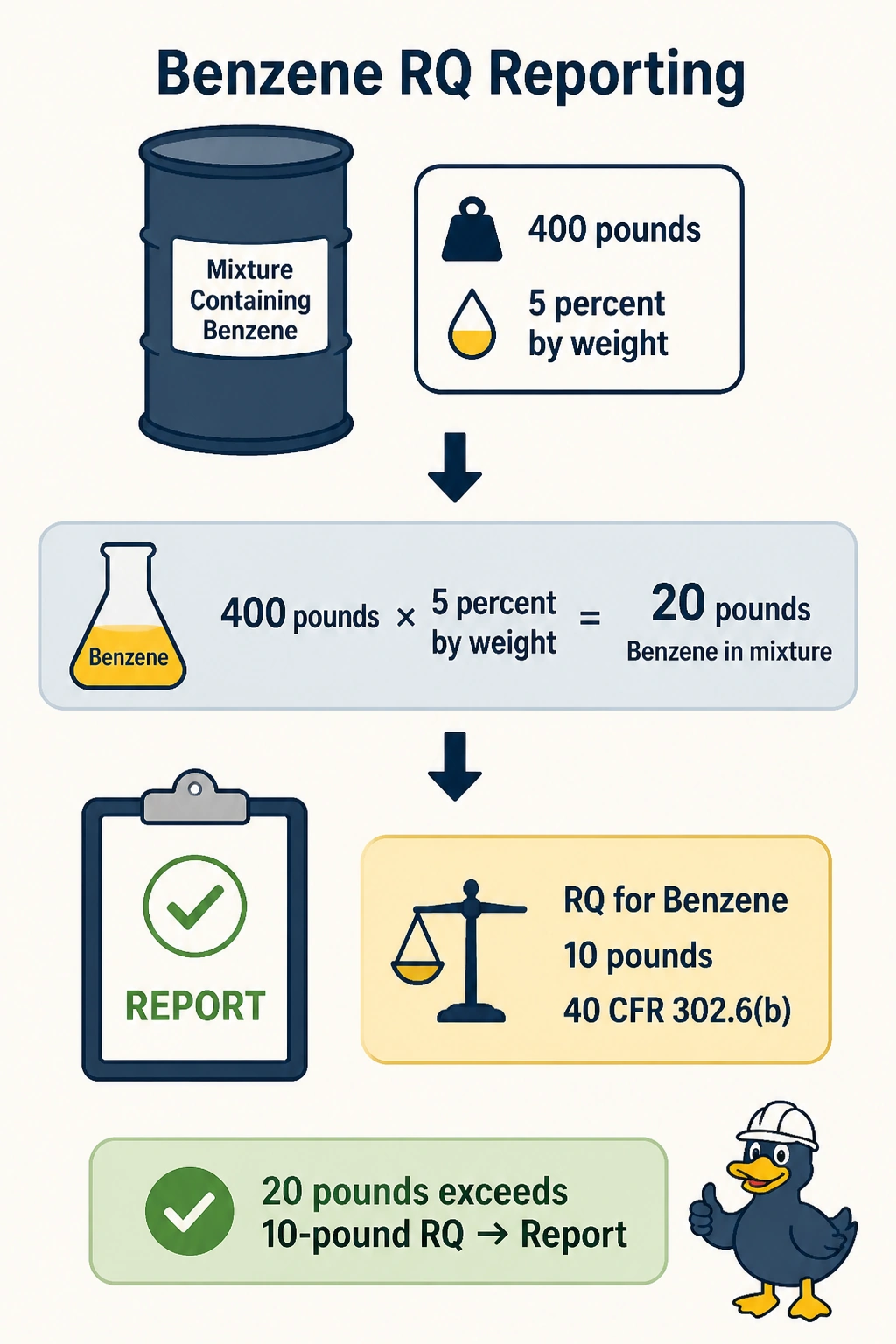
A transfer hose fails at a chemical plant, spilling 400 pounds of a solvent mixture onto unpaved ground. Safety Data Sheet records show the mixture contains 5 percent benzene by weight that was added to the solvent outside the petroleum refining process (CERCLA reportable quantity: 10 pounds) and 95 percent petroleum-derived mineral spirits. Under 40 CFR 302.6(b), what must the person in charge determine regarding CERCLA notification?
Select an answer to reveal the explanation.
Short Explanation
Diluting a hazardous substance in a mixture does not dilute your reporting duty. The trap is looking at the 5 percent concentration and assuming it is too small to matter, when 5 percent of 400 pounds is 20 pounds—double the 10-pound RQ. You count it here only because this benzene was added outside refining — benzene indigenous to mineral spirits would be excluded.
Full Explanation
Under 40 CFR 302.6, when the exact composition is known, you must calculate the benzene mass and report because 20 pounds exceeds the 10-pound RQ (400 multiplied by 0.05 equals 20 pounds). This holds only because the benzene was added outside the petroleum refining process; benzene indigenous to mineral spirits, including benzene added during refining, is excluded from CERCLA, while benzene added outside refining is not. Because the release reached unpaved soil and exceeded the RQ in 24 hours, immediate National Response Center notification is required. Choosing to delay reporting for 24 hours because the spill remained inside an unpaved facility containment berm violates immediate notification because soil contact is a release to the environment. Choosing to skip CERCLA notification because benzene is only five percent confuses other programs' de minimis ideas with CERCLA mass calculation. Choosing to compare the 400-pound weight only against the state petroleum underground tank threshold fails because the petroleum exclusion does not cover added benzene, so the federal obligation remains. If the exact percentage is unknown, 40 CFR 302.6 requires comparing the entire mixture weight to the lowest RQ of any known constituent. Operationally, keep pre-calculated trigger weights in the spill binder to avoid field math.
Prefer to study offline? Printable PDF study book + test engine ($7.50, unofficial). These questions stay free here.