
A former bulk fuel depot has floating gasoline (light non-aqueous phase liquid) and adsorbed petroleum vapors in low-permeability silty-clay soils at a shallow water table. Which in-situ remediation technology simultaneously extracts free-phase product, contaminated groundwater, and soil vapor under high vacuum?
Select an answer to reveal the explanation.
Short Explanation
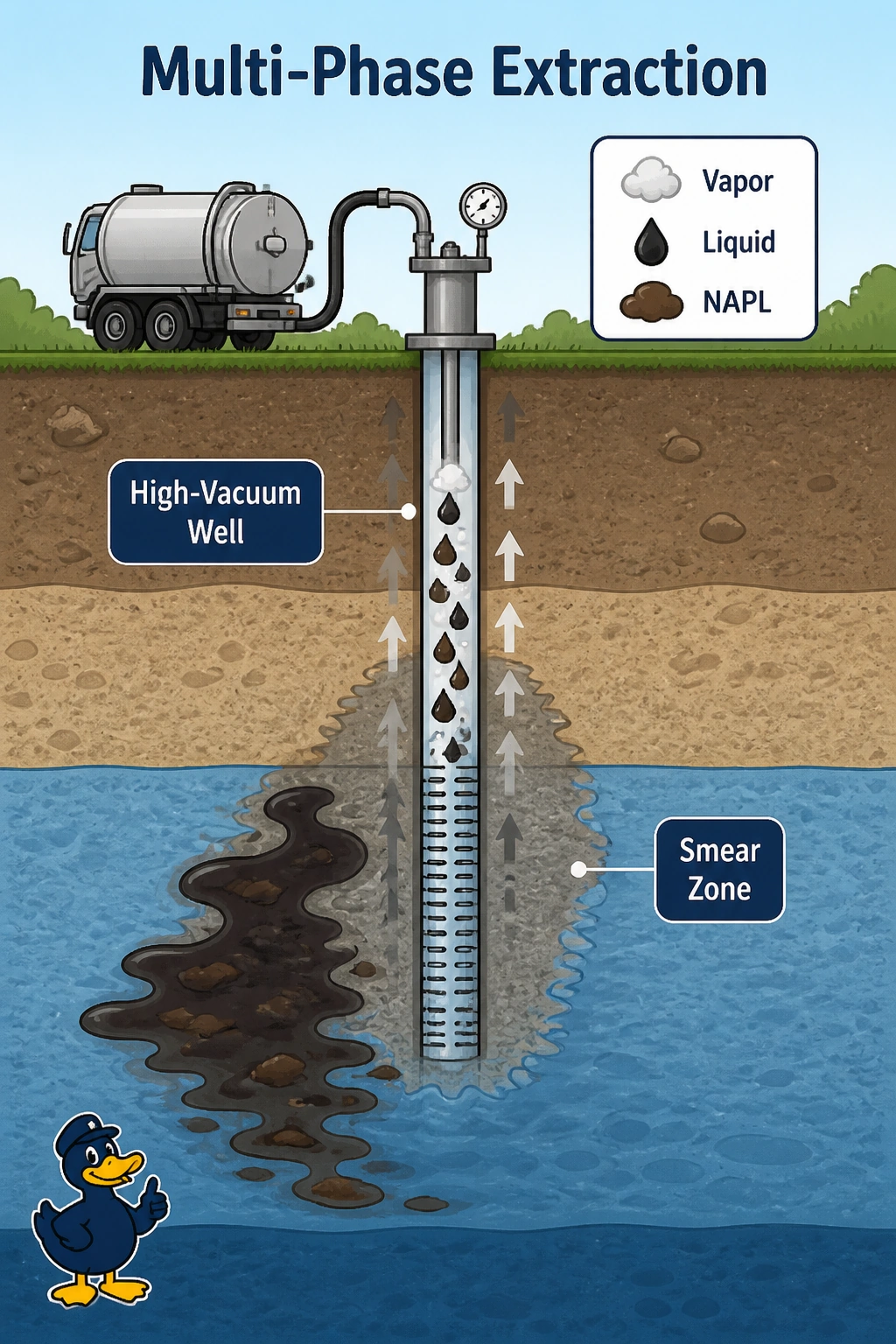
You’re right to look for a method that can reach the gasoline, groundwater, and vapors together in tight silty clay. Multi-phase extraction uses high vacuum to recover all three through wells screened across the smear zone. Monitored natural attenuation relying solely on passive dilution leaves free product in place, so it does not provide that recovery.
Full Explanation
Multi-phase extraction using high-vacuum wells screened across the smear zone is the suitable technology because it applies strong vacuum to recover free-phase gasoline, depress the water table to expose the smear zone, and extract volatilized hydrocarbons in one integrated system. Monitored natural attenuation relying solely on passive dilution without recovery is unsuitable as the primary remedy while mobile free-phase LNAPL remains a continuing source of groundwater contamination. Gravity-fed air sparging injected deep beneath an impermeable clay confining layer is ineffective because air cannot readily penetrate low-permeability clay and may migrate laterally off-site beneath the confining unit. In-situ soil washing with potable water flooded across an uncontained surface pad can mobilize residual petroleum downward and spread the plume laterally without capturing leachate. One caveat is that extracted off-gas and recovered oil-water mixtures require above-ground phase separation and vapor-abatement permitting. As a practical check, monitor the vacuum radius of influence and recovered LNAPL thickness in adjacent observation wells to confirm hydraulic capture.
Prefer to study offline? Printable PDF study book + test engine ($7.50, unofficial). These questions stay free here.