
A remediation team is evaluating groundwater treatment options for a shallow, dissolved-phase hexavalent chromium plume migrating slowly toward a property boundary in sandy aquifer soils. The site owner wants a passive in-situ remedy that treats contaminants continuously under natural hydraulic gradient without operating aboveground mechanical pumps. Which remediation technology best fits this objective?
Select an answer to reveal the explanation.
Short Explanation
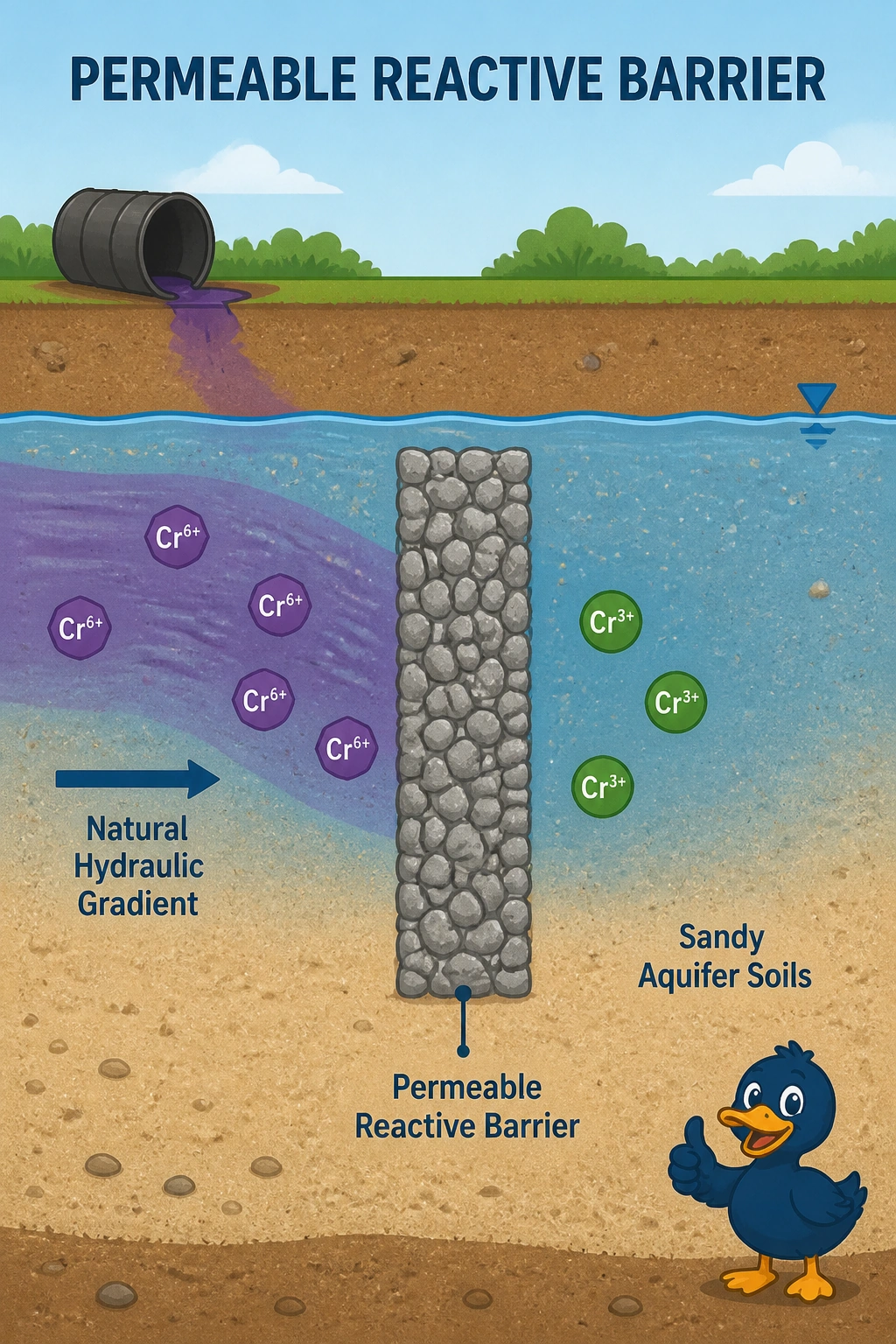
Picture an underground water filter built right into the path of a moving plume. When you need passive in-situ treatment driven by natural groundwater flow, a permeable reactive barrier placed across the plume degrades or immobilizes contaminants without continuous pumping. Watch out for vadose-zone vapor tools or ex-situ excavation, which miss the passive groundwater requirement.
Full Explanation
A permeable reactive barrier placed across the groundwater flow path intercepts dissolved-phase contaminants as groundwater moves naturally through an engineered subsurface zone of reactive media, such as zero-valent iron, which reduces hexavalent chromium to less mobile, less toxic trivalent forms in place. Because it relies on the natural hydraulic gradient, it avoids continuous mechanical extraction and aboveground treatment hardware. Soil vapor extraction with vacuum blowers targets volatile organic compounds in unsaturated vadose-zone soils and is ineffective for dissolved metals below the water table. Excavation and off-site thermal desorption is an active, ex-situ soil remedy designed to volatilize organic contaminants rather than passively treat groundwater in place. Surface capping with an impermeable liner limits rainwater infiltration and vertical leaching from source soils, but it does not actively treat a migrating groundwater plume. Caveat: reactive media can foul or lose permeability over time if geochemistry is poorly characterized, requiring monitoring wells downgradient. As an operational check, verify hydraulic capture and downgradient chromium concentrations through periodic groundwater sampling.
Prefer to study offline? Printable PDF study book + test engine ($7.50, unofficial). These questions stay free here.