
A chlorinated solvent plume in a deep fractured bedrock aquifer is migrating toward a municipal drinking-water supply well, and source-zone excavation is infeasible beneath active plant buildings. Which remedial approach best provides immediate hydraulic containment to protect the downgradient receptor?
Select an answer to reveal the explanation.
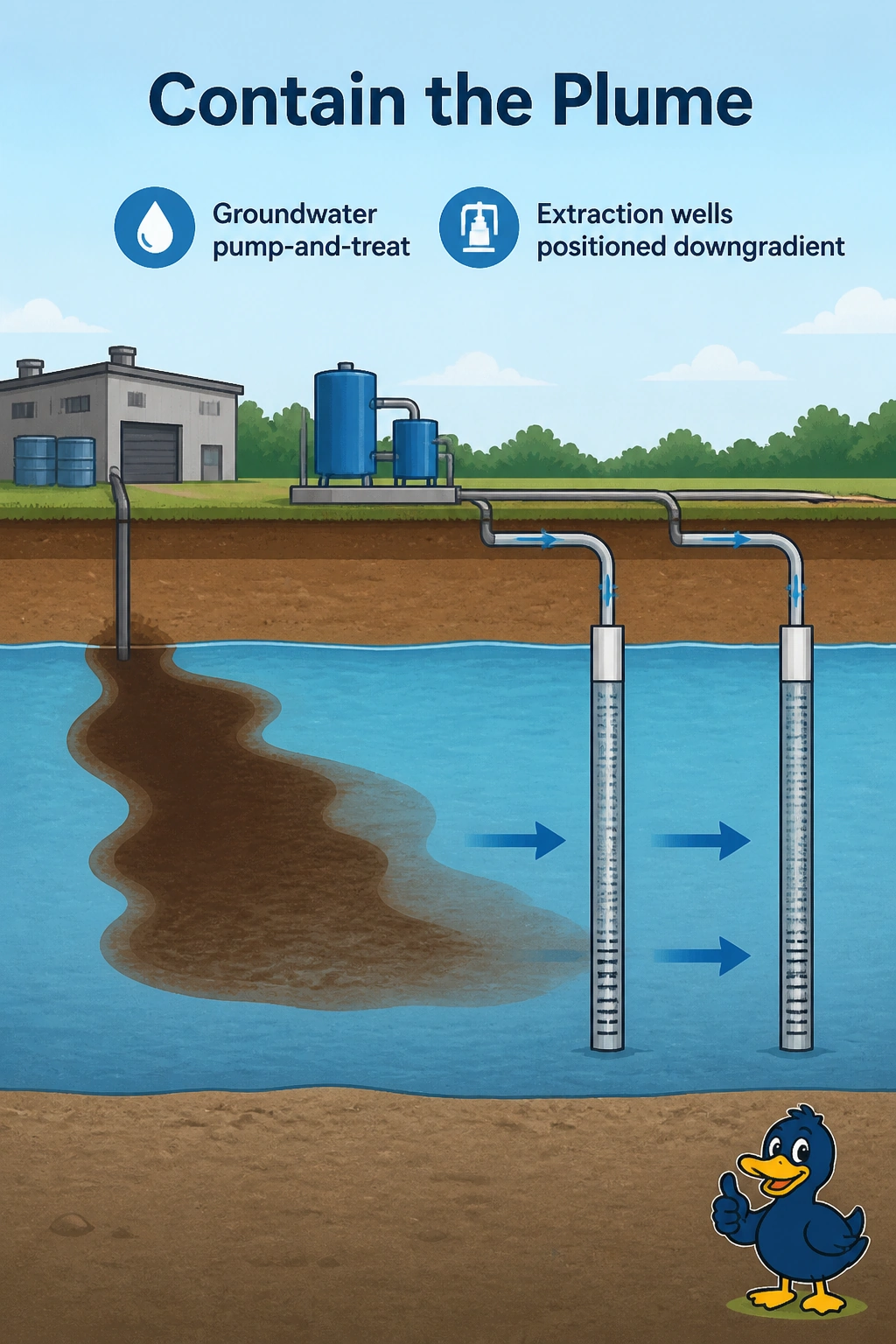
Short Explanation
When a toxic plume is actively marching toward a municipal water well, your first job is to stop the groundwater in its tracks. The trap here is choosing a passive or shallow technology that leaves deep, fast-moving bedrock water free to reach the receptor.
Full Explanation
In fractured bedrock where source removal is blocked, Groundwater pump-and-treat with extraction wells positioned downgradient creates a capture zone that reverses local hydraulic gradients and intercepts contaminated water before it reaches the municipal supply well. Monitored natural attenuation relying solely on native biodegradation without active pumping is inappropriate when a plume is actively expanding toward a sensitive receptor, because natural processes alone cannot guarantee timely containment. Air sparging wells screened across the deep fractured-bedrock flow path inject air to enhance volatilization and aerobic biodegradation, but they do not pump groundwater or establish hydraulic containment and cannot reliably stop plume migration in fractured flow. Surface asphalt capping over the parking lot to block rainwater infiltration may reduce vertical leaching from shallow soils, but it will not halt lateral groundwater migration already moving through deep bedrock fractures. Caveat: pump-and-treat excels at hydraulic containment, though complete aquifer restoration in fractured bedrock often takes decades due to back-diffusion from rock matrices. As an operational check, review capture-zone modeling and routine water-level contour maps from observation wells to confirm the plume stays inside the extraction cone.
Prefer to study offline? Printable PDF study book + test engine ($7.50, unofficial). These questions stay free here.