
A former service station site has a dissolved benzene and toluene plume in a shallow, permeable sandy aquifer below the water table, with no free-phase product floating on the surface. Because soil vapor extraction alone only treats the unsaturated zone, which complementary in-situ technology can volatilize contaminants directly from the saturated groundwater zone?
Select an answer to reveal the explanation.
Short Explanation
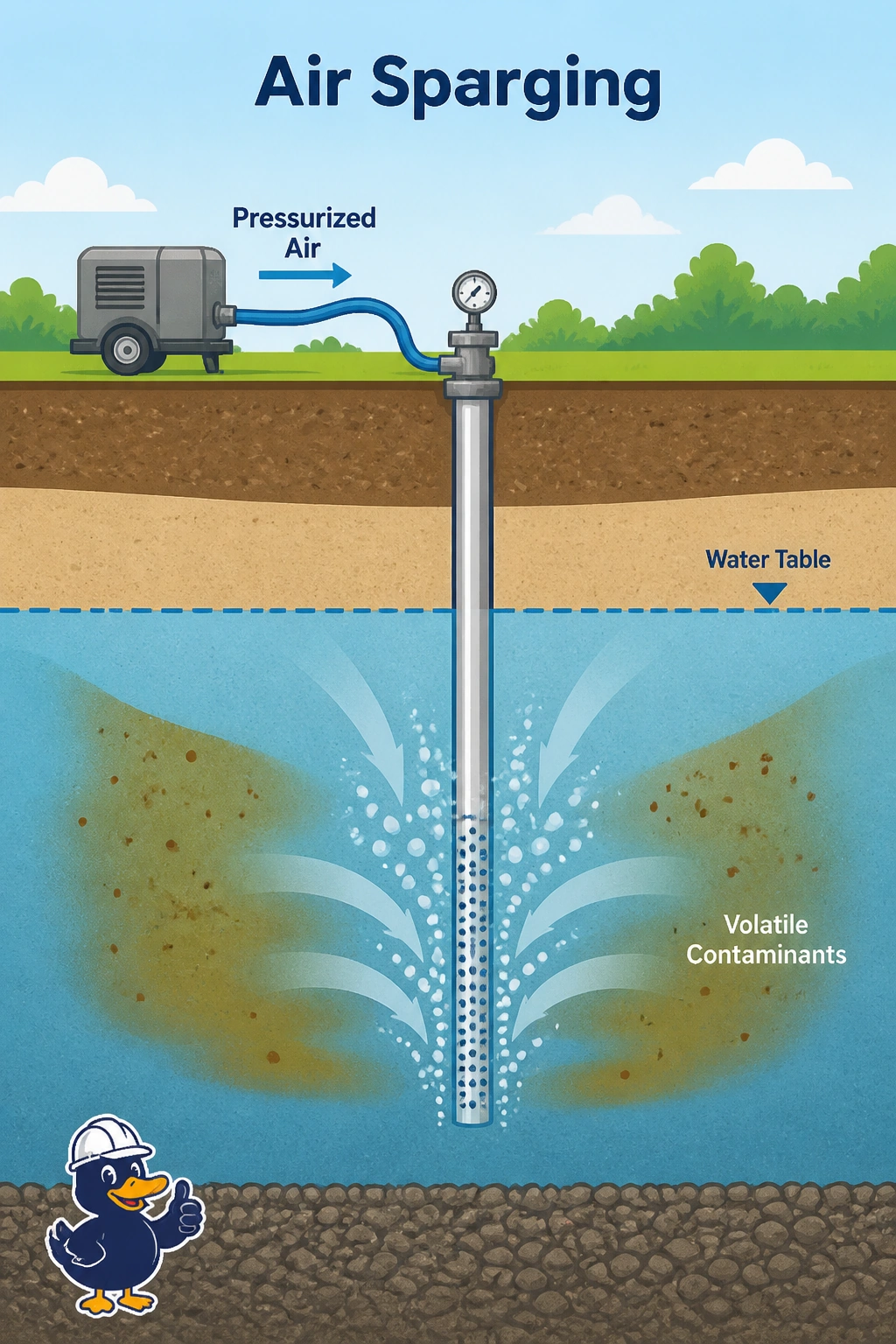
Soil vapor extraction works great in dry soil above the water table, but it cannot pull vapors straight out of waterlogged sand. To strip benzene out of groundwater in place, you have to bubble air up from below using air sparging.
Full Explanation
In permeable sandy aquifers contaminated with volatile organic compounds like benzene and toluene, "Injecting pressurized air below the water table via air sparging" forces air bubbles upward through the saturated zone, transferring dissolved VOCs from groundwater into the vapor phase while also supplying oxygen to stimulate aerobic biodegradation. When paired with an overlying soil vapor extraction system, those rising vapors are safely captured in the unsaturated zone rather than migrating into nearby buildings. "Installing an asphalt surface cap to block rainwater infiltration" limits downward leaching from surface soils, but it does not actively remove dissolved hydrocarbons already residing below the water table. "Excavating only the top foot of clean surface topsoil for off-site reuse" fails to reach the deeper saturated aquifer plume. "Applying lime stabilization solely to raise the groundwater pH above ten" is used for immobilizing certain metals or neutralizing acid, not for stripping volatile petroleum hydrocarbons from groundwater. Caveat: air sparging works poorly in tight clay or heterogeneous soils where air channels bypass contamination, and it must never be operated without vapor capture if subsurface utility corridors or basements lie nearby. As an operational check, monitor dissolved oxygen, groundwater VOC concentrations, and perimeter soil-gas pressures during pilot testing to verify uniform sparge radius and complete vapor capture.
Prefer to study offline? Printable PDF study book + test engine ($7.50, unofficial). These questions stay free here.