
A chemical plant is designing a new process unit that will hold a regulated flammable hydrocarbon above its EPA Risk Management Program threshold quantity. During worst-case release modeling, the engineering team confirms that an off-site public receptor lies within the endpoint distance, and the unit is also covered by OSHA Process Safety Management. Under 40 CFR 68.10, which Risk Management Program level applies?
Select an answer to reveal the explanation.
Short Explanation
EPA Risk Management Program tiers work like security clearances: the higher the potential off-site impact, the stricter your prevention duties become. A common trap is thinking a clean five-year accident history qualifies a new process for Program 1 even when neighbors sit inside the hazard zone.
Full Explanation
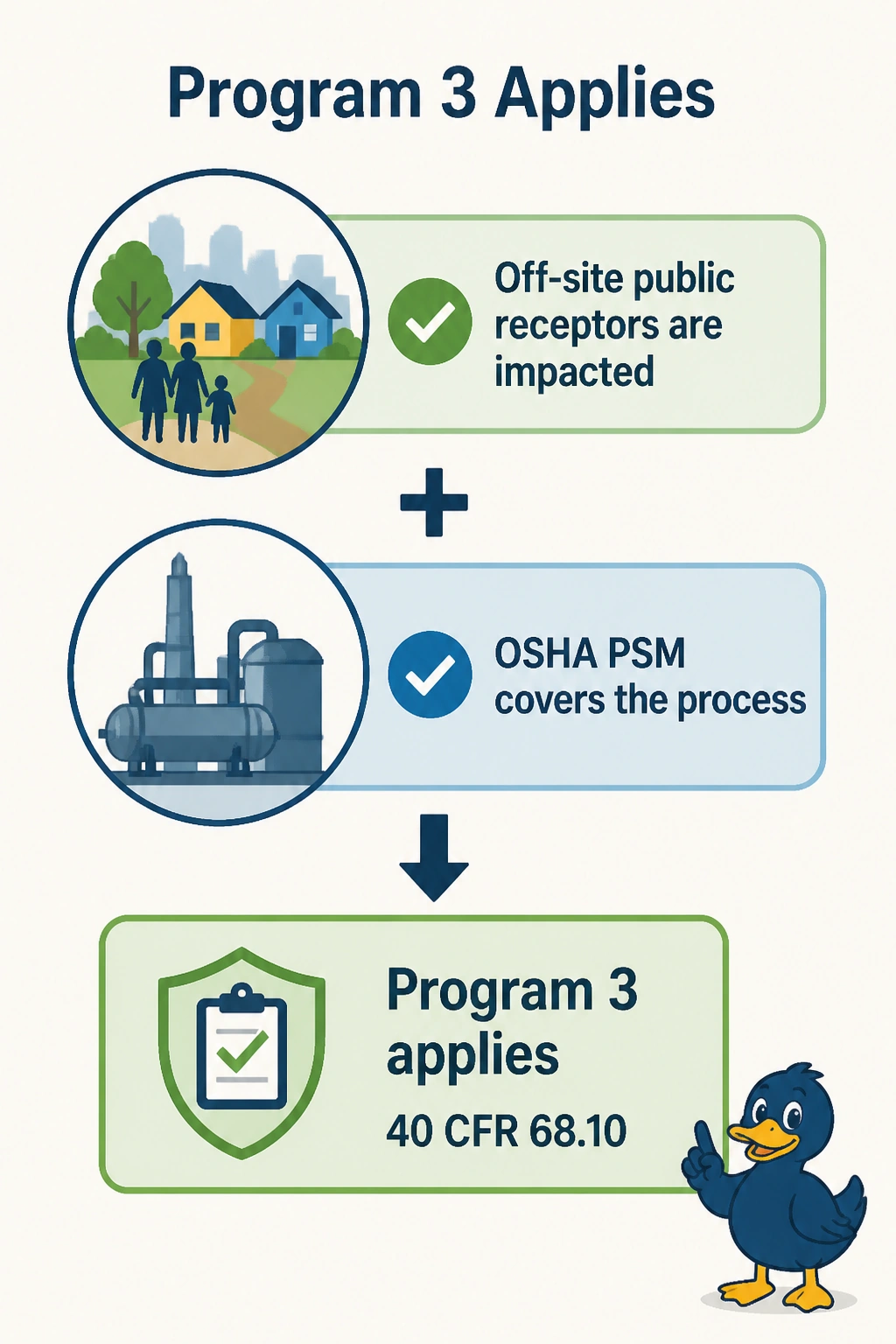
Under 40 CFR 68.10, Program 3 applies because off-site public receptors are impacted and OSHA PSM covers the process. A covered process qualifies for Program 3 whenever it fails the Program 1 eligibility test and is either in a listed high-hazard NAICS code or subject to OSHA Process Safety Management under 29 CFR 1910.119, triggering full prevention program and hazard assessment duties. Selecting Program 1 applies because the new unit has not experienced any accidental releases in the past five years fails because Program 1 also requires that no public receptor be within the worst-case release endpoint distance. Selecting Program 2 applies because flammable hydrocarbons are exempt from Program 3 prevention requirements fails because both toxic and flammable regulated substances fall under Program 3 when the NAICS or OSHA PSM trigger is met. Selecting No RMP program level applies until the process completes its first calendar year of commercial operation is incorrect because RMP registration and compliance are required no later than the date a regulated substance is first present above its threshold quantity. Note as a caveat that RMP applicability is evaluated per covered process rather than facility-wide, so different units at one plant can carry different program levels. As an operational check, verify worst-case endpoint distances against current property-boundary and public-receptor maps before ordering regulated feedstocks.
Prefer to study offline? Printable PDF study book + test engine ($7.50, unofficial). These questions stay free here.