
During a housekeeping inspection at a resin-grinding facility, an EHS specialist finds fine organic polymer dust accumulated on overhead structural beams and process enclosures. Which cleaning method should the facility require to prevent a secondary dust explosion?
Select an answer to reveal the explanation.
Short Explanation
Settled combustible dust looks harmless on a beam until a sudden air blast turns it into an explosive fuel cloud. You want to capture that dust gently with rated vacuum equipment rather than suspending it in air. The trap is reaching for compressed air or aggressive sweeping, which launches fine particles straight toward hidden ignition sources.
Full Explanation
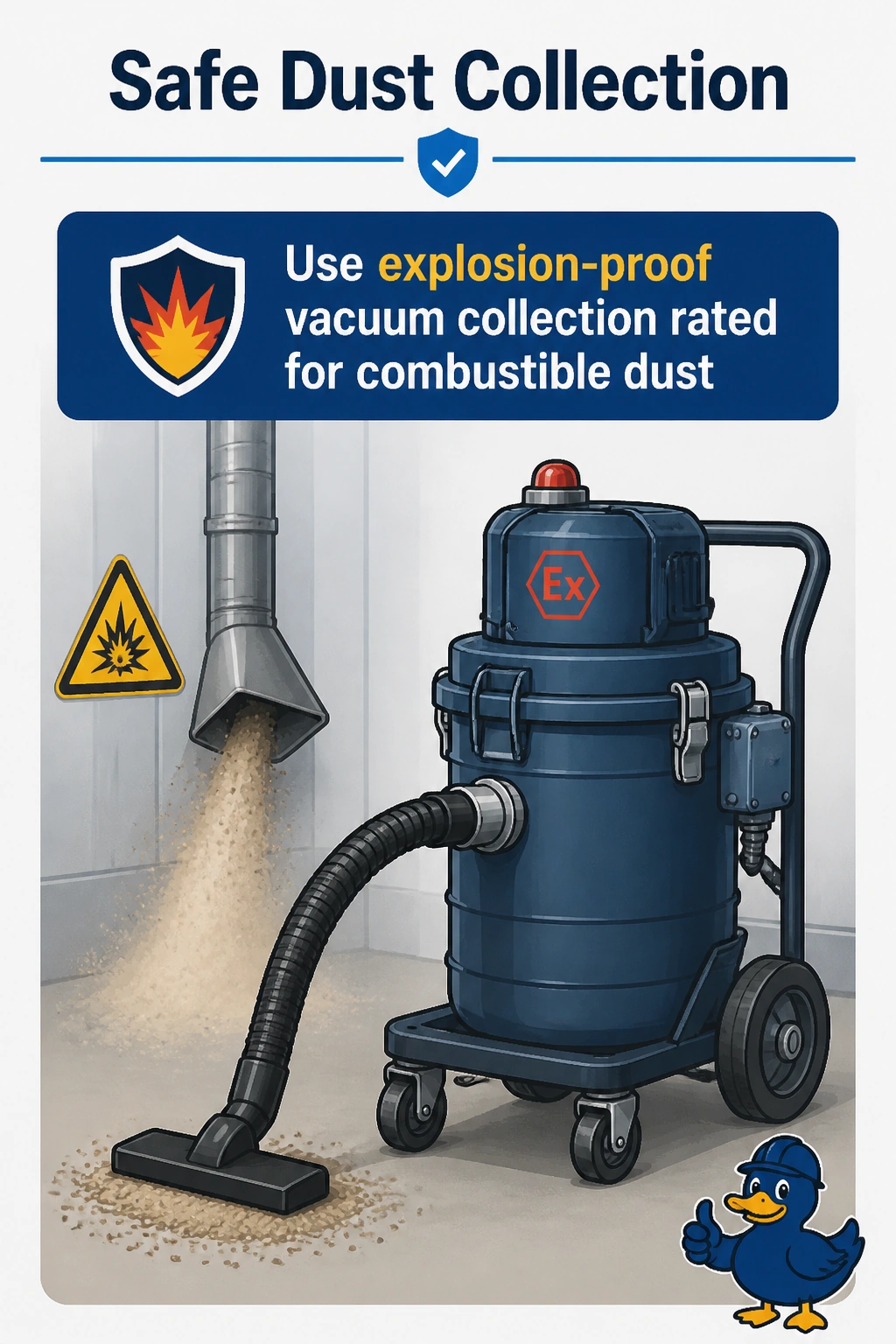
To eliminate settled fuel without creating an airborne explosive cloud, the facility must Use explosion-proof vacuum collection rated for combustible dust. Bonded, grounded, Class II rated vacuum systems capture fine particulates inside an enclosure designed to prevent static sparks and motor ignition. Choosing to Use high-pressure compressed air to blow settled dust off overhead beams is a primary cause of devastating secondary dust explosions because it disperses thick layers into a dense, ignitable cloud across the entire bay. Choosing to Sweep the dry dust vigorously with standard stiff-bristle brooms during shifts also kicks fine combustible particles into suspension near active machinery and electrical equipment. Choosing to Increase general dilution exhaust fans while sweeping dust into floor piles fails to capture dust at the point of disturbance and can draw suspended dust into non-rated fan motors. Note that OSHA's Combustible Dust National Emphasis Program and NFPA 660 (2025), which consolidated and superseded NFPA 652 effective December 6, 2024 restrict blow-down unless all ignition sources are shut down and strict precautions are met, so an operational check should verify that vacuum hoses and nozzles are conductive and properly bonded to ground before cleaning begins.
Prefer to study offline? Printable PDF study book + test engine ($7.50, unofficial). These questions stay free here.