
An industrial hygienist assigns workers to wear full-facepiece, negative-pressure air-purifying respirators during a solvent-coating task that requires an Assigned Protection Factor greater than 10. Under OSHA 29 CFR 1910.134(f)(6), which fit-testing method is required for these respirators?
Select an answer to reveal the explanation.
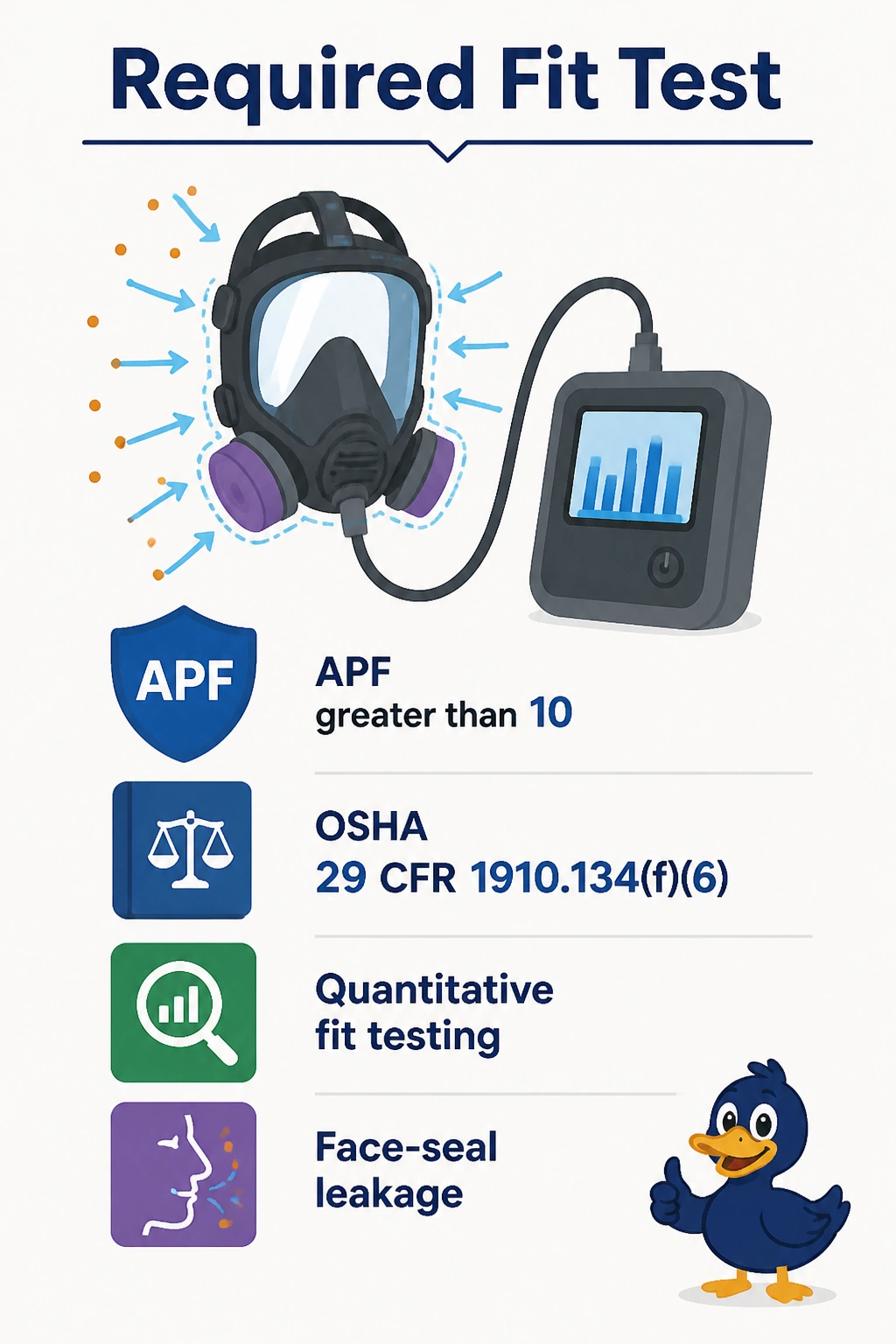
Short Explanation
When you step up from a half-mask to a full-facepiece respirator for higher protection, your fit test has to step up from pass-fail taste or smell to hard numbers. The classic trap is assuming qualitative smoke or saccharin tests work for every negative-pressure air-purifying mask.
Full Explanation
Under OSHA 29 CFR 1910.134(f)(6), Quantitative fit testing measuring face-seal leakage is required when a negative-pressure air-purifying respirator must achieve a fit factor greater than 100, which applies to full-facepiece respirators relied upon for an Assigned Protection Factor above 10. Quantitative fit testing uses an instrument to numerically measure the concentration of a test agent outside versus inside the facepiece so the required higher fit factor can be objectively verified. Choosing Qualitative fit testing using saccharin aerosol fails because qualitative protocols rely on the wearer's sensory response and are restricted by regulation to negative-pressure respirators needing a fit factor of 100 or less. Choosing Qualitative fit testing using irritant smoke fails for the same regulatory reason, as it cannot validate the higher fit factor required for full-facepiece protection. Choosing User seal checks performed before each shift fails because positive- and negative-pressure user seal checks are daily pre-use verifications, not a substitute for initial and annual fit testing. As a caveat, if a full-facepiece respirator is worn only where an Assigned Protection Factor of 10 or less would suffice, qualitative fit testing is permitted, though most programs use quantitative testing for full-facepiece masks. As an operational check, review respirator fit-test records before issuing full-facepiece cartridges to confirm an instrument-based quantitative pass is on file.
Prefer to study offline? Printable PDF study book + test engine ($7.50, unofficial). These questions stay free here.