
A Phase II investigation at a commercial office park identifies a shallow chlorinated solvent groundwater plume directly beneath a slab-on-grade building with occupied offices. Which sampling approach directly evaluates whether volatile vapors are migrating toward the indoor air breathing zone?
Select an answer to reveal the explanation.
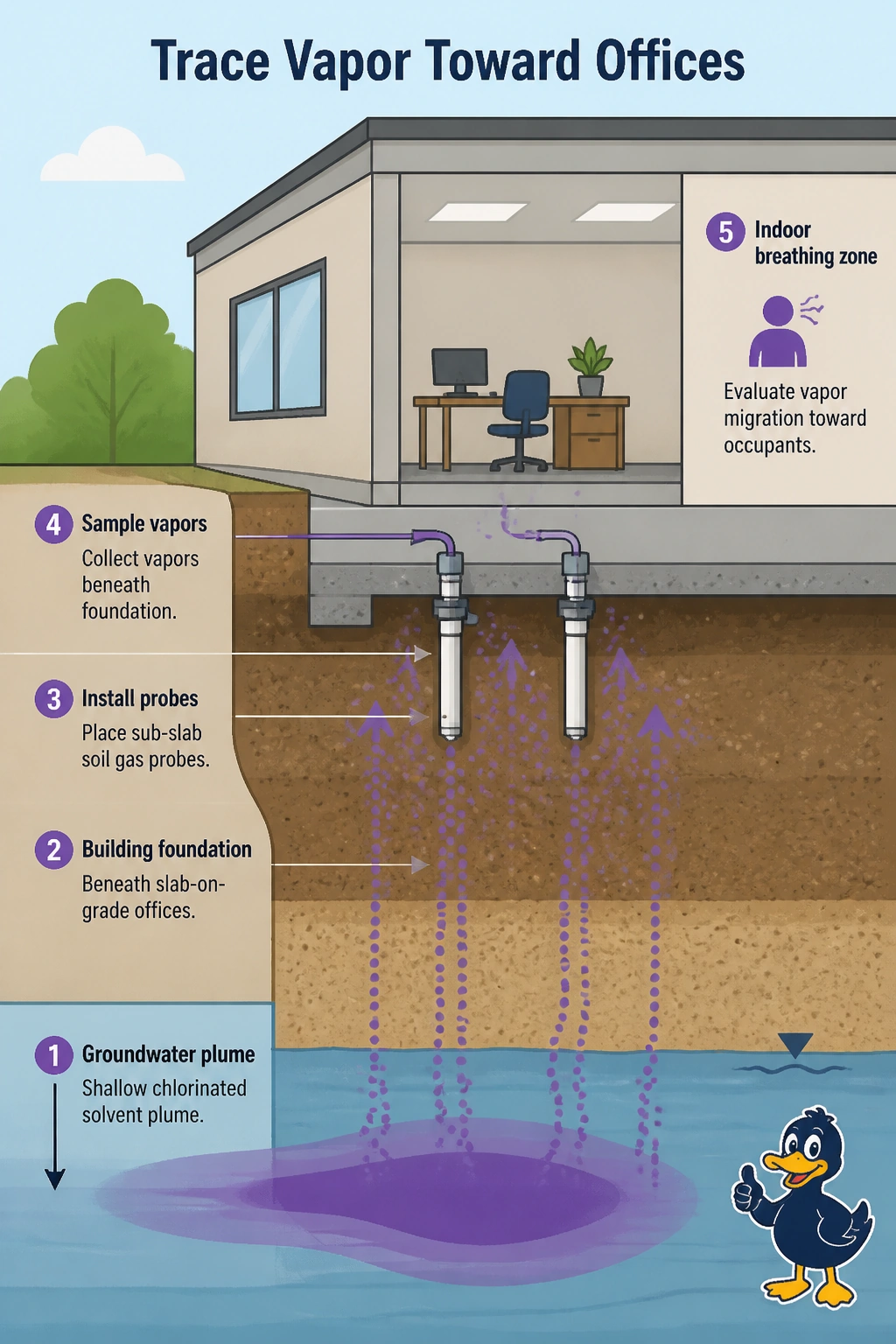
Short Explanation
You’re asking whether vapors are moving beneath the building toward the indoor breathing zone, so sub-slab soil gas probes give you the direct measurement. Surface soil, storm drain solids, and pond sediment answer different questions, not whether vapors are accumulating under the foundation.
Full Explanation
Installing sub-slab soil gas probes to sample vapors beneath the foundation directly evaluates whether volatile organic compounds from a shallow chlorinated solvent plume are partitioning into soil gas and accumulating beneath the slab-on-grade building. Comparing sub-slab vapor concentrations with vapor intrusion screening levels helps determine whether indoor air sampling or mitigation is warranted. Surface soil grab samples from landscaped areas miss subsurface vapor migration pathways beneath the building footprint. Total suspended solids in storm drain catch basins measure physical sediment runoff, not volatile subsurface vapors. Sediment cores from a nearby retention pond characterize surface-water sediment impacts and do not measure vapor intrusion potential beneath occupied offices. A key caveat is that sub-slab soil gas results can vary with barometric pressure, soil moisture, and building HVAC operation, so paired indoor air and ambient air samples may be needed for confirmation. As a practical check, leak-test probe seals during sampling so outdoor air dilution does not skew laboratory results.
Prefer to study offline? Printable PDF study book + test engine ($7.50, unofficial). These questions stay free here.